A quote from the kunming conveyor belt factory, reserved for the rubber belt
Show method editing
The old specifications of the ordinary conveyance belt are expressed in width (mm), number of skeleton layers, and five figures of upper and lower laminate thickness (mm) and length (m). For example: 500*5*3*2. 5*100 means a conveyor belt of 500 mm width, 5 layers of tape, 3 mm thickness of upper covered glue, 2. 5 mm thickness of lower covered glue and 100 m length. 500 mm*5p (3+2. 5)*100 for general production. The new specification of the general conveyance belt is expressed in terms of the vertical full thickness stretch strength (kn/mm), the general-purpose letter g, the bandwidth width (mm), the cover layer performance level code (l is light, h is heavy, m is normal), and the upper and lower rubber thickness (mm). In the case of ring belts, there is also a perimeter (m) inside the tape. In addition, if necessary, there is an indication of the core mass and number of layers. For example: a conveyor belt with a specification of 500gb800l3/1. 5-30 (nn3) which indicates a vertical full thickness stretch strength of 500kn/mm, general purpose, a bandwidth width of 800 mm, a laminate performance level of light, with upper and lower covered glue thickness of 3 mm and 1. 5 mm, respectively. The tape is circular, with a 30m inner perimeter, a nylon with a core mass and three layers of fabric。
Debug method edit
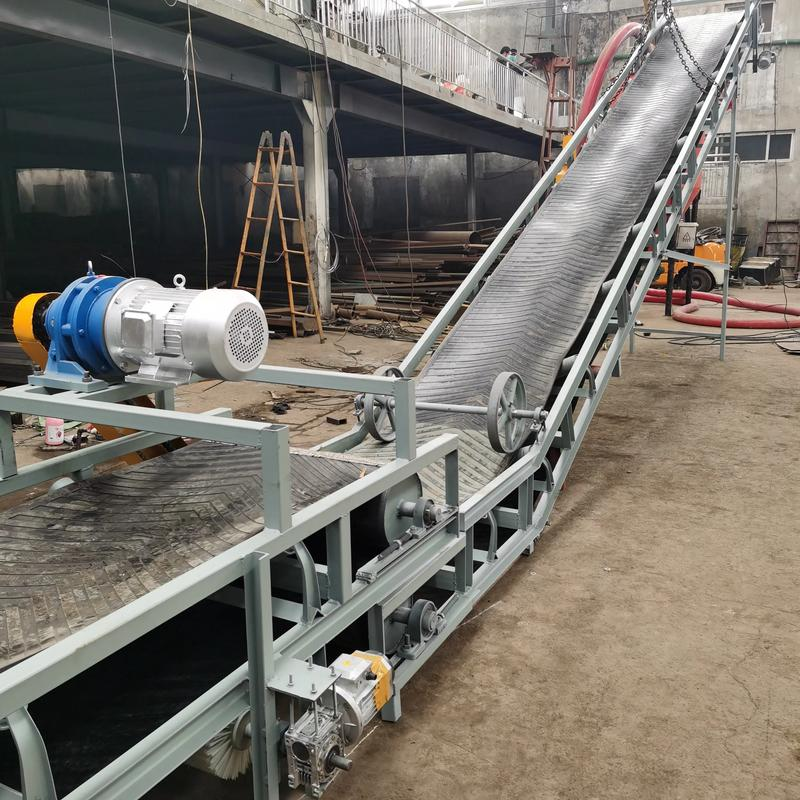
The conveyor belt is a key equipment for the delivery system and its safe and stable operation directly affects production operations. The flight belt is the most common malfunction of the carrier and its timely and accurate handling is its safe and stable operation. There are many phenomena and causes of deviation, and different methods of adjustment are needed to address them effectively. This paper is based on years of on-site practice, using the principle of mechanics to analyse and explain the causes of such failures and the methods used to deal with them。
A head-drive roller or tail shift is not vertically linked to the centre line of the carrier, resulting in the transfer belt moving towards the roller in the head or tail. When the roller is tilted, the laxity of the conveyor belt on both sides of the roller is inconsistent, and the pull fq along the width direction is inconsistent, increasing or decreasing, which leads to the belt being accompanied by a downward movement fy, which leads to a run-off towards the side of the roller, known as “run loose”. The adjustment is that for a head roller, such as a conveyor belt to the right side of the roller, the bearing on the right side shall be moved forward, and the run on the left side of the conveyor to the roller will be readjusted repeatedly until the transfer belt is in a more desirable position. It is desirable to install the roller accurately before adjusting the driver or moving to it。
2. Misprocessing, clay or wear on the outer surface of the roller, resulting in different diameter sizes, with the conveyor belt moving in the direction of the larger side of the diameter. It's called running. The stress is shown in figure iv. Fq of the conveyance belt produces a moving fraction fy of the larger diameter and, under the influence of fy of the transfer belt, a deviation. In this case, the solution would be to clean up the surface glue of the clean roller, and the process errors and wear and tear imbalances would have to be replaced by reprocess the packaging。
3. The location of the drop-off at the reproduction point is different from that of figure v, which causes a run-off of the conveyor belt, and the position of the drop-off at the reproduction point has a very significant impact on the run-off of the conveyor belt, especially when the upper and this article's transmitters are projected vertically. Consideration should normally be given to the relative height of the two belt machines above and below the reproduction point. The lower the relative height, the greater the mass of the material, the greater the impact fc on the side of the lower belt and the difficulty of keeping the material in the middle. The material is tilted on the transect of the conveyor belt, and fy, the force of shock fc's horizontal fraction, eventually leads to a belt deviation. If the material is on the right side, the belt is on the left side and vice versa. In this case, the relative height of the two transmitters should be increased as far as possible during the design process. More careful consideration should be given to the form and size of the upper and lower funnels, guidance tanks, etc. Of a space-limited carrier. The width of the general guidance slot should be around three fifths of the bandwidth. In order to reduce or avoid belt runs, blockages can be increased and material can be changed in the direction and location of the material。
4. There is a large vertical error between the installation position of the payload and the centre line of the carrier, leading to a run-off of the conveyor belt in the bearing segment. The transport belt runs forward with a forward pull fq, which is decomposition to the pull force of fz and fc, a horizontal pull force, which enables the tortary axis to move in direction, and which is bound to produce a reactionary fy to the conveyance, which moves the conveyor belt to the other side, leading to a runoff. It is not difficult to understand the reasons for the deviation of the conveyance belt, and the method of adjustment is clear。
The first method is to process growth holes on both sides of the manufacturing team for adjustment. The specific adjustment is shown in figure ii, where the top-directional run of the belt, as shown in figure ii, should be moved to the left at the lower end of the shift to the right at the upper end of the move。
The second approach consists of the installation of a diversionary support group, which has a variety of types, such as an intermediate rotor, a four-column pole, a stand-up, etc., and is based on the use of a barrier or a diversion in a horizontal direction or the creation of a horizontal thrust that automatically enables the belt to reach its heart for the purpose of adjusting the belt's deviations, with the same stress and a tilted thrust of the load support group. It is generally reasonable to use this method when the total length of the carrier is shorter or when the carrier is operating in both directions because the shorter carrier is easier to run and is not easily adjusted. It would be preferable not to use long-band carriers, since the use of diversion groups has a certain impact on the life of the belt。
A quote from the kunming conveyor belt factory