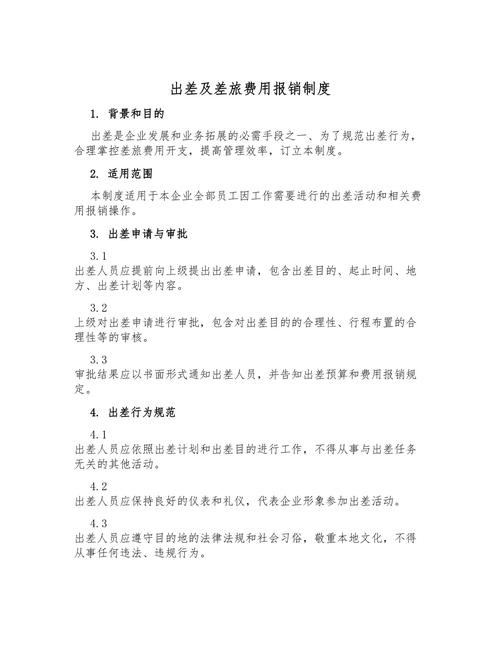
The purpose of the page system for the reimbursement of travel expenses is to strengthen the financial management of companies, regulate the reimbursement of business travel expenses and ensure the smooth running of the company's business activities while safeguarding the legitimate rights and interests of employees. 2. This system of application applies to the reimbursement of expenses incurred by all employees of the company in connection with business trips. 3. Fundamental principle of authenticity: the reimbursement of the cost of the vehicle must be incurred on the basis of the actual business trip and the certificate is valid. The principle of reasonableness: reimbursement of the cost of the vehicle shall be in accordance with the actual business needs of the company and shall be based on reasonable and necessary principles. Compliance principle: reimbursement is made in strict compliance with national laws and regulations and with the requirements of the relevant financial systems of companies. 2. Definition and classification of mission 1. Travel is defined as the conduct of an employee who, owing to the business of the company, has to leave his or her place of habitual residence and travel to work elsewhere. 2. Classification of country missions: missions in the people's republic of china. International missions: missions outside the people's republic of china. 3. Vehicle reimbursement is covered by 1. The means of transportation selects the aircraft: the aircraft may be flown with the approval of the superiors because of operational exigencies or long distances. Economic class is the reimbursement standard and special circumstances require first-class or business-class travel in advance of approval by the senior management of the company. Trains: depending on the itinerary of the mission and actual needs, heavy iron, vehicles, ordinary trains, etc. May be selected. Priority is given to high iron or motor vehicles, and special circumstances require the consent of the head of department. Long-distance vehicles: in the absence of a suitable train number or flight, long-distance vehicles may be selected. The cost of long-distance vehicles is reimbursed at the actual fare. In-city transport: includes buses, subways, taxis, etc. The cost of transportation within the city shall be reasonably reimbursed on the basis of the actual place of travel and operational needs. 2. Specific cost breakdown of airfares: includes fares, fuel surcharges, airport construction costs, etc., but excludes additional insurance costs purchased such as aviation accident insurance. Fees for train tickets: including fares, booking fees, etc. Long-distance fares: the amount actually purchased. In-city transportation costs: bus tickets, metro tickets, etc. Are reimbursed on the basis of the actual amount incurred; taxi fares are reimbursed only on the basis of detailed information, such as the date and place of operation, starting and ending, subject to a review, but, in principle, to the choice of public transport, subject to the approval of the head of department, if the need for a taxi arises in exceptional circumstances. Iv. Reimbursement rates and limits 1. Domestic aircraft on mission: the amount of reimbursement is determined on the basis of the distance to which the mission took place and the route criteria established by the company. In general, economy-class fares are reported for sale within a certain limit, which is based on regional and operational needs. For example, for business trips between first-line cities, the economy-class fare limit is us$; for business trips between second-line cities, the limit is us$$. Trains: 2nd-class high iron and 2nd-class motor vehicles are reimbursed according to the actual fare; 1st-class seats are reimbursed at the rate of % of the 2nd-class fare; business seats are subject to special approval and the reimbursement rate is not more than double the 2nd-class fare. Ordinary train hard seats are reimbursed on the basis of the actual fare, with a hard-bed rate of % of the hard-seat fare, and a special approval for soft-beding, and not more than twice the hard-line fare. Long-distance vehicles: reimbursement based on actual fare, with a single long-distance vehicle reimbursement limit of $. Intra-municipal transport: intra-municipal transportation costs are contracted, with a daily reimbursement limit based on the number of days of travel and the city of destination. The daily limit for first-line cities is one dollar, the daily limit for second-line cities is one dollar and the daily limit for third-line cities is one dollar. An employee is required to maintain the relevant transport document as a reimbursement document and, in the case of business requirements exceeding the limit, to provide a detailed explanation of the reasons and to be approved by the head of department. 2. Aircraft on international business missions: on the basis of international shipping routes and company-mandated standards, economy class fares are reported for sale, provided that detailed mission plans and budgets are submitted to the company in advance and approved. In the case of first-class or business-class travel due to special business needs, special approval is required from the senior leadership of the company. Other transportation costs: transportation costs in foreign cities, such as taxis, subways, public transport, etc., are reimbursed at the actual amount incurred, provided that the corresponding notes and instructions are provided. For international long-distance transportation, such as international trains, ships, etc., the reimbursement rates are applied in line with the domestic reimbursement rates for the same means of transport and are approved in conjunction with international travel requirements. V. Reimbursement process 1. Before a staff member requests a mission for business needs, he or she should complete the mission request form, detailing the reasons for the mission, the destination, the expected time of the mission and the choice of means of transportation, and submit it to his or her superior for approval. The approved travel request forms serve as the basis for travel and subsequent reimbursement. 2. While expenses are incurred and certificates are obtained for travel, staff members shall properly keep all bills relating to the cost of the vehicle, including tickets for airfares, train tickets, long-distance tickets, taxi invoices, etc., and ensure that they are clear, complete and consistent with the trip. For electronic instruments, they should be downloaded and stored in a company-designated reimbursement system or folder in a timely manner. 3. Upon completion of the mission for which the claims are submitted, the staff member shall submit to the company's finance department, within a specified time period (usually within the working day following the return from the mission), together with the completed travel claims and the related tickets, vouchers, etc. The travel claim form should include detailed information on the date, place, means of transportation, cost breakdown, and should be signed and confirmed. 4. Once the department has reviewed the claims received by the treasury, it first transfers the claims to the employee's department for preliminary examination. The head of department shall review the authenticity and reasonableness of the claims in the light of the request for travel and the actual operations. If problems or questions are identified, the staff member should be contacted and verified in a timely manner and the audit opinion signed on the travel claims bill. 5. Following the approval by the financial audit, the financial services carry out detailed reviews of the compliance of claims and the implementation of reimbursement standards. Check the authenticity of the documents and their compliance with the requirements of the corporate reimbursement system, return the non-conforming claims and require employees to add or correct relevant information. Following the financial clearance, the audit was signed on the travel claims. 6. The final approval of claims is made by the appropriate level of leadership, in accordance with the financial approval authority of the company. In general, smaller claims are approved by the head of the department; larger claims are approved by the head of the company's management or general manager. After approval, claims enter the payment process. 7. Based on the approval, the financial services pay the employees the reimbursement according to the manner and time of payment specified by the company. Where payments are made through bank transfers, the accuracy of the transfer information should be ensured; where payments are made in cash, the relevant procedures should be followed in accordance with company cash management requirements. In exceptional circumstances, when a multi-person colleague is required to travel in connection with his or her business, such as transportation by air, train and other means of transport, he or she shall, as far as possible, make a uniform reservation in order to obtain a more favourable fare. For transportation costs shared by multiple persons, reimbursement is made on the basis of the actual share of the costs, provided that the name of the partner and his/her share are indicated in the reimbursement certificate and the relevant booking or itinerary certificate is provided. 2. In the course of a mission, a change of means of transport shall be reported to a superior in a timely manner, if the change is due to force majeure or operational requirements, and the relevant supporting material shall be provided thereafter. The reimbursement of transportation costs after the change shall be in accordance with the standards and approval process established by the company, and if the change results in costs exceeding the original budget, the reasons must be specified and approved. 3. In cases of over-charging, staff members shall provide details of the subject matter and supporting information in respect of the cost of vehicles in excess of the reimbursement rate, where for exceptional reasons it is necessary to travel by means of high-cost transportation or to incur additional transportation costs. Following approval by the head of department, the financial review and the corresponding level of leadership, a percentage of the excess is reimbursed or special treatment is granted. In the event of an unauthorized overpayment, the company will not be reimbursed for part of the cost and will be subject to appropriate disciplinary action, depending on the circumstances. Vii. Oversight and inspection 1. Internal audit services of internal audit firms conduct regular audit inspections of the reimbursement of operational travel expenses, focusing on the authenticity of claims, compliance, implementation of claims processes and compliance with reimbursement standards. In case of identified problems, the relevant departments and personnel are required to undergo corrective work in a timely manner and to be held accountable in accordance with corporate requirements. 2. Staff supervision encourages company employees to report irregularities in the reimbursement of business travel expenses. In cases of proven violations, the company will take them seriously and give the whistleblower appropriate incentives. At the same time, the legal rights and interests of whistle-blowers are protected and the information reported is not disclosed。3. Periodic assessment of the financial services of the company and the relevant management authorities to evaluate and revise the system of reimbursement for business trip fares on a regular basis and to adjust the reimbursement rates, processes and procedures in a timely manner in the light of business developments, changes in laws and regulations and actual performance