To solve a problem of error and then explore the optimization of web codes, a common skin-skinned seo optimisation team or individuals would recommend a full div+css style for web pages to speed up by saying, “registering search engines is friendly and now popular”, and even try to avoid using table on web pages. In fact, div+css is only one of the methods used for many of the HTML web layouts, with the greatest advantage being that users experience better, since div+cs can display some of the downloaded div regional content without having fully downloaded the HTML. This does not mean that the search engine also acquires the div+css page at a faster rate, because the search engine needs to wait until the page is fully downloaded and stored in the database before it begins to be analysed, without analysing part of it later, and that the speed with which the user experiences the web page opens does not mean that the speed with which the entire page is downloaded can only be addressed by optimizing the web code, content. Table generally requires a complete download of table to show, and of course css styles can be used to solve problems that table can show without a complete download. So the div+css can't improve the search engine experience, and the div+cs epidemic can't be useful. This is the same reason that some web pages, even users, can't browse but are recorded in the search engine. If the user experience is optimized (the user experience optimizes include the web page seo), we in shanghai suggest that the web page be more div+css-based without adding to the web code。
Div+css is a web-based layout that differs from the traditional table layout, and that both div+cs and table meet the w3c standard, which ensures that your website will not be eliminated as a result of future upgrades in network applications. The optimization of the div+css for the search engine depends on the level of professionalism of the web-page design rather than on the div+cs; many div+cs-designed pages do not guarantee the optimization of the search engine, or even a simpler code design than the table page, such as the layout of the four or more columns of the web-page structure to see whether the div+cs is simple or the table, the multiple layout of the web-pages makes the design of div+cs extremely difficult, and the div+cs-based layout is generally used only on relatively simple pages. Moreover, it is clear that the entry and sequencing of the web page by the search engine is not measured by the use of table and div+css positioning, nor is there a search engine that would be friendly to div+cs, saying that only the div+cs layout is only part of the irresponsible pseudo-seoer sex. We observe that the search engine does not have an impact on the layout or ranking of the web page, but rather on the content of the web page, the distribution of keywords on the web page, and the sorting of the search engine by links to the relevant website. Div+css and table each have advantages and disadvantages in web design, and seo web code optimization should be applied flexibly to keep web structures and codes simple; keywords are evenly distributed in web content; web development and maintenance are simple。
Div+cs layouts have some advantages and disadvantages. Div+cs advantages: the faster posting of the web pages, the more flexible location and performance of the web pages due to the wealth of css styles; the reduced number of page codes and easier alignment of pages and styles as a result of the separation of page content from styles; and the reduced interconnectivity due to the easier division of labour in team development. Div+css shortcomings: div+cs has not yet achieved uniform compatibility for all browsers, making the design more complex; div+css is much more complex than table, multilayered div can seriously affect web code readability, and web design masters are vulnerable, let alone beginners, and css is likely to be quite complex and large in one or more external files, and the entire web page would be unsatisfied if css files were to be accessed differently。
Table layouts have some advantages and disadvantages. Table advantages: table forms are very compatible with browsers and are traditional HTML elements, and the position of table remains important in the foreseeable future; the presentation of data on the web pages is simpler, the design of dynamic web pages is easier and web codes simpler; table is more easily located on the web pages than div+cs. Table shortcomings: table is not flexible enough for web-page design in a complex web structure; table's embedded suite will significantly increase web-page code availability, affecting web-page code readability; more data content in the web pages will affect the speed of web-page growth (table will only be available if it is loaded); web-page updating and maintenance will be more complex and style-changed more difficult (which is one of the main reasons why table is not used in the common website program)。
Optimizing the seo web code allows the main content of the web page to be placed above the web code when it is designed, and searching for spiders to access web content is also generally considered to be the main element of the page. However, the div+cs layout often does not meet this design requirement, in which case the web-page keyword can be evenly distributed using table or by adding a summary text (e. G. Readable) to the top of the web code。
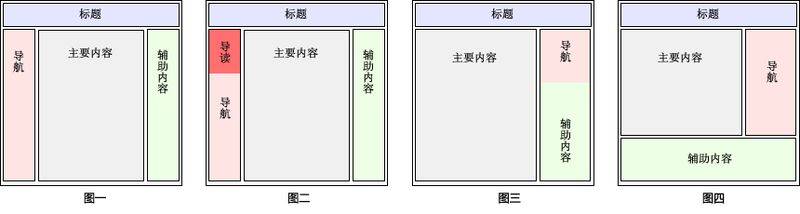
Map of web structure
The use of div+css in the web structure of figure i and figure ii enables the main content of the web page to appear at the bottom of the web code, as the main medium content component of div requires a final movement to the web site。
TitleNavigationSupporting contentMain elementsTitleReadNavigationSupporting contentMain elements
The use of table tables in the seo web-code optimized web-page structure allows the main content of the web page to appear in the middle of the web-page code, which is somewhat better than the div+cs web-page structure。
Title
| Navigation | Main elements | Supporting content |
| ReadNavigation | Main elements | Supporting content |
The proposed structure of the web pages in figure iii and figure iv allows the use of either the table table or the div+cs web-page structure to make the main content appear at the top of the web-page code, which is why some content-publishing, news- and blog-like pages are ranked high in the search engine (which is preferred by 100 degrees)。
TitleMain elementsNavigation, support content
TitleMain elementsNavigationSupporting content