There's smoke again in the coffee field。
Recently, starbucks china announced that, as of 10 june, the prices of a total of 10 products had been reduced collectively by the star ice, iced tea, tea and latte series. The bureau of red star capital noted that the current price reduction covered all stores with these three categories, with a price reduction of $2-6 and an average price reduction of about $5, if measured against a large cup。
Previously, starbucks had reduced prices at the end of the sale by means of discount coupons, landing platforms, etc. China's coffee market is highly competitive, and does the starbucks have to lower their curvatures under the “roll” to $6. 9 and “roll” to $1. 8
The red star capital bureau found that the starbucks drop product was concentrated in non-cartery, and it was fortunate that ray had been throwing 600 million coupons to promote light milk tea. For a chain of coffee brands, competition has spread beyond coffee。
23 minimum
For the first time in 25 years, starbucks china announced a price reduction
On 10 june, the starbucks china service issued a tweet, “more than coffee”, stating that “the summer's heart cost was $23”。
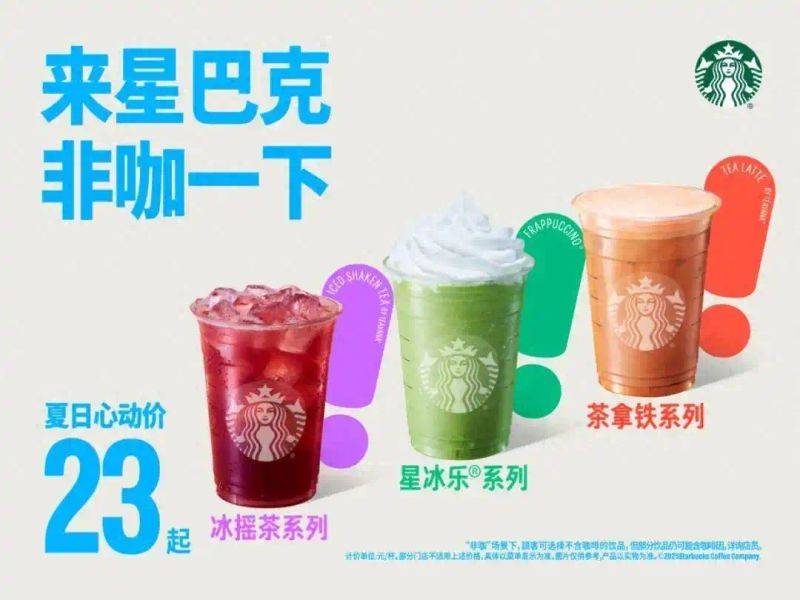
By starbucks, china
In the starbucks applet, red star capital found that, for example, with three of starbuck's three ace series, a 36-dollar cup of tea star ice is now sold at $32 and a 31-dollar ice crickberry. The price of black gallon tea is now $26, and the price of large cups of chalk latte, which cost $35, has dropped to $29. This price reduction has stabilized some of the products, which had been between $30 and $40, going down between $20 and $30. A price of $23 can be bought for a medium-sized cranberry black gallon tea or a medium-sized lemon tea。
It was the first time that starbucks had entered the chinese market in 25 years, and the prices had been reduced。
Previously, starbucks had achieved price reductions in various ways, such as issuing coupons on the internet, and buying off out of platforms。
At the end of this year, consumers told red star capital that on may 30, he had entered a small program of swiss cafe and found that the price of multiple drinks, such as coconut latte, mocha, orange c and standard american, was $6. 9 per cup. In response to this, ray responded to the red star capital bureau that $6. 9 was not a price reduction, but a two-leaf ex gratia benefit for consumers for midday and children's day, with a random coupon of $6. 9。
Since the beginning of the year, with substantial subsidies from the american group, hungry and kyoto-based delivery platforms, such as milk, tea and coffee have benefited, couti has emerged out of the brand and consumers have even been able to buy drinks at a single price of $0. 8 per cup。
Starbucks, china, 5% increase in the second quarter
Expert: possible future open association
In april this year, starbucks published the second quarter of the 2025 fiscal year, which shows that the total number of starbucks chinese gate stores at the end of the reporting period was 7758. China's market revenues amounted to $739. 7 million, an increase of 5 per cent over the same period。
According to the chinese merchant newspaper, in the second quarter of the 2025 fiscal year, starbucks china added additional numbers to dig deeper into local consumer demand。
Brian niccol, chairman and ceo of starbucks, said that in china, the product line had been adjusted to introduce several product innovations that matched market demand - the chinese team achieved a positive growth of 4 per cent in the number of co-workers and a significant improvement in sales in the second quarter。
The chain expert, li weihua, believes that there are several characteristics of starbucks' current price reduction: first, starbucks chose to drop in the may-june tea season; secondly, they did not decline at much rate; thirdly, the core product of starbucks (coffee) did not fall; and fourthly, starbucks, after the drop, was in the price range of the new tea in the head。
As china’s coffee market and tea market collectively swung, starbuck’s price drops were “swing-in-the-roll” and allowed for more effective market competition. In li's view, the next step in starbuck's opening up the china region is highly likely。
Multi-brand synchronization
The market for non-coffee drinks is a competition
In response to the price reduction announced by the chinese authorities, the chinese side of starbucks stated that this was not a price war, but rather that it was a day-to-day service in the market for coffee and non-coffee。
In recent days, ray was fortunate to announce the launch of a first-rate fruit and vegetable tea — knitty and light. The red star capital bureau has noticed that it was the first time last year that ray launched a scoundrel. "ri was lucky to give you a hundred million 9. 9." in march of this year, it was announced that a large-scale campaign of $9. 9 million was launched again, with approximately 500 million coupons issued, and $9. 9 was available for the purchase of a light milk tea series, with a cumulative total of 600 million tea coupons。
Non-coffee beverages are receiving attention from coffee giants by virtue of their “full-time” character and relatively low raw materials prices。
According to china's food industry analyst zhu danbhorn, starbuck's products can be described as a combination of product and emotional properties. Emotional properties can be found in their third space, atmosphere, branding, value added。
“starbucks' coffee is not easy to reduce, because once the price is down, it becomes a brand loss. But lower prices for non-coffee products can better meet the core needs of some non-coffee consumers.” jodambhorn says. In his view, starbucks' coffee product was dominated by a “price ratio” and non-coffee by a “price ratio”. A combination of the same product matrix is more scientifically sound for the current catering industry。
In his view, the ultimate goal of starbucks is “multi-consumption population”. Increased access to food, innovative products, and the use of a combination of such means are all good strategies。
Red star reporter