The objective sharing of goods transaction logic, technical methods, and wind control systems in this paper, which is used only for investor education and interpretation of market patterns, does not constitute investment advice, does not shout, does not direct operations and does not promise returns. Futures are a high-risk type of investment, volatile and leveraged, and ordinary investors need to be fully aware of the risks and participate rationally. Full-text rhetoric, genuine validation, non-exaggeration, untraceable, fit for people who really want to learn about band trades in a systematic way。
First, let's get this straight: small money is a band, not a bet, a method
Many have the impression that futures are high-risk, one-night wealth, and zero. This is a complete misunderstanding. Wave trades make money that continues in the trend, not to guess direction, not to gamble up and down, much less to be full of silos。
The so-called band captures an intermediate trend: it can last 3-15 days or for several weeks, without head, tail and only the most stable and fluid part of the middle。
The approach i'm talking about today is very clear:
1. Start with small funds and do not seek windfall, but only stability, continuity and replicability
2. Only band trends, no ultra-short-stamping, no long-term recovery
3. To be implemented in a structured manner, without feeling, without information and without mentalities
4. Place the risk first and quantify all entry, exit, loss and position。
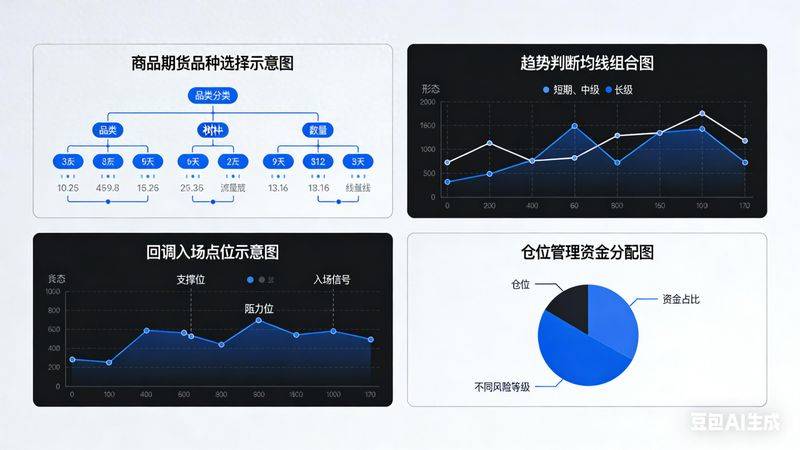
A lot of people in the market teach you to "one shot at the bull" and "one shot at the ground," which is not true. The long-term viability of the wave trade depends on a set of closed-ring systems: selection of varieties, determination of trends, access, risk management, profitability and discipline. One less link, not far。
It's not a science, it's not a myth, it's just the real way you can use it, you can contrast it. It depends on whether you're strictly committed, not how magical the method is。
Before a band is made, it must be understood that the core volatile logic of commodity futures
Before talking about a four-step strategy, you have to understand: why are commodity futures rising and why are they falling? Only when you know the bottom logic can you hold the list and not run away。
Commodity price volatility revolves around three things:
1. Supply and demand: supply is low, demand is strong and rising; supply is large, demand is weak and demand is fragile。
2. Finance: big money goes up and big money goes down。
3. Emotions: breakthroughs, fragmentations and trends。
Wave trading is the same trend in capturing supply and demand + funds + emotions。
We don't anticipate the top, we do the right thing。
Trends upward, with more opportunities
The trend is downward, with only opportunities available
The concussion doesn't do it, or it's wrong。
This is the principle at the heart of the band trade: to stand side by side with trends and not against business。
A lot of small losses, not lost in technology, lost in:
They have fallen, raised their ceilings, lost their lives, made money, dried up and changed their varieties frequently. Get rid of those problems. You've already won half。
Iii. Four-step cattle capture strategy: full closed loop, every step down land
The strategy is divided into four steps: the selection of selected species for a precise trend and strict exit from the field。
Each step has a clear standard and there is no ambiguity, so that the walk-through software can be used directly。
Step 1: choose the right species - only those that are “trends, trades, fluctuations”
It's not all that can be done, it's not the right species, it's the same。
Only three hard indicators are used for the selection of varieties, all of which are satisfied before joining the observation pool:
1. Large turnover, high holding
Low trade-off varieties are easy to slip points, easily charged and inconvenient. We only make the dominant varieties: crude oil, fuel, asphalt, methanol, ethanol, pure alkaline, screwd steel, hot rolls, soybeans, soybeans, palm oil, sugar, cotton, etc。
2. The trend is clear and not long-term
The species that were shaken for more than 20 days were removed directly. Waves are only made “out of direction”, without ambushes and without guesses。
3. Sufficient space for volatility
One day is too small to make money; the volatility is too extreme and risks are uncontrollable. We've chosen a medium-variant species with strong trends。
It takes 10 minutes per week to sweep the whole variety, leaving only two or five eligible species, concentrating on it and not changing it frequently。
Conclusion: selecting the right species equals 40 per cent of the success of the trade。
Step 2: setting trends - the simplest way to determine the direction of space
To judge trends, without complex indicators, i will give you the firmest, most realistic and least delayed approach:
Line combination + high low point up/down。
I'll give you the standard. Just do it:
Two conditions are met by multitrending:
1. The price is above the average 20-day line, which turns upwards
2. Dayline level: high and constantly innovative, low and rising。
The empty trend meets two conditions:
1. The price is below the average of 20 days and the average of 20 days turns downward
2. Dayline level: low points are constantly being innovated and high points are decreasing。
Not done:
Prices are punctured over and below the 20-day average, flat and irregular — without any participation。
The benefits of this approach are:
1. Will not be deceived by small shocks
2. Only the true intermediate trend
3. Simple, uniform and unchallenged。
Remember one sentence: the trend is not clear; the trend is clear and the move is back。
Step 3: precise access field — search for resonance points, with the highest success rate
When the trend is set, it does not follow up and fall, but waits for a return/back。
The most comfortable entry point for the band is trend + structure + signal resonance。
I'll give you the rules of entry:
More admission conditions (trends upward)
1. Prices revert to the 20-day mean line or to the high support position in front of the step
2. Recomposition process shrinks and falls
3. Daylines or 60 minutes of k-line stop-and-go: long shadows, sunbags, light stars
4. The first luminous line emerges after the drop, confirming activation。
Meet these four points, come on。
Open entry conditions (trend down)
1. Price rebounds to the vicinity of the 20-day mean line or to the front low pressure level
(b) resurgent process shrinks, rising impotent
3. Daylines or 60 minutes of low k-lines: long shadows, shaded suns, dusk stars
4. The first quantification cave after the stagnation confirmed the decline。
This is the way to move back:
Following the general trend, a small turnback was made, with a high success rate, a small loss, and a profit/loss ratio。
Many suffered: chasing the highest, empty at the lowest and being beaten as soon as they entered。
This approach avoids the root causes of the increase and fall。
Step four: strict departure - buys a student, sells a master
There are two types of out-of-the-box transactions: cessation of damage (life-saving), cessation of gain (meal-eating)。
No exit rules, no strategy。
1) rules for cessation of impairment: fixed, firm, non-capable
I'll give you the safest standard of loss:
- maximum losses on individual transactions not exceeding 2 per cent of total funds
- 2-5 points below the lowest point of entry on the k line (adjusted for variety)
- once triggered, uncompensated, uncompensated, uncommitted, unobligated
Meaning of cessation:
One wrong and no broken bones, ten wrongs and still alive。
Small money is more important than anything。
2) cut-off rules: no fish tails, let profit run
The wave segment is no longer perigee, and the movement is no longer perigee:
1. First objective: a surplus/loss ratio of at least 2:1 to be considered for reduction
2. After the reduction of the warehouse space, the remaining warehouse space will be closed by 20 days of average line movements:
- do more: take the 20-day line and break it effectively before it's all out
- empty: take the 20-day line and break it through effectively
3. Quantification of the upper/long submersible, acceleration of tving/discovery, direct complete exit。
This set of benefits:
- small trends can capture full profits
- the tendency to hold the cow band
- not washed out, not in a roller coaster。
Summarizing the four-step core:
The selection of a variety has set a trend back to the field average and has been strictly stopped。
The whole process is organized, without guesses, without gambling, without mentalities。
Small funds (30,000 starters) warehouse management: the key to real survival
A lot of people don't lose the way, but they lose too much。
30,000 principals, who want to live, who want to be big and steady, have to follow the silo iron law:
1. Single warehouse not exceeding 20 per cent of total funds
The 30,000 was used to open the warehouse at a maximum of $6,000, and the remaining money was spent entirely against fluctuations。
2. No more than two silos at the same time
Focusing on the most favourable trends is not fragmented or confusing。
3. 2 consecutive losses, which ceased on the same day
Improper state of affairs. Improper rest. No retaliation。
4. Never heavy, never full, never overnight full kilo
Futures are highly risky overnight and small funds are always kept on safety pads。
Silo management is the lifeline for the steady growth of small funds from 30,000。
Without warehouse control, the next cow's strategy will be zero。
V. Real various efficients and benefits: no examination, no duction
This strategy does not make every single profit; it has the advantage of overall stability。
In the normal market environment:
- it's about 40 to 55%
- the ratio of gains and losses has stabilized at 2:1 to 4:1
- when you lose, when you earn
In the long run, the result must be positive。
The deal is not better than who, but who lives long, loses less and can hold it。
Small funds are the most taboo: pursuing 100 per cent success and doubling overnight。
Those who can do it are those who make it slowly, continuously and steadily。
Six of the most vulnerable mistakes: avoiding them, you're over 90%
I'll list the deadliest mistakes of the band deal
1. Reverse copying to the top
It's not just a loss, it's a loss
I'll make a profit and run
4. Frequent change of varieties, frequent trading
5. Full, heavy, overnight
6. Dealing with information, feeling and mind
As long as you change all six of them and stick to the four-step strategy, your trade curve will immediately shift from a “big up” to a “stable up”。
Implementation is more important than methodology: a simple set of daily transactions
Here's a process you can do every day:
1. By 9 a. M.: sweep the variety and confirm the trend pool
2. To make only those species with clear trends, pending a return to the field
3. Signs of re-entry, without emotion or judgement
4. To stop the damage and not change it manually
5. Profit is held on a mobile basis without getting out of the car
6. One minute record of closing: right and wrong, cause and point of improvement。
For 21 days, you'll have a muscle memory, and the trade will not be gambling, but the rules will be enforced like work。
It's written at the end: it's not a gift, it's self-discipline
Futures markets never have a “zero risk and no loss” and any strategy has a period of loss。
The value of this band is not to double it overnight, but to make you:
- small money survives
- we can catch them when there's a trend
- we can avoid the shock
- risk is always manageable
- long-term positive returns
Those who are truly able to come out of futures markets are not the smartest, but the rules-abiding, the enforcement, the stopping。
The methodology has been fully spelled out in plain language, without reservations, without guidelines and without follow-up courses。
Can't you do it right, all by yourself。
End of discussion
Do you usually make futures short-lines or bands? Is it easier to lose more than the loss, the reversal or the loss of profits? Do you think the hardest part is to find a signal or to control a space? We welcome the sharing of your true experience in the comment area, which brings us together in rational communication and common progress。