
The data in this column is compiled by the department of distributive market data statistics, which counts hundreds of new businesses on a daily basis, and is published exclusively in the green squirrel and reported to the market information department of the ministry of agriculture。
The trend in pork prices
Last week (2 march-8 march), average wholesale prices of white pigs fluctuated slightly and rebounded slightly。
Comparison of average price trends for white pigs at the end of february-early march 2024 and the same period in the previous year figure
(united states dollars/kg)
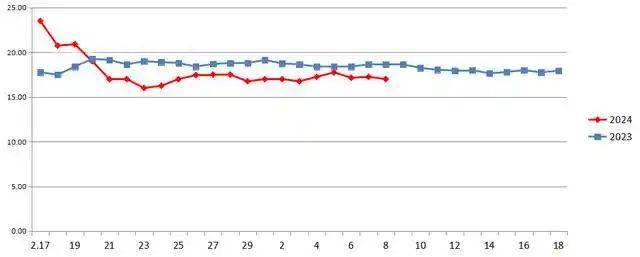
On 8 march, the average wholesale price of white-coated pigs on the market was 17. 0 yuan/kg, the same as the previous week (1 march) of 17. 0 yuan/kg; 37. 61 per cent lower than the same period of the previous month (8 february) of 27. 25 yuan/kg; and 8. 85 per cent lower than the same period of 18. 65 yuan/kg last year. The circle is flat; the monthly ring is down; the year-to-year ratio is down. Last weekend prices decreased by 11. 23 per cent on a year-on-year basis and by a smaller percentage on a year-on-year basis。
Last week, while the daily average of white pigs increased significantly over the previous week, the market level was still not stable, and there was still trade in slaughterhouses in absentia, leading to some fluctuations in single-day listings and repeated meat prices. Based on recent trends in meat prices, the main manifestation is the fact that prices are at a standstill, rising and falling, and that they are subject to volatility。
There are two main reasons for the rigidity of meat prices: on the one hand, the recent stock of pigs is still adequate, consumption is not warm and demand has not yet been fully restored, leaving the price of pigs and meat under pressure; and, on the other hand, recent data show that by the end of january, the stock of able-bodied pigs had fallen close to, and even slightly below, the desired value, which has led to increased expectations of later price movements in some farms, as well as increased affordability. The price of meat does not go down with two factors。
Overall, meat consumption is recovering rapidly after the festival, with average listings on sunday showing a marked increase from last week. At this rate, as sales increase, the pressure on the sales of piglets decreases, and there is little room for a fall in meat prices. However, since the current stock of piglets is still adequate, there has been a marked increase in march's output from february's in large farms, and there is little room for the white pig price rebound。
Egg price trend
The price of eggs went up last week。
Comparison of the average price of eggs in late february-early march 2024 with the same period in the previous year figure
(united states dollars/kg)
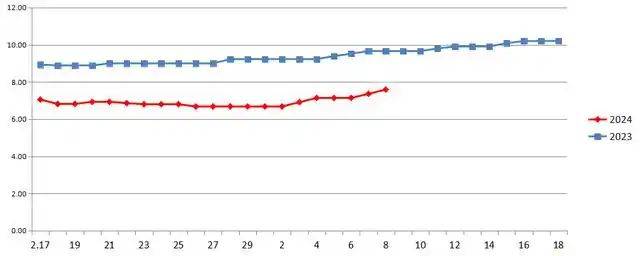
On 8 march, the average wholesale price of eggs in the new field market was $7. 59/kg, an increase of 13. 62 per cent from $6. 68/kg in the previous week (1 march); a decrease of 11. 85 per cent from $8. 61/kg in the same period of last month (8 february); and a decrease of 21. 43 per cent from $9. 66/kg in the same period of last year (8 march). The ring ratio has risen; the monthly ring ratio has declined; the year-to-year ratio has decreased. Last week, there was an annual decline of 27. 63 per cent, and last week there was a contraction。
Last week, the price of eggs rebounded at the bottom, with a sharp increase within the week. Large price increases were mainly driven by internet prices, which were forecasted before the price increases, so the price of eggs rose last week and the industry was not surprised。
The sale of eggs is still warm, the quantity of eggs in a canteen has returned to normal, private consumption is still at the stage of digestion and storage, and sales in the retail chain have yet to recover completely。
As demand has not yet been fully restored to normal conditions, stocks of eggs in chicken farms are still adequate, as are the stock of wholesale market vendors, and eggs are transported on a daily basis and there is a backlog in the market。
However, the current price of eggs is the price of lost chicken farms, which are resistant to low prices and have a tendency to sell them, and eagerly hope that they will rise. In this context, the rebound in egg prices last week was also a more normal market phenomenon. In particular, late week, as a result of an upward trend in egg prices, chicken farms often show negative attitudes towards egg sales and continue to wait and wait. So, there's still a drive to keep the prices up in a short time。
Last week, the activities of the egg storeer's wheelhouse were nearing their end, the backlog of eggs in the previous period was almost exhausted, the newly purchased eggs were essentially in stock, and progress in the egg storeage was affecting later trends. As a result, the trend in the price of eggs in a short period of time will gradually move out of the valley, mainly with steady increases。
As stated earlier: “the current price of eggs is the price of a lost chicken farm, and this will not last long because of the strength of the front-stage chickens, the size of the post-year stock of egg-producing chickens, and the gradual recovery of production capacity in the first half of the year”, which is actually the only way to lift the price of eggs。
Trends in vegetable prices
Last week, the overall prices of vegetables were smooth and slightly volatile。
Trends in average wholesale prices of vegetables between late february and early march 2024 and the same period of the previous year figure
(united states dollars/kg)
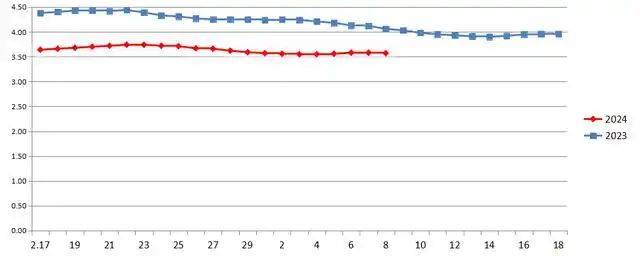
On 8 march, the market's weighted average vegetable price was 3. 57 yuan/kg, the same as the previous week's (1 march) rate of 3. 57 yuan/kg; it was 12. 07 per cent lower than the same period last year's rate of 4. 06 yuan/kg. The circle is even; the year-on-year decline. Last weekend, prices declined by 15. 80 per cent on a year-on-year basis, and last week they decreased somewhat on a year-on-year basis。
Year-on-year decreases have been reduced, mainly by the overall decline in the price of vegetables during the same period last year, and have remained stable this year. Last week saw a marked decline in the price ring, and last week the pace of the decline was suspended. The overall price is more or less the same, with varying degrees of increase and decline in the prices of various vegetables. Some vegetable prices rebounded; others went down。
According to the various categories of vegetables, prices have increased in two main categories: last week, when prices declined significantly, and last week, when modestly adjusted vegetables were dominated by small varieties of vegetables, including apricot, beryllium, spinach, oilseed, etc. The last week saw a concentration of these vegetables on the market, which last week was reduced, prices stabilized and picked up; the first type was vegetables that started changing seasons, mainly with celery, sorghum and white carrots, which began to run out of vegetables from the previous production and which were not connected in time, resulting in a gradual increase in prices。
Similarly, vegetables whose prices have fallen can be divided into two categories: one is a return to temperature, with production starting to increase, supply capacity increasing and prices falling. Such vegetables are also dominated by small, fresh varieties of vegetables, including croupiers, veggies, romanas, veggies, ryes and aristocrates, all of which have begun to grow in recent times, with prices falling continuously; a group of vegetables, including carrots, green pickles, peppers, and prunes, which have begun to grow in part and in a new season, in which new carrots have been added to the market; green melons in the sea and south; peppers in guangdong, hainan and fujian have entered the beijing market in large numbers; and plumes in the eastern and south-western regions have also entered the beijing market。
While overall prices were at the same level as last week, prices for a wide range of vegetables increased and fell, resulting in price volatility for a variety of reasons, mainly due to frequent weather and smooth supply chain connections, while the gains and losses experienced by businesses in the course of their operations affected price volatility. The smooth operation of overall prices last week was the result of a combination of factors。
Subsequently, temperatures will continue to rise, providing more favourable conditions for the growth of vegetables, while the vegetable supply chain will face a shift in production and production patterns, and the adverse effects of repeated changes in the front-period temperature on the growth of vegetables in the successor site will be felt, and overall prices will show a downward trend in volatility, but there is still a convergence of increases and declines in single varieties, which will lead to variations in the prices of vegetables later in life。
Overall, the price of vegetables has reached seasonal drops, and the rate of decline will change over time, with price fluctuations occurring from time to time and falling into normal market fluctuations。
Contribution from the department of market statistics of the new location