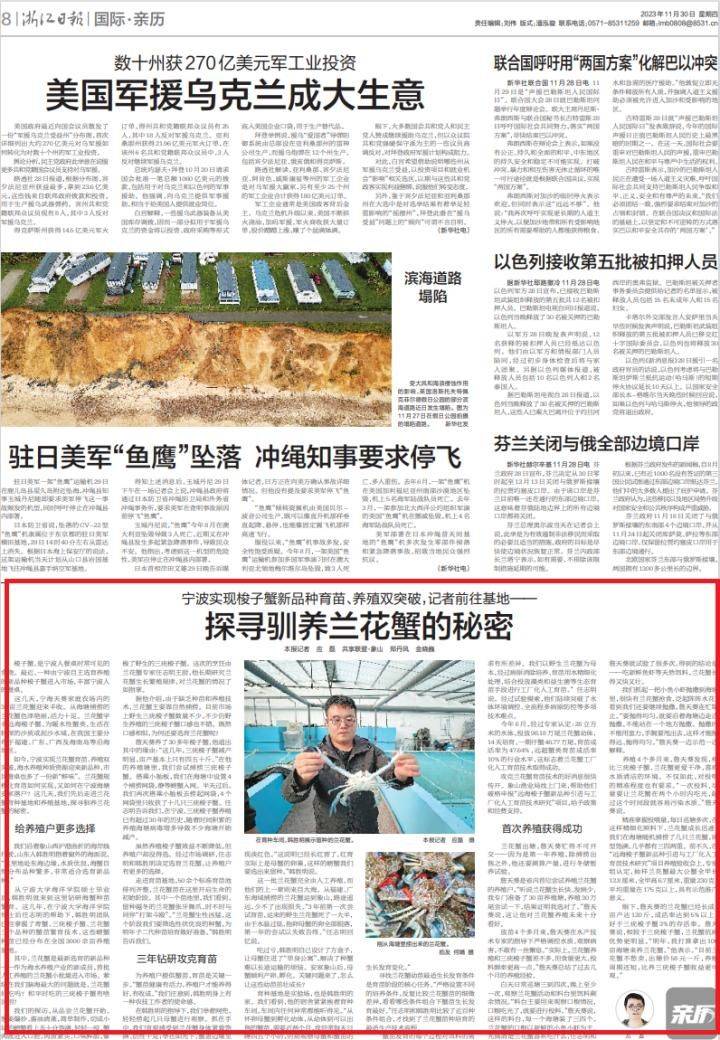
We traveled along a cluttered coastline like the western port of mount west, where han seung-ming, a mountainman, pointed to the sea outside the window and said, “this is on the eastern edge of the sea, with excellent water quality and a wide variety of natural species of sea crabs, which are well suited to the selection of new varieties”
After graduating from the m. A. Of the university of nimbau, han seung-min came here to study the breeding of sea crabs. Over the past few years, with the help of zhiming, the post-doctor of the university of ningbo school of oceanography, the han seung-ming team has mastered the techniques of breeding crab seedlings of three species: crabs, sancho krabs and orchid crabs, which have been spread across over 3,000 acres of the country。
Of these, orchid crabs are the latest selected new species - new members of the seawater farming industry, with the first small batch of orchids being farmed. The biggest problem in our minds is, is the orchid crab good? What difference does it make when you're eating a three-carat
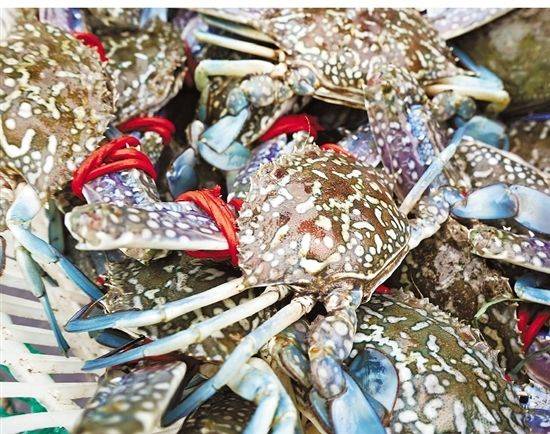
Our visit began with taste of orchid crabs. Crabs that have been cut into small pieces, look full, bite lightly, enter their mouths, their flesh is strong, their taste is sweet, and they look like wild three-shelf crabs. This time, the orchid crab expert, who is chef zhiming, has been studying orchid growth patterns and knows everything about orchid crabs。
According to him, orchid crabs are mainly dependent on natural fishing due to lack of seedling and breeding techniques. There are so many wild salmon crabs in the market, and many of the wild-planted salmon crabs feel so good. If you have a similar taste, why do you have to choose orchid crabs
The sunflower had been growing crabs for more than 30 years, and he explained the reasons for them: “in these years, there was a marked decline in the production of the crabs, and the acre production was almost 50 pounds.” in his farm pond, we tried to fish the salmon crab. We're on board, we're putting four fishing bags in the pond, waiting for crabs to enter the net. Half a day later, we went to pick up a net bag on a small board, and in four bags we harvested just a dozen three-carat crabs. Ren zhiming tells us that in ningbo, there have been more than 30 years of maroon crab farming, and that the increase in the number of pond-planted viruses that have accumulated over time has led to the loss of many ponds。
Despite the declining efficiency of the shuttle crab farming, farmers have no choice. As a result of market research, ren and han seung-ming decided to choose orchid crabs, giving farmers more options。
Walking into the nursery, more than 50 standard seedlings were organized, where orchid crab seedlings opened the initial stages of life. In one of the pools, we see the planting of winter crabs, with the occasional “fights”. "orchid crabs are wild, and at this stage we have to screen the good-looking crabs and prepare them for next year's seedlings." han seung-ming told us。
Three years of research and research
The provision of crab seedlings to farmers is a key step. “crab seed is healthy and alive, so that farmers can grow well and produce a harvest.” we note that han seung-ming has a sense of the mission of agricultural technicians。
Under han seung-ming's guidance, we're holding a few female crabs in our pocket. In the grip of our hands, we can visually feel the orchid crab body is so full and alive that, in the sun, the edge of the crab cap is light red. "this means it's red ointment, and it's actually the ovaries of the female crab, and we have to choose the crab to keep it." han seung-min says。
This batch of orchid crabs is entirely artificial, while their predecessors came from the sea. The orchid crabs caught in the area of fujian and guangdong are transported to the elephant hills, which is a long way from here, without loss. “for the first time in three years, the wild orchid crabs were brought to die, and the eggs of the eggs fell out of the water at too low a temperature, and the first year's attempt ended in failure.”。
At a loss, han sing ming himself designed the square box that allowed the mother crab to live in a “single apartment” to address the difficulty of long-distance transportation. After the settlement of the elephant mountains, the mother crabs successfully laid their eggs and hatched. The key question is, how can these seedlings thrive
The breeding base is the laboratory and home of han seung-ming. We see that his dormitory is close to the breeding workshop, where any anomaly can be heard. “from egg-bearing to hatching, from larvae to saleable crab seedlings, it takes almost two months for me to sleep for four or five hours a day, constantly observing the growth and development of mother crabs and crab seedlings.”
The search for the best growth and development conditions for orchid crab seedlings is central to the nursery stage. “strengthening different conditions of development, comparing the subtle differences in orchid crab seedlings over and over again, to see which conditions combine the best growth and development of crab seedlings.” by comparing the combination of nearly 100 conditions, ren chi minh and han seung-min found the most suitable production process for seedlings of orchids。
“there are differences in the demand for bait for each process of crab seed development. We use wild orchid crabs as a parent, through pathogen elimination, precision treatment of water for seeding, and industrially artificial seedlings combined with ecological breeding methods such as algae and fungi.” after the experiment, they broke through a number of technical difficulties, such as environmental regulation of the water body, prevention of the whole process multi-pathic pathogen。
In june of this year, experts determined that 28 cubic metres of water, 9818,000 tailed orchids of crabs, 14 days of breeding, 467. 7 million tails of crabs, and a rate of 47. 64 per cent of seedlings and 10 per cent of crab seedlings, marked the success of the orchid plant's technology for artificial seeding。
The good news about the orchid crab breeding technique soon spread. The mountain fisheries agency came to help them break the grid by declaring the project “research on the introduction of new species of long-sea shuttle crabs and industrially artificial seeding techniques”, which provides policy and financial support。
It's a success for the first time
The orchid crab is out of the pond, and the sunflower is too busy to deal with — because it is the first year of farming, and in addition to fishing for sale, he is required to measure production and conduct a winter storage suspense experiment。
The first farmer in the province to try orchid crab farming. "i heard that the orchid crabs were growing fast and had little disease, and i had prepared 30 acres of farm ponds for 300,000 tails, which proved me right." james aoi said it made him very happy about the future of orchid crab farming。
After more than four months of seedlings, the zangyang alumni, under the guidance of experts in aquatic technology, have strictly regulated the quality of water and observed the disease, and have not let up. “in practice, orchid crab farming is similar to tripod crabs, but the amount of food is higher and the frequency of the feed is higher.” zhang tianqian has taken stock of farming experience over the past few months。
During the day, the ponds are patrolled three to four times and at least once at night to observe the fall crab activity and the rest of the bait in the table. “the material table is primarily used to observe rations, which are to be delivered when they are exhausted.” aoi said that each pond had three or four of these. The orchid crab is fed mainly by fresh fish and shrimp. Just to find out what the orchid crabs like to eat, wing chi minh and janyan have tested it many times, and the conclusion is that the orchid crabs are growing fast and strong, eating natural baits like fresh fish shrimp。
We caught a little fish shrimp tossing it in the pond, and soon the crabs of the orchids went for food, and the water rose. Seeing that we're still going to throw, the japanese are busy stopping. “to throw evenly, you have to walk along the pond and throw it, not in a single place. You can't throw it with force, you can't throw it with your wrists, so you can throw it far away and evenly。
For more than four months, zangyang has found that the crabs are more clean and more water-purified than the crabs. Moreover, the precision of feeding is required. "a once-in-a-kind, try to get the orchid crabs to eat out in two hours, and beyond that time, it's easier to pollute water quality." aoi said。
The orchid crabs grow rapidly, with precision in feeding and repeated daily patrols. We caught a few orchid crabs at random in the pond, full-sized, almost three or four times two. More recently, at an acceptance meeting of the project “research on technology for the introduction of new species of long-sea shuttle crabs and industrially artificial seedlings”, the group concluded that the sampled orchid crabs are 12. 8 cm in length, 6. 7 cm in height, 230 g in weight and above 175 g in mean weight, and are of exemplary outreach interest。
At the moment, the orchid crab has grown to 120 pounds of acre, with a survival rate of more than 5 per cent, better than the 3 per cent survival rate of the tripod crab. The orchid crab is more resistant to disease than the tripod crab. "next year, i'm going to bring out 100 acres of ponds to raise orchid crabs." he said, “at present, orchid crabs are sold at a price of $58 per pound and have a shorter breeding cycle, which is much more profitable than raising a three-shelf crab.”