In recent years, the “platform dividend” judgement has become almost consensual across borders. It's a hype, policy change, price-pression strategy. In one example, small and medium-sized sellers are physically exposed to the fact that re-reliance on the platform is likely to be “with rhythm” and even “triggered”。
At the same time, as the demand for brand recognition and service experience from overseas increases, more and more offshore firms are moving to stand-alone stations as a means of controlling user relationships, strengthening brand assets and settling data capabilities。
Especially in today's increasingly competitive product class, the value of independent stations is no longer just a “self-builder network”, but rather a brand-owned data engine and user pool。
But the path to independence is far more complicated than expected. From the essence of the manual to the practical recommendations, the system deconstructs how smes can build and operate an independent station that can truly transform, sink and grow from zero。

I. What is an independent station? It's not just a network of officials
Many sellers are vulnerable to an error when entering the independent station track: using the independent station as a “demonstration site” or “back-up traffic point”. In practice, however, a truly successful stand-alone station is a full-fledged business closed-door that includes:
Branding and trust-building: brand concepts, user evaluations, sustainable practices。
Flow acquisition and succession: led by advertising, seo, content marketing, etc。
Conversion and repurchase design: commodity structure, promotion strategy, payment process, user experience。
Data acquisition and analysis capacity: user path tracking, funnel analysis, rfm model。
User asset deposition: operation by means of mail marketing, membership systems, marketing advertising, etc。
In other words, stand-alone stations are not a website, but rather a “brand digital operating system”。
What are the common types of stand-alone stations
1. Branded official network
Suitable sellers with original product, stronger design or content capabilities. The emphasis is mainly on sedentary brand recognition, emphasizing user experience, visual unity, brand story expression, etc。
2. Sales city
It is more focused on gmv targets, with a wide range of products, with a certain level of inventory capacity, and focuses on the components of price, logistics, payment processes, etc., that have a significant impact on conversion rates。
3, b2b pilot station
The core purpose is to obtain information on the sources of information (leads), often in the garment, hardware, home, 3c parts, etc., with emphasis on clear product catalogues, simple routing of queries, and rich client endorsements。
Iii. The nature of the distinction between independent stations and platforms
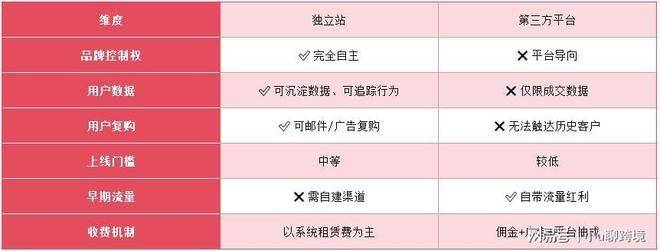
In short, independent stations are more like “long-termist” positions, and platforms are suitable for “short-term roi maximization”。
Iv. Core strengths of stand-alone stations: sedimentation is what makes sense
Customer data ownership: you can clearly know who bought what, when, which channel - which is almost impossible to get on the platform。
Flexible marketing space: from page design to mail automation, from time-limited discounts to membership mechanisms, you have full marketing freedom。
Brand asset accumulation: a continuously updated brand website, like a digital business card, with long-term transmission of brand value。
Risk hedge tools: platform policy mutations, account anomalies, etc. Are frequent and stand-alone stations provide “back-up options”。
V. The hidden challenge of independent stations: not everyone can do it. Yes
While independent stations are full of imagination, they do not really produce much. Common challenges include:
The flow is difficult: all flows have to be pulled by themselves。
High operational complexity: multi-skilled combinations of seo, advertising, page structure, data analysis, etc. Are required。
High pre-investments: construction costs, extension budget, content production, staffing。
Instability of conversion: no platform endorsement, high threshold of prior confidence, long transformation cycle。
The stability of the system is demanding: problems such as cardon, failure of payments, security gaps, etc. Can lead directly to loss of clients。
It is therefore a prerequisite for the establishment of independent stations to be prepared for a “durable war”。
Vi. Who's supplementable to be independent? Image + capacity threshold is not possible
Images of vendors suitable for stand-alone stations:
1. Brand sellers
(b) original capability to provide differentiated products
Have some capacity for design, packaging and content
It is possible to keep up brand stories and deepen awareness through marketing。
2, b2b seller
Have clear industry solutions and product lines
Clear image of the target client
There is a team system for receiving leads and completing sales。
3. Vendors with flow or content resources
Having mature youtube channels, high-activity social media accounts (e. G. Instagram fans)
(b) long-term cooperation with kol or dalit
A stable seo/sem team。
4. Medium- and long-term players who value brand assets
A long-termist mentality
The budget supports the ongoing input of the site + operations team
There is an intention to build its own user pool and data assets。
Which sellers are not suitable
No marketing budget or team configuration at all
High homogeneity and non-differentiation advantage of products
I hope i see roi in three months, or i just want to make money
Target markets are too dispersed, no major market or user image
In addition, it is strongly recommended that all sellers ask themselves a question: do you have sufficient will and determination to make independent stations a long-term undertaking

How to build an independent station
1. Site selection: do not miss the platform, step by step
Saas platform: e. G. Ueeshop (domestic), shopify (overseas mainstream), suitable for most smes, functional and quick。
Open source stations: for example wordpress + woocommerce, magento, high freedom but high technology。
Customization development: large brands suitable for adequate funding and complex needs, with dedicated development teams。
2. Domain name + host: don't try to be cheap
The domain name suggests a simple, branded, memoryful combination in english
Host recommends the selection of cdn service + overseas servers (us/europe/hk)
The selection of purely domestic servers or unstable low-cost hosts is not recommended。
3. Structure of the website: each page must be "for transformation"
The core pages include:
First page: focus main type, trust element (evaluation, media coverage, qualifications)。
Product page: clear pictures, functional description, dimension presentation, user evaluation。
About us: brand story + vision + team + contact。
Privacy policy/repatriation policy: the clearer the policy, the less user concern。
Performance and seo optimization: loading fast, structure clear to be competitive
Image compression, cache optimization, code streamlining
(a) the url is clearly structured to support a multilingual version
The mobile end is well matched to ensure smooth access to different devices。
5 payment and logistics systems: do not let users lose at the last step
Payment advice: paypal + credit card (stripe), local payments such as klarna (europe)
Logistics proposal: choose logistics suitable for themselves, such as postal packages, commercial couriers, etc.
6. Test and go online: do not roll over before you go online
Cross-browser compatibility checks
Multi-end equipment testing
Paths, functions, payment process tests
Compliance inspections (needs for overseas filing of icps, payment compliance, etc.)。
Not just a station, but a “home”: long-term operational strategy for independent stations
Social media operations: facebook/instagram is the main battleground overseas and content needs to be combined。
Advertising: it is recommended to test materials and funnels starting with small budgets, and tiktok ads also applies to sub-groups。
Mail marketing: creation of mailing lists, automated processes such as holiday marketing, recovery of shopping vans, and customer birthday blessing。
Client service response mechanisms: creation of online passenger service + faq to address issues of return, privacy and enhanced satisfaction。
Multilingual, multi-currency optimization: an english/french/spanish site in line with the target market and a local payment currency。
Deep till you have roots. Data is your most valuable asset
It is easy to build an independent station and hard to make it truly “run”. Each step, from the logic of building a station to the operational strategy, affects the quality of your future user pool and data engine。
If you're a seller who really wants to build a long-term brand, store customer data and improve bargaining power — independent stations are definitely not an option, but an option。
But remember, it's not a shortcut, it's a marathon