Common selections for hong kong cloud servers include standard cloud servers, light cloud servers and large bandwidth cloud servers. Among them, light cloud servers are more priced than large bandwidth cloud servers, which have a larger network capacity, with high bandwidth requirements such as live broadcasting, video, etc., to support larger business flows, particularly in high-flow, low-delayed claims business scenarios, which can respond more efficiently to network congestion problems and ensure business stability。
Description of the billing line for the use of hong kong's bandwidth cloud server resources:
Computation of resources: cpu core, memory capacity as the basis for the core billing, and common configurations such as 2 4g, 4 nuclear 8g, 8 nuclear 16g for different price brackets. The higher the configuration, the greater the ability of the server to handle high-sale, large-data volume operations, the associated cost increases。
Storage resources: contains system disks and disks, which usually provide 50-100gb ssd base storage by default. Additional charges will be charged for storage capacity (utensium/gb/month) in the event of an expansion (e. G. For storage of mass video material, user data, etc.). The unit price of the ssd hard drive is higher than the normal cloud disk due to faster reading and writing。
Bandwidth resources: the bandwidth of hong kong node cloud servers is generally divided into bgp fine lines (cn2), bgp optimized lines, and pure international lines, with differential charges based on the “bandwidth type”. Among these, hong kong's broadband cloud servers use bgp optimized circuits, the central reason being that they meet most users' needs for cross-regional (especially mainland and hong kong) network connectivity at a cost much lower than the bgp fine line (cn2), while avoiding the short panel of late and low stability when a pure international line is directed at users in the interior and achieving a high-price balance between “cost control” and “performance application”。
Analysis of common billing patterns
Monthly payment model: natural monthly rates, calculated monthly on selected bandwidth, (cpu / memory), storage configuration settlement costs, flexible adaptation to short-term, volatile operations。
Quarterly payment model: a three-month fee cycle with a one-time quarterly fee, with some service providers supporting “quarterly upgrade configuration” (e. G., temporary transfer of bandwidth from 30 mbps to 50 mbps for the second month, with only a premium) but without supporting intermediate downgrading or refunds, which is an “intermediate option” to balance flexibility with value for money。
Annual payment model: a one-time annual fee is paid for a 12-month pay cycle, and some service providers also support “2 annual payments, 3 annual payments” (with greater discounts), usually requiring “a fixed set-up during the annual pay cycle” (with no return to the original cycle differential if an upgrade is required), but are entitled to value-added benefits such as “free configuration upgrade” “extension of service”, which is a “price-for-money” option for their long-term stable operations。
Additional cost statement
Superscaling: the temporary growth of operations requires short-term upgrades of cpus, memory, storage, etc. (e. G., a temporary upgrade of 4 nuclear 8gs to 8 nuclear 16g at a live peak), most service providers support an expansion of the “day-to-day margin”, the difference = (new configuration monthly fee - original configuration monthly fee) the number of days of the month x the duration of the expansion, which is usually higher than the long-term upgrade。
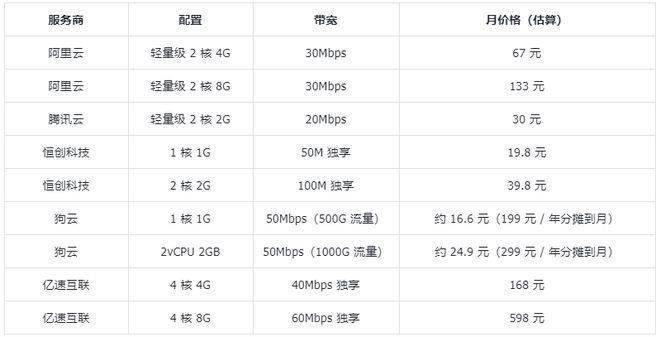
Eflex ip: most service providers by default provide 1 free static elastic ip, and if additional ips (e. G. Multi-site, load balancing) are required, the number of ips will increase and the cost will increase. Configure price reference - common large bandwidth hong kong cloud server suite
Common problems faq
Q1: how is hong kong's bandwidth cloud server accessing the country? A: delays in access in most of the interior can be contained in 20-50 ms, in parts of the region close to south china (e. G. Guangdong) at 10-20 ms, and loads are almost as fast as the united states interior server。
Q2: how is hong kong's bandwidth cloud server accessing overseas (united states, japan, singapore, europe, etc.)? A: the pace of visits is very good. As a global network hub, hong kong has access to multiple international submarine fibre-optic cables with bgp-optimal broadband servers that match intelligence with the best overseas links。
Q3: what are the scenarios for the hong kong bandwidth cloud server? A: in addition to an independent station for foreign trade, multiple high-flow, cross-regional business scenarios: live/ video type 2 cross-border electrician 3 games speed up four major data transmissions。
Q4: does hong kong's bandwidth cloud server affect seo optimization
A: hong kong's bandwidth cloud server does not in itself affect seo optimization. The core requirement of the search engine for the server is "stable running" and "quick loading" (which usually takes 3 seconds to open the page)。
Q5: is the bandwidth of hong kong's bandwidth cloud server “only”
A: the market is divided into “only bandwidth” and “shared bandwidth”, with large bandwidth cloud servers dominated by “only bandwidth”。
Q6: is it complicated to upgrade the configuration (e. G., increase bandwidth, expand storage) during use
A: simple operation and support for "soft upgrade". The majority of mainstream service providers will complete the upgrade by paying the difference after the console provides visual configuration upgrade portals, selecting the resources to be upgraded (width, storage, cpu/ram, etc.), most configuration upgrades will not require the re-establishment of the server and will not disrupt operations。