Too many people feel the same。
Dental is generally considered to be a high-profit industry comparable to the eye. A small, growing tooth at a price of tens of thousands, and a conservative estimate of 300,000, if calculated on the basis of full teeth (28-32), has made many people look back on the path of looking at their teeth, thereby raising the call for “loss of freedom to look at their teeth”。
At the same time, the oral state of health is not encouraging. According to the fourth national oral health epidemiology survey, up to 97 per cent of adults in the country are suffering from oral problems, particularly among young and middle-aged people aged 20-39, who have become the main force in the process of dental surgery。
In an interview with the chinese newsweek, dr. Zou shiki, director of cultivation, beijing university hospital no. 3, said: “in addition to the high cost of imported materials, the most important reasons are the high technical barriers to the cultivation of teeth, the heavy reliance on overseas technology for the domestic cultivation of teeth and the low rate of substitution for national production. Although there are currently some countries where teeth are grown, raw materials, production techniques, consumables, sophisticated equipment, etc. Are imported from abroad, the foreign market is in an absolute position and we do not actually have the right to price.”
The success of tooth cultivation depends on the integration of the plant and bone, and the development of advanced surface treatment techniques for titanium-growing bodies is key. According to zou qi, there is a huge gap between domestic and imported tooth cultivation. “it is difficult to catch up in 30 or 50 years, and he prefers to import more expensive teeth to grow, even if the patient chooses. So the environment is not very optimistic, and now it's more important to upgrade dental technology."
Market prices are uneven
Following breast teeth and constant teeth, the planting of teeth is known as the “third teeth of the human race”. Generally speaking, the planting of teeth is the planting of artificial materials (artificial teeth roots), which are implanted in the bone of the tooth in the missing part, and the placement of custom artificial crowns on the upper part of the bone after completion of the union, consisting essentially of three parts of the plant, the base and the crown。
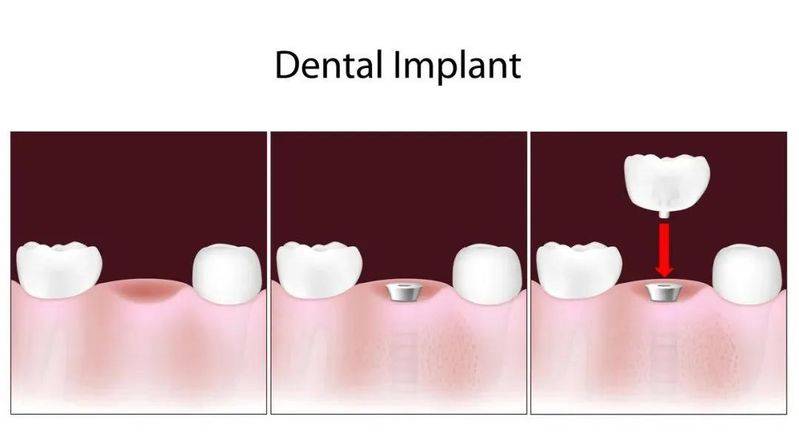
Brief chart of the process of planting teeth. Figure/mixer creativity
The high popularity of tooth growing is due mainly to the fact that it can have restoration effects very similar to those of natural dental functions, structures and aesthetic effects, which are evangelical for people with dental deficiencies。
However, the high cost of planting teeth remains a pain that cannot be said for itself。
Three years ago, the topic “the first 90 years after having gone bankrupt by looking at teeth” was the subject of microblogging, and to this day it continues to be raised. In march this year, the national people's congress, on behalf of li xiao li, recommended “incorporating teeth into health care”, a topic that, as soon as it came out, triggered a lot of debate and quickly took over the top of the hot list。
According to zou qi, some developed countries in europe and the united states may have higher prices than domestic tooth cultivation. “the price of domestic tooth cultivation is not much higher than for them, but it is certainly much higher than the average domestic income.”
In response to calls for medical coverage, zou qiu told the chinese newsweek that, in fact, not only were teeth grown, but most of the other dental materials and devices were imported, so that dental care was somewhat “unsatisfactory”; moreover, the incorporation of the cultivation of teeth into the health-care system would place a considerable burden on national health care, which is currently less practical。
The costs of dental cultivation in hospitals include, inter alia, the planting of plants, the planting of bases, the crown, the repair of materials, the cost of surgery and the cost of anaesthesia. The deputy medical doctor of the beijing coordination and hospital centre for painless dental treatment revealed that the cost of planting bodies in public hospitals was around $3,000-$12,000, about $1,500 in planting bases, $300-2,500 in crowns (300-$1,000 in roasting teeth, $1,000-2,500 in total china), $1,000-3,000 in restoration materials, $3,000-$3,000 in surgical and anaesthesia fees, mostly at $7,000-22,000. Each of these costs is largely priced in public hospitals and floats upwards and downwards depending on the patient's different oral status and brand selection。
Zou sqi told journalists that the cost of an import of ordinary materials to grow teeth in public hospitals could be $8,000 and the cost of better materials would be more than 10,000. “the cost of materials and treatments are split among the final costs of teeth cultivation. In fact, half the cost of treatment is not very high because of the high technical content of teeth growing, which is really not expensive for a good doctor. It is also extremely costly to train a qualified dentist.”
Unlike public hospitals, the pricing of private dental hospitals appears to be more “a bit more arbitrary” and less transparent, with some additional costs, such as “surgery difficulty fees”, in addition to the costs of planting bodies, bases, crowns, design schemes, etc。
In the united states, journalists enquired about the prices of private dental hospitals and found that the total cost of teeth growing varied from one import brand to another (south korea, united states, switzerland, etc.). The total cost of tooth growing varied from one brand to another。
For example, in the case of south korea, where imported teeth (brand: dotting) are grown, the price for the same imports is $3,799 for a dental hospital, while the prices of several other dental hospitals are not uniform, and the price is as high as $7,599 for a price difference of $3,800; in the same dental hospital, the same korean brands, dentes and dotting, grow teeth, the price difference was raised to $482。
Staff at a dental hospital told the china news weekly that it was mainly about the patient's bone count, which, if it was good, might be more selective. “the difference in the prices of planted teeth in imports such as korea, the united states and switzerland is mainly due to `surface treatment ' , `bones integration ' , `work to clinical length'. Some dental hospitals are cheaper to grow their teeth, which may not be the total cost, but the price of the plant in which they are grown, and may charge additional costs one step at a later stage.”

The same dental hospital has different prices for teeth growing in different south korean import brands. Figure / mission
According to industry sources, there is indeed some confusion in the domestic market in terms of the price of teeth growing. Given the quality of the plant, the medical technology and the consumption of hospital operations, the price of the plant (i. E. The imported plant) is difficult to reduce in the future market and is likely to increase. Domestic prices are actually not high compared to the price of growing a tooth abroad。
According to zou qi, in the future, as science and technology develop, costs fall and inflation factors are taken into account. The price of teeth growing is likely to fall, but it is also small-scale and volatile。
So what difference does it make between the prices? Zou si qi told the chinese newsweek that the difference in effect was still felt by the doctors, and perhaps not by the patients. “in particular, it is easier for doctors to operate by choosing more expensive growers and fewer complications for patients. Cheap teeth can last three to five years, and better quality teeth can be 10 to 20 years.”
Zou qiu also stated that “the level of technology of the different medical institutions and doctors is uneven and their fees are not fully matched by technology. So, the choice of a doctor is most important."
Technological barriers are difficult to break down
“the cultivation of teeth requires higher operating techniques for dentists, so i think the total cost is higher than the cost of materials.” a consumer who used to grow teeth told china newsweek, “i chose to import teeth in the united states, because it was a small tooth on the side of the mouth, so the price was actually good, at a total cost of around $8,000, within my expectations.”
Why don't you choose to grow your teeth? The consumer indicated that the technology for the cultivation of teeth was the first to be developed from abroad and that it might be better to slowly produce domestically in the future, but that the domestic technology for the cultivation of teeth, materials, etc. May not be mature. “mostly on the basis of this consideration, i would prefer more expensive imports to grow teeth, which would be more reassuring.”
If future national production of tooth can be done, the consumer claims that he will consider the domestic production of tooth, but may still be looking forward to it at an early stage。
In their investigations, journalists found that it was not a case in point. When domestic grower technology is not yet mature, many people opt for imported teeth for “safer, longer” reasons。
According to industry sources, the visibility of domestic tooth growing is still unknown and, in terms of the attitude of the domestic population, there is a greater trend towards imported tooth cultivation, with lower confidence in domestic production, especially in the area of planting bodies, preferring more expensive imports。
In fact, the market space for domestic dental cultivation is huge, as can be seen from the rate of domestic dental penetration。
Owing to disposable income and the price of dental surgery, the country currently has a low rate of penetration. The rate of penetration in developed countries is generally between 1 million and 2 million, with the highest rates of 6 million in south korea and israel, compared to 25 million in china in 2020. It is projected to reach 1 to 2 million in the country, totalling 14 - 28 million (approximately 3. 8 million in 2020), at a cost of $110,000/one for treatment and at $140 - 28 billion for tooth terminal space。
However, in the face of a huge market dividend, domestic production does not prevail。
Pacific securities analysts believe that, in terms of global markets, european and south korean farming systems dominate, with the top six brands accounting for 75 per cent of the market by size of income. At the domestic level, the market patterns of growers are similar to those of international competition, with more than 90 per cent of foreign brands (including those of europe and the united states and south korea) and less than 10 per cent of the market share of national product plates。
In reply to china newsweek, zou siu qi said that “the cultivation of oral materials such as teeth is a state-of-the-art technology that is now largely entirely dependent on imports, and that the related materials technology and manufacturing processes in the country are far different from those in europe and the united states, and are much larger than those in the fields of space science and technology, aircraft and automobile manufacturing. Every time a tooth is grown and every other type of denture is made, or neither of the world's teeth is identical, and each one is customised by doctors and technicians. A denture process may involve dozens of processes in which the materials and equipment used are essentially imported abroad.”
Why can't the country grow teeth? Zou qi stated that it was mainly subject to material and technical constraints and that it was difficult to catch up. It was well known that the raw materials for the cultivation of teeth were titanium, but how they were handled and processed was the core technology. “a piece of steel, for example, how you can make it into a useful part, which is essentially a technical issue.”
For its part, the luxurious view is that the real barrier to entry for plants is the lack of clinical data on domestic plants, and that failure requires practical validation。