The price tables for automobile consignment charges are not uniform and are determined by a combination of factors, as detailed below:
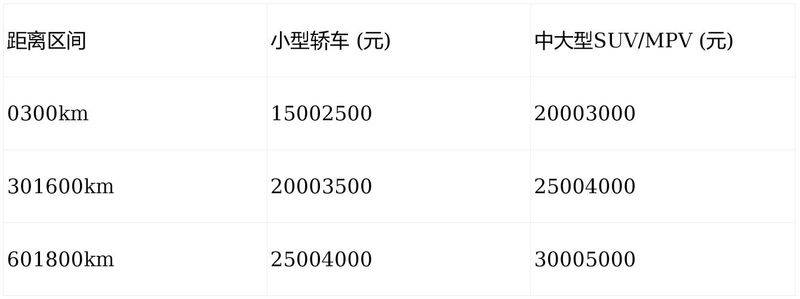
The base freight cost is a core part of the cost of the shipment and is based mainly on the transport mileage. Usually based on “how much per kilometre”, e. G., 2 yuan per kilometre. The further the transport distance, the higher the base freight. For example, from beijing to shanghai, about 1,200 km at a cost of between 2000 and 3,000 yuan, and from beijing to guangzhou about 2,000 km at a cost of between 3,500 and 5,000 yuan。
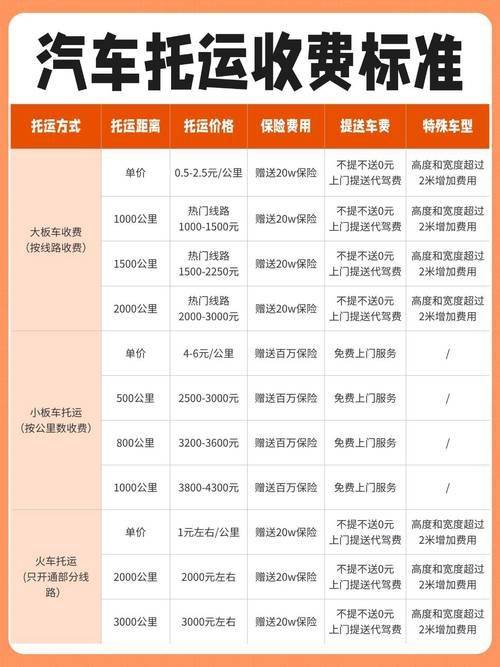
Routes are also an important factor. Roads with mountainous roads, narrow roads or congestion increase transport difficulties and time costs, thereby increasing freight costs。
Seasonal factors and oil price volatility also affect shipping costs. Increased demand may lead to higher prices during holidays or during the high transport season; at the same time, volatile oil prices can have a direct impact on transport costs。
The type and weight of vehicles are also important considerations. Large vehicles will incur additional costs as they occupy additional shipping space. For example, ordinary domestic cars may not incur additional costs, while large suvs may require $300-500. More heavy vehicles can increase transport costs, including fuel consumption and wear and tear on vehicles, and may therefore incur additional costs. Overweight vehicles are charged based on the degree of overweight。
The purchase of insurance is essential to guarantee the safety of vehicles during shipment. Insurance rates usually range from one to three per 1,000 vehicle values. For example, for a small car worth $200,000, the cost of insurance is $400 if the premium is two per thousand. Some shipping companies provide free base coverage, while the excess is purchased by the client。
Additional costs may also arise if the vehicle is to be picked up or transported to a designated location. Depending on proximity and transportation, the cost may be around $200-500; it is higher in remote areas。
If vehicles need to be stored temporarily at the shipping company's warehouse, storage charges will be charged on a daily or weekly basis, depending on regional and shipping company policies. For example, some companies charge $20-50 per day for storage。

Additional costs may arise where special transport requirements exist. The basic shipping price is the basis for the freight cost, which is determined per ton of kilometres according to specific transport conditions. Transport prices are influenced by, inter alia, regional differences, supply and demand linkages in the transport market, fuel prices and vehicle acquisition costs, and are adjusted accordingly. The whole cargo is rounded to the nearest integer in tonnes; the zero load is rounded to the nearest integer in kg, with a minimum billing weight of 1 kg, and the end is rounded。
The volume of light bubbled cargo is 333 kg per cubic metre. The costing miles are calculated on the basis of the actual operating miles from the place of loading to the place of discharge, in kilometres, with the tail number coming to 1 kilometres. When deviating for special reasons, the actual mileage is used. The whole-car freight formula is: freight = the weight of the charge x the mileage charge x the basic freight cost of the whole vehicle + other costs. The formula for the calculation of freight charges for zero-cargo goods is: freight = the weight of the charge x the mileage charge x the basic freight price for zero-cargo goods + other costs. The basic transport price of the zero-cargo cargo is usually higher than that of the whole vehicle cargo。