The yellow crane building is a seven-word poem written by the tang dynasty poet choi. The poem depicts the beautiful view of the yellow crane upstairs and is a good piece of the ancient homeland. The poem, which came from the return of the fairy man on cranes, led to the yellow crane building; the zhuang league, which said that since the departure of the fairyman, the zhuang crane building had been going on for thousands of years; the cervical philosophy, which entered the scenery and wrote the scene that was seen in the yellow crane building; and the qin, which ended with the writing of the love of the sun and the twilight of the smokebath, which returned the poetry to the invisible horizon. The whole poem is uncoherent, but the sound is bright and silent, and the faith is done, and the picture is mixed and far-reaching。
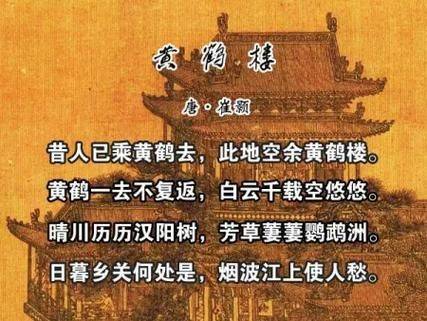
Original work
Yellow crane building (1)
The old man had gone on a yellow crane (2), where there was no yellow crane building。
The yellow crane is gone and the clouds are empty (3)。
Ying hyang tree (4), parrot continent (5)。
Where's zhiguang。
Comment translation
Comment
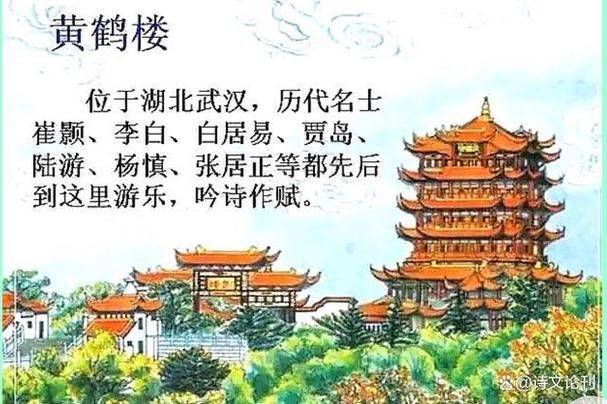
(1) yellow crane building: built by wu wong wu of the three countries for the second year. The ancient buildings were located on the chang huang crane in hubeivu, facing the river and the mountain of turtles on the other side of the river。
(ii) pasters: the legend is that in ancient times there was a fair man named faye, who took the crane and took it。
♪ take it easy ♪。
(4) yingkawa: the bright bright side of the river. Kawakawa, plain. History: clear and quantifiable. Hanyang: geographical names, west of the yellow crane building, north bank of han shui。
(5) 萋萋: a description of the vegetation. Parrots: in the south-west of wuchang county, hubei province, han huang zuzu was declared a parrot country as a guest of the great feast when he was in jiang shatai。
(6) home country: home country。
(7) smoke wave: the dark side of the river。
White translation
The fairies of the past flew on yellow cranes, leaving nothing but empty crane buildings。
The yellow crane has never returned, and for thousands of years only the clouds have wandered。
Hanyang yingchuan has a long history and is better able to see the country of parrots。
Where do i come from? It's even more painful to look at the smoke
Create background
The poem was written at a time when it could no longer be tested. The yellow crane house was famous for its location in the mount wuchang huangchang (also known as the snake mountain), where it was said that the ancient fairy son ann had passed by the yellow crane; and the legend that the féinden crane was here (see the book of peace), a poem written by the name of the building. The poets arrived at the yellow crane building, looked at the future, i. E. The landscape, and made a great poem and made it。
The book
Overall appreciation
He said, "there's no way out of sight and the poem is on top." it is not necessarily true that the legends or the followers of the future are attached. Li baek did write this poem twice. The first four words of his poem parrots say: “the parrot crosses wu gang water and the name of the parrot is used in the river. The parrots fly west to the mountains, and the trees of the fragrances are so green and green. It is also clear that the poem "the phoenix of the golden hills" is being studied. To this end, the poets say the words of zhong yu's "the chinese seven words" and say, "the yellow crane house is the first one." choi choi choi choi choi's hanground。
The yellow crane building has become a famous work of the millennia, mainly in the aesthetic sense of poetry itself。
On the one hand, there is a sense of a false combination. Poetry is written from the name of the building, written by legends, then published. The quaker, who was nothing, now has nothing to do, saying that it will never return, and that there will be years before it is invisible to the ancients, and that the qiang will go to the empty house, except for the clouds, and will be able to show the uncertainty of the world. The poets wrote these words about the feelings that people used to feel at that time in the yellow crane building, and they were reckless and emotional。
The second is the beautiful and colourful drawing of weather. There are paintings in the poems that have historically been considered as an artistic standard for the writing of the poems in the mountains, and the yellow crane building has reached this remarkable point. In a myth of integration with the sunshine crane, the union painted the nearest view of the yellow crane building, implying that the building lays on the river. In its lamentation that the yellow crane is never going back, zhuang has painted a vision of the yellow crane building, which is a spectacular display of the sky and clouds. The neck of the queen's caucasian was a direct example of the bright sun outside the yellow crane building. The taillines groan and indirectly show the evenings of yellow cranes down the river. In the whole picture presented in the poems, the landscape of the yellow crane building, the vision, the sunscape, the evening scene, the changing wonders, the weather rises, and the syllables of the fairy crane, the famous towers, the blue sky clouds, the clear desert sands, the green tree avalanche, the falling sun and the twilight river have a clear image and colour. The poem is full of paintings and is rich in paintings。
The first four words of the poem seem to have been said, “the word is the word is the word, the word is the word is the word, the word is the word is the word is the word, the word is the word is the word is the word is the word is the word. The word yellow crane has appeared repeatedly, but because of its dynamic, the reader has “swirled his hand and sent his eyes to his feet” and has been anxious to read it and to notice its overlap, which is a taboo of the legal ethos, and it seems that poets have forgotten to write “a voice before it has to sound” and the seven rules in which the words are fixed. Let's see: the first five or six words are the word "yellow crane"; the third sentence is almost all silent; the fourth sentence is all three squares like "freedom"; and whatever war is, it's all the words of ancient poetry。
The poet did not necessarily intend to write the law, but he did not do so in the same way as dubert's poems, which he did later, in the red house dream, said, “if there were any strange words, it would have made even the truth wrong”. Here, choi's work is based on poetry's purpose and the principle of “no harm to words”, which is why he wrote a poem that is so rare in the seven books. In addition, the repeated use of two-tongues, acoustics and supersonics or phrases, such as yellow cranes, “return”, two-council phrases, “here”, collusive phrases such as “the river”, and supersonic phrases such as “twirling”, “syllables”, “syllables” and “syllables” have created this poetic sound, clarity, harmony and beauty。
The first half of the poem was in disarray, the second half of it went straight, written what was seen in the building, and written from upstairs on the hanyang city, the parrot's fragrance green tree, and the resulting distress, which was put aside and collected. And if we leave it alone, we do not go back to the law, then it is not a seven-track, but it is seven-year-old. It is like a two-faced poem, but it is the end of the story, and it is a change of breath. This seemingly fragmented connection is also the rule of law in terms of the beginning, the transmission, the transformation and the combination of the poems. Yuan yang's second book, "the number of poets" , is about to be joined by the head, and says, "it's about to be cut off, like the pearls of the dragons."
This is the first four words of this poem, and the quaker's legend is that the hyenas are cuddled by each other. Yang jianji also said, “scrambling from the past and changing, such as thunderstorming mountains, consternation”. It is intended to explain that mutations should be made in the last five or six sentences, which are unexpected. This poem turns around, the tone goes back to the right place, and the frontier is very different from the previous one, which is exactly what the law requires. The qur'an, the yellow crane, has gone away, giving him a sense of ignorance; and when it is turned into a clear-water savannah, and has passed through the sight of manchuria, this contrast not only brings out the sorrows of those who have gone far from the building, but also causes the writings to fall into motion. "the king and the sun will not return, and the spring will rise." the poem's words, “scathings”, are also used as a means of bringing to the end the meaning of where it ends and how it ends. It is also in accordance with the law that the last link is drawn with the writing of a love between the smoked river and the twilight, so that the poetry can be returned to the beginning of an indistinguishable world, so that it can respond to the “coherence” of the amount that the leopard ends can contain。
It is understandable that it has been promoted as a singout on the yellow crane building, thanks to the great success of this poetry。