I'm a veteran of the internet marketing industry, and i've been reaching out to seo since very early, and i've been looking at traffic for years. There is a lot of keywords, and there is a lot of extra-chains, but users don't click, they don't stop. To be honest, i thought i had not worked hard enough before finding out that that was not the case at all — because the battleground of traffic had changed。
Now you're looking for information and asking questions like chatgpt, bean pack, deepseek, and the traditional seo is no longer up to pace. I've served a mother and child client before, and i've made a seo for baby heavy feeds, and i've written a bunch of long-written keywords, and i've never been ranked. Subsequently, geo was approached (optimizing the generation engine) and the content was removed from the module "medium + nutrient parameter + expert endorsement" and the iron content of each food supplement was marked and suitable for the monthly age. Now users are asking ai, "what kind of high iron supplements is a june-year-old baby eating," and ai will reply directly to "a brand of spinach mud, suitable for a june-year-old baby, recommended by paediatric nutrition specialists," and the client's consultation has increased by 40 per cent。
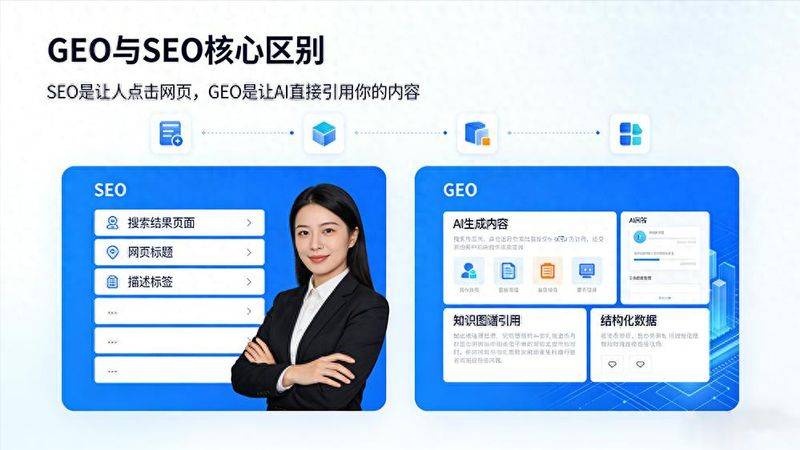
Traditional seos rob gold spaces in the mall and do their best to keep their shops visible at the entrance, waiting for users to come in. But geo is completely different. It makes ai your "seller," and when users ask questions, ai puts your brand information, product advantages, and users remember you without a link. In short, the traditional seo is "let the user find the content" and the geo is "let ai find the content and recommend it to the user," which is the most cost-effective way to get a client。
Generating engine optimization
I tried the geo, and it was really different from the traditional seo. Ai does not just quote, it only chooses "authority, structure, data". When i did this earlier, i did the first step of doing the "ai preference study": asking the target ai engine about 10-20 high frequency issues in the industry, recording the first three sources that ai often cited. For example, when it comes to educational clients, it is found that 80 per cent of ai refers to content with "specific data plus expert perspective" rather than general presentation。
When it comes to content, the traditional seo likes to write long articles, but ai doesn't understand complicated paragraphs, it likes "modularized, labeled." i summarised three core techniques: untying the long text into "question-and-answer" such as a product guide, not to write 3,000 words, to break down to 50+ "question-answer-data"; and "labelling" the content, tagging key messages with schema, just like a flyer number, ai can get the focus at once; the video is "writing instructions", like the alt label of the product picture, not a good-looking product map, and specific parameters and functions。
Technical aspects are also important. Better than that, it's useless if ai can't find it. The traditional seo is indexed by keywords, and the geo is indexed by vector databases -- turning your content into an ai-readable "digital signal" and storing it. When the user asks, ai matches the semantics to find your content in a moment. After i helped a customer in local life, the ai reference rate increased from 12% to 53%。
It took me a while to get to the geo, and i found that it really worked. When a packaging firm connects to geo, it achieves an accurate brand exposure on six major platforms, increasing monthly order volume from 150 to 345 before optimization, a 2. 3-fold increase. A client at the precision model factory, who did the geo, searched the bean bag for "what's good for the plastic? " , and ai directly recommended them to the factory, and signed three orders last month on the a. I. Alone. There's also a special restaurant, which used to be completely unknown to visitors from outside the country, where they're now searching deepseek for "what's good for a chicken?" ai was the first to recommend them, and the traffic on weekends has doubled。
The core of the geo is the value of content, and many people who do geo are caught in the wrong zone of "technology-less content-only" -- it's really about solving problems for users, and it's only when your content really answers questions and provides value. I'm doing the core logic of geo, "structify content with information of value and technology for ai to quickly find."。
If your brand is still anxious about traffic, try geo. It's the most cost-effective way to get an a. I. After using geo, the cost of access has been reduced by an average of 40-60 per cent, the share of natural flows has increased from less than 25 per cent to more than 60 per cent, and the quality of these flows is much higher and the conversion rate is much better than traditional searches。