999 dollars to stay at the mao tai hotel in sanya and a bottle of a market price of $1499? On the evening of 17 september, al-ai's pigboard platform opened at 8 a. M. And was sold as low as 999 a night, triggering online discussions. However, this cross-border association appears to have failed, not only by being called a “squadhouse” by netizens, but also by getting off the shelf about an hour after sale. In response, mao tai responded that the propaganda was not correct and that a change had been requested。
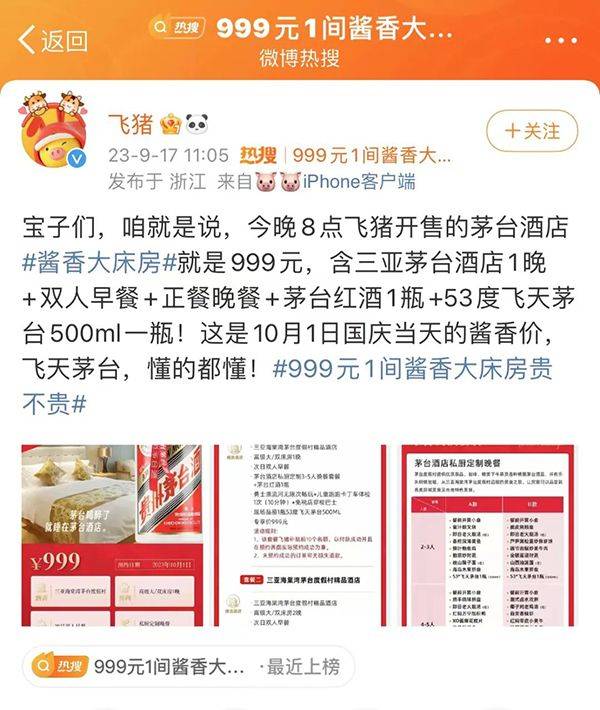
Strictly speaking, this is not a brand-to-brand cooperation, and the hotel itself is invested in the toilet. It's more like an extension of the brand, tied up the toilet and the hotel room。
But this was a tough tie, which did not see any “technical content” for marketing, nor did it develop any new products, but provided an opportunity to “take advantage” — to enter a bottle of a pedestal at a higher market price than a room. It seems to be squandering brand value and no wonder it is being ridiculed。
For some time now, a number of headlines have been seized by a cross-border coalition of mao tai. First, there was the launch of the soy latte with lucky ray, the first day of sales of which was over $100 million; then, there was also a report of an instant run-off with dev. But the marginal effect of the consortium seems to be declining. Wine heart chocolates are visiblely less hot than latte sauce, and this joint "saffron bed room" flips over, with brand value as if they had gone through rapid overdrafts。
If analysed carefully, it is still possible to find that there is a lot of pain in mao's frequent association. The performance of the toilet is of course strong. It is the food and beverage industry. However, consumption trends are not friendly to the huts. According to reports by roland berg, only 8 per cent of chinese consumers under 30 years of age consume alcohol. White wine is losing young people, that's losing the future。
This is why the toilet is targeting such social currencies as coffee and chocolate, with the aim of catching young people. But there is a concern about this cross-border: almost every collaboration is in the form of a “traying” of its own products: abandoning the white wine sector and breaking the brand's traditional “high-end” “mystical” status and diluting brand attributes。
Thus, all of the conglomerates of the huts are as if they were a marriage. And the hotel combination is even more detached, without any marketing package, with only one -- cheap enough, of course, not too smart。
This is an indication that mao tsai currently does not produce the products of truly rival young people, either by name or by white or by brand value added. A few people remember that mao-tai had put out ice cream, that it started with a 66-dollar price, that it is now sold at a discount in many places, and that it sells only 10 million cups a year — and, you know, 5. 42 million cups of soy latte a day in association with rish。
A similar problem is not limited to the toilet. The traditional liquor stores, such as quixuan, the old cellars, and the mountain of gugong, have all produced a combination of ice cream, coffee, tea, etc., but few of them have picked up water flowers, and few of them can name, let alone increase the repurchase rate and become more ambitious targets for the main business。
At the present time, of course, it is not possible to assert that the cross-border association of traditional liquor companies has been failed and ineffective, but this is a difficult task. It is not so much a product as a culture between a liquor dealer and a young man. These joint products, currently dominated by a sense of freshness, a genuine, cultural acceptance that young people may not be able to do。
Therefore, the white wine industry, in order to achieve its ambition to capture young people, is not enough to produce, but is behind it a recreated culture. If the image of society is not truly similar to that of young people, it is simply an expression of “honour” as if it were a pity for young people, and the future may be a bad one, and the fresh feeling will quickly fade away and even become aversion。
After all, how many more discounts can you afford? And when brand value is no longer available, what else does that name leave? These are issues that the relevant manufacturers should seriously consider。