On 20 september this year, the 35th national day of love for tooth, the office of the national commission for health and health, the office of the national health service, the office of the general superintendency of financial supervision and the general directorate of the national drug control and inspection authority recently issued a circular on furthering the management of oral health services and safeguards (hereinafter referred to as the circular), in which it was proposed that the prices of plant implantation fees in public health-care institutions, the cost of crown implantation fees, bone implantation procedures, etc. Should be specifically regulated; therapeutic health-care projects and medical consumables should be included in the basic health-care coverage. What's the situation in guangdong? Are you sure you can pay for your health insurance?
A. Tooth growing
Public hospitals reduced from $15,000 to $7,000
The circulars of the four sectors propose optimizing the prices of health services and health policies. On the one hand, it optimizes the price of services and reduces the burden of public consultations. In accordance with the relevant regulations, local health-care departments have fully implemented the full-process target of regulating the price of oral medical services, and have made special efforts to regulate the prices of public health-care institutions for plant implantation, crown implantation, bone surgery, etc。
On the morning of 12 september, the guangdong department of health and social security, in the context of thematic education, launched a live radio programme, the guangdong people's voice hotline, which provides information on guangdong's efforts in the area of special management of oral cultivation。
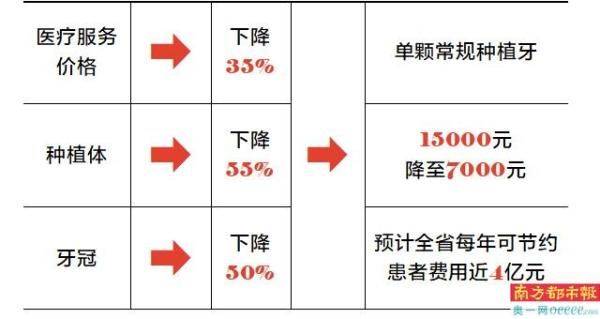
Since the beginning of this year, the province of guangdong has adopted a separate fee for “technical services + specialized consumables” to regulate the main costs of oral cultivation. :: optimizing 15 of the more than 200 oral cultivation projects under the current health-care pricing project and setting the provincial benchmark for the price of health-care services for oral cultivation, an average reduction of 35 per cent. At the same time, cropping was carried out at an average price reduction of 55 per cent, and the price of the crown canopy was regulated by an average reduction of 50 per cent。
Since 20 april this year, guangdong province has been implementing a comprehensive approach to regulating the cost of medical services for oral cultivation, the purchase of a centralized belt for planting, and the “triple” of a network of price limits for dental crowns. The total cost of conventional tooth cultivation in public health institutions has been reduced from around $15,000 to about $7,000, and the price reduction has been radiationed to private health institutions。
By the first half of 2023, guangdong province had implemented 12 batches of more than 800 drugs, as well as 17 batches of medical materials such as coronal arteries, artificial joints and pacemakers. The average reduction was 36 per cent, with a maximum of 98 per cent, and the average reduction of 61 per cent and a maximum of 93 per cent. Union procurement of medicines covers chemical, medium and biological drugs, including anti-infection, digestive, respiratory, nervous, oncological, cardiovascular and nutritional drugs, representing 82 per cent of clinical use。
Focus
What are the main costs of planting a single tooth? Where are the prices?
Oral planting costs = grower costs + crown costs + prices for medical services
Previously, the main reasons for the high price of tooth growing were the high cost of medical services and the non-transparent cost of medical services, and the high price of oral plants, i. E., the high price of consumables. (d) set price-regulating targets for single dental care services through specialized governance to rationalize fees for medical services; and reduce the price of materials such as growers, tooth crowns, etc., through centralized lead procurement and competitive networking。
What are the price-regulating targets for single conventional dental care services?
In guangdong province, as required by the national regulatory goals, the price-all-process regulatory target for single conventional dental care services is 4,500 yuan (the economically developed, highly expensive municipalities can relax their regulatory target by up to 20 per cent, and the health-care institutions belonging to the national dental centre or the oral cultivation profession may be relaxed by up to 10 per cent)。
(a) the costs of diagnostic and inspection fees, biochemical and video-testing costs, plant implantation (single) costs, repair of tooth crown (single) implants, medical 3d scanned design modelling and printing costs, anaesthesia costs, as well as related medicines such as ablution, antibiotics, washing, swollen and painkillers
The cost of medical consumables, such as planting systems and tooth crowns, is excluded, as is the cost of such services as tooth extraction, tooth cleaning, root tube treatment, bone implantation, soft tissue transplantation, immediate planting and immediate restoration of harvests, scaffold implantation and temporary crown restoration。
How is it priced for groups requiring multiple or complex cultivation?
In guangdong province, the project on prices of dental care services has been standardized, the project on original oral cultivation has been revised to 15 main projects, the project on elimination of non-use and duplication has been cleared, and the project on the implantation and immediate restoration of dental plants for which market prices have been adjusted has been converted into a government-directed pricing project。
Guangdong province has established a benchmark price for dental-planted medical services, which divides 21 municipalities across the province into three price zones. Local prices are determined by the municipalities on the basis of the region in which they are charged, the level of development of the regional economy and the capacity of the population to withstand them. In exceptional cases, such as the planting of multiple teeth, complex planting or the need for bone-planting of a tooth bed, public health institutions charge fees based on these optimized projects。
04
How much did the price fall after the high-value consumer collection of oral growers and the bid for a crown were put on the net?
Since the formal implementation of the comprehensive governance requirement on 20 april, the prices of dental care services throughout the province have fallen by an average of 35 per cent compared to the pre-adjustment level, 55 per cent for growers and 50 per cent for toothcaps。
How much is it going to cost for a single tooth after the price of oral cultivation?
Following the introduction of a specific policy on the price of oral cultivation, the total cost of a single conventional tooth growing in guangdong province has been reduced from around $15,000 to about $7,000, with an estimated annual savings of nearly $400 million for patients across the province。
05 what health-care institutions in the province have implemented price reductions for dental cultivation?
All public health institutions operating oral cultivation throughout the province have implemented oral cultivation governance policies with private health institutions that are committed to “participating in the collection of tooth consumption and accepting the price regulation of a single routine full-process process”。
The rest of the private health-care institutions set their prices reasonably in accordance with the principles of fairness, legality and integrity, taking into account local health-care regulation objectives and the price of the bulk of the inputs。
Information can be found on the list of health-care institutions involved in target management and collection, the total cost of a single tooth growing, the price of a toothcap net, the price selected in the plant, and the location and contact details of the hospital。
B. Dental claims
The circulars of the four departments propose to optimize the safeguards policy and lead to early control of oral health problems. On an affordable basis, eligible therapeutic medical services and medical consumables are programmed into basic health insurance payments. Support to encourage commercial insurance to play an active role in reducing the economic burden on the population。
In response to a question from netizens on the website, the guangdong department of medical security stated that, in accordance with national policy, qualified dental treatment projects had been included in the payment of health insurance. On 15 august 2021, guangdong province unified the implementation of the " catalogue of basic health insurance, industrial injury and maternity insurance projects in guangdong province (2021) " , which included eligible dental treatments such as pre-dental extraction, grinding, complex tooth removal, dental transplantation (therapeutic self-transplantation), fragmentation treatment, etc., in the payment of medical insurance, which is regulated by the health insurance fund。
The state circular on the issuance of opinions on the management of medical care, the scope of medical services and the standard of payment of basic medical insurance for urban employees specifies that “rehabilitative devices such as glasses, prostheses, prostheses, prostheses, prosthetics, hearing aids” and “all kinds of beauty, beauty projects and non-functional cosmetics, orthopaedic surgery” fall within the scope of the basic health insurance without payment. Tooth crowns, braces, roasted china teeth, dentures, etc. Are considered to be prostheses, and dental implants are part of a beauty and orthopaedic treatment programme, which is not paid for by the health insurance fund。
In december 2022, in guangzhou city, for example, a new policy to reform the way in which out-patient care was provided benefited 27,000 participants, increasing the per capita reimbursement from $150 to $380, an increase of 153 per cent. On 6 december 2022, mr. Chen, a citizen of guangzhou, was treated at his district oral hospital for dental pains and haemorrhage, and was examined and provided with dental prostheses, for which he was reimbursed $2101. 78. Under the old policy, the current reimbursement was only $300; when the new policy was introduced, an additional $180,178 was reimbursed。
Focus
Tooth extraction and root tube treatment are reimbursable
Q: which dental expenses are reimbursable?
Part of the dental costs are covered by medical insurance, and the costs of dental care are of a therapeutic nature, such as those incurred in the extraction of teeth, filling of teeth, root tube treatment, treatment of dental choreography and dental aromitis。
Toothwashing, planting, etc
Q: what are the non-reimbursed dental expenses?
Response: costs for dental projects for non-disease treatment. For example, tooth washing, roasting, white teeth, broken teeth, tusk repair, tooth planting, lacerated teeth treatment, dentures, etc., are items for which health insurance cannot be reimbursed。
Q: why is only part of the cost of treatment reimbursed?
The current basic health insurance system in the country is based on the basic medical needs of insured persons, while dental projects other than treatment for diseases are higher-level medical needs and are not considered for payment。
Although the cultivation of teeth has not been covered by health insurance, in order to reduce the burden of the cost of planting teeth for the general population, since 20 april this year, the province of guangdong has fully implemented a comprehensive management of the “triple-hub” of the artery system, with a 50 per cent reduction in the total cost of a single tooth。
The cost of medical services for oral cultivation is such that the price of a single routine full-process medical service cannot exceed the maximum price. Prices for full-process medical services include the sum of the cost of medical services such as outpatient check-ups, biochemical and video tests, plant implants, crown implants, etc. Required to complete a single routine planting。
Can you pay for your teeth?
Response: in accordance with the " catalogue of basic health insurance, industrial injury insurance and maternity insurance care projects in guangdong province " (2021), eligible dental treatments such as pre-tooth removal, tooth removal, complex tooth removal, dental transplantation (restrictive self-portation) and cavity treatment have been included in the health insurance payments, which are paid by the health insurance fund。
Teeth supplementation involves materials such as dental therapy and crowns. Of these, the dental component (including basic materials, treatment fees) is covered by health insurance, the costs incurred in the event of dental disease, such as extraction, treatment of dental problems, and dental inflammation, are covered by health insurance, but some, such as roasted tooth crowns, are in the form of cosmetics and are not reimbursable。