What is most frequently asked about rural areas recently is not food prices or subsidies, but whether the land is divided, whether it will be collected and how it will be signed if it is moved out. To be honest, many are concerned about one thing and the location of the contract is still stable。
The answer goes first, and as of 1 may 2026, matters relating to rural land contracting in the country have been governed by the new uniform rules, which require the extension, transfer, recovery and determination of rights. The most critical sentence was to extend the second round for another 30 years after its expiration and to stabilize the contractual relationship in general to 2057。
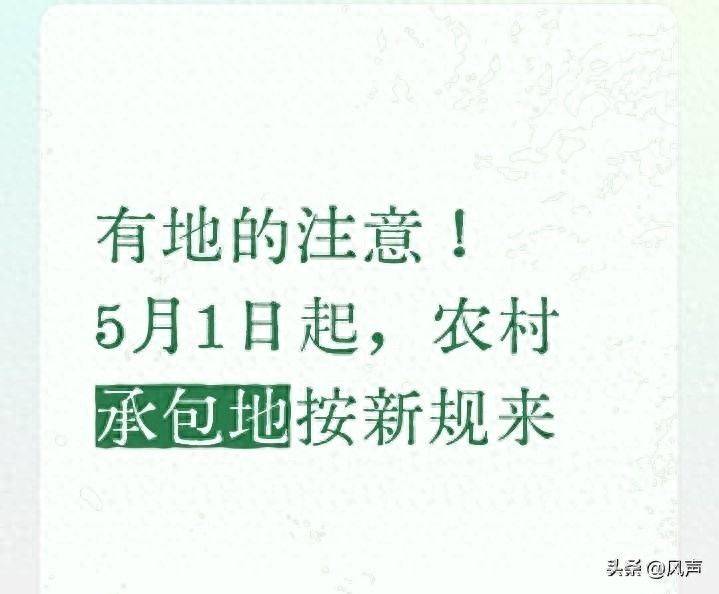
What this means is that the most easily understood statement of the population is that the vast majority of farmers have their original plots, their size, their tenure, and they have no movement and have a direct extension. The two rounds on the internet that are due to be retraced can stop and the policy direction is clear。
This is not a temporary rule. There was already a legal basis and a round of pilots. By the first quarter of 2026, seven provinces across the country had been able to pilot the extension package as a whole, with 221 districts and 349 townships first testing, covering more than 25 million farmers and involving more than 300 million acres of arable land. In the pilot, the completion rate of extension packages exceeded 97 per cent, satisfaction was above 95 per cent and no large-scale disputes arose. Why is it now that national unity is being pushed out of the way。
A lot of people are concerned about the first thing. The new regulations provide for direct principles, broad stability and minor adjustments. Most villages will not be re-separated and will not be re-repossessed in the name of extended contracts. National land titling authority registrations are now almost complete, with more than 1. 5 billion acres of title and a 99 per cent rate of authority, followed by extensions based on such authority information。
That's not just not moving, it's not. The villages can be fine-tuned on a small scale in the face of natural disasters, destruction, spasms and historical contradictions. However, the procedure is very strict and is subject to approval by more than two thirds of the members of the collective economic organization and approval by the commune government and the county agricultural and rural sector. Whoever can board is obviously not alone in the village. It would be even more untenable to replace the place with one word。
The second thing is, we're still in town. This problem is most sensitive in places where there are many workers. Once again, the new regulations make it clear that peasants who enter the city cannot be forcibly deprived of their rights to land contracts, use of residential premises and distribution of collective income. That is to say, the withdrawal of land cannot be considered a precondition for your settlement。
Here's a particular detail. As long as the farmers have not voluntarily returned to the contract in writing, neither the village community nor the town can say that you are not living in the village and take it away. You work outside, stay in the city for a long time, even buy a house, which does not automatically amount to giving up the land. In some areas of jiangsu and zhejiang, when the civilization of farmers was promoted earlier in the years, it was repeatedly stressed that voluntary withdrawal could not be done in a one-size-fits-all manner, for that reason the land was the last resort for many families。
However, contractual rights are not always tied to an individual. Family land is contracted on a household basis and not on the personal property of the elderly. As long as there are other family members in the family, the family continues to grow in the family name. In the event of the disappearance of the entire household, the cancellation of the civil registry and the absence of a legal member, the right to contract is lost and the land is legally recovered by the village community. Many thought that the land could be inherited in the same way as a deposit, and that was not an accurate understanding, at least for family contracting for arable and grassland。

The third thing is, how do you do it without losing? The country now has more than 587 million acres of land in circulation, accounting for nearly 42 per cent of the land under contract. In 2025, the average flow price was about $915 per acre, and some high standard agricultural land could reach over $1,200. It is not uncommon for the earth to be increasingly drifted and the pit to come out, and it is not uncommon to say that the rents are being collected, rents are being rented and even trees are being built。
After 1 may, the flow became more intense. First, no one can force you to move, nor can they stop you from moving legally. Secondly, a written contract must be signed and no more oral agreement or white note can be relied upon. The contract must contain clear pieces, terms, rent, means of payment, purpose, liability for breach of contract and must be filed with the commune. Third, rents are in principle directly to the farmers ' own accounts and cannot be collected in the village and transferred. The problem was that, in the past, many disputes were not about renting or renting, but about money being turned around。
There is another one that is easily overlooked and whose land use cannot be changed in the future. Arable land is still used for agricultural production, and basic agricultural land is more focused on growing food and not being able to dig ponds, build houses and collect soil. In previous years, the conversion of drifting lands into landscape parks, pick-up parks, which appeared to yield high returns, and the subsequent contact with the red line for cropland protection, led to problems in the contract and easier exposure to inputs. Do you think it's a good idea if the rent is high。
The land issues arising from the change in marriage are also more straightforward this time. Expatriate women, divorced women, widowed women and sons-in-law may not be alienated or reduced by changes in marital status. The family has the right to register the land and the family has no share in it. Legal rights and interests should also be recognized in the case of a son-in-law residing in a female village group. In reality, such disputes are often not on paper, while in village practice, the new rule is to bring this ambiguity to light。
Land confiscation compensation is also one of the most closely watched items. The compensation scheme will be publicized at a later date of not less than 30 days and will be able to apply for a hearing if there are objections. Compensation would also have to be paid in full into a dedicated account, and the collection could not be started without the availability of funds. The national average rate of compensation for arable land is now around $50,000 to $150,000 per acre, higher in the developed regions and 20 to 50 per cent of basic agricultural land. However, there are already large differences in land prices between different regions, as well as between an acre, peri-urban and remote towns, and the level of compensation will not be the same, depending on local standards and not directly based on off-site figures。
The red line that really needs to be remembered is just a few. Village officials cannot collect land privately, force low prices, withhold rents, make verbal and excessive transfers, deprive themselves of their rights through changes in marriage and domicile, or use agricultural land for non-farm construction. It's no big deal。
In short, this new rule of uniform implementation is to make as hard a rule as possible many things that have been easy to deal with through words, practice and ambiguity. You have a contract in your home, whether in the village or in the city, and these questions should have been figured out sooner. This is the most significant part of the new rule, which is based on the principle of non-division of land, the taking of power, the transfer of contracts and the direct arrival of money。