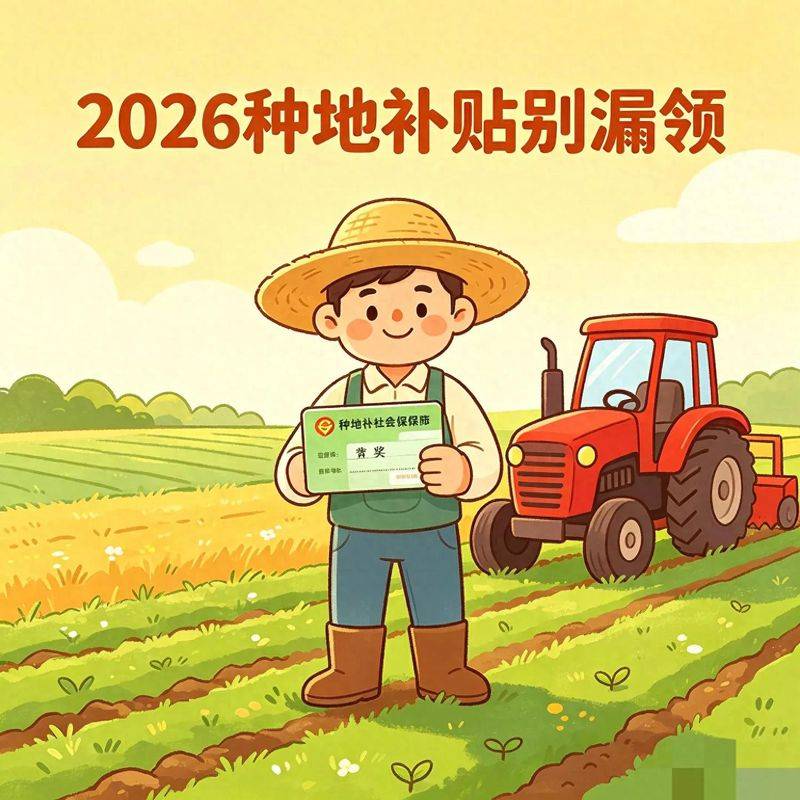
Hello, i'm kobayashi. The long-term focus on three farmers'students, the policy of non-farming, the general understanding of rural practicality, the non-routing and non-comprehensible official language, and the provision of the most tangible and relevant dry goods to the general public is a policy of compliance。
Today, this article, which is intended for all the country's farmers, is based throughout the process on the policy of strong agriculture, which was continued in 2026 by the ministry of agriculture and rural affairs and the ministry of finance. If you grow land at home, tend agricultural land, or if your elders work in agriculture for the rest of the year, you have to watch it carefully. I will be able to share this first-time knowledge of the new regulations on various types of rural subsidies, alerts and pit avoidances。
State support for rural areas has now been stable, with the implementation of a number of affirmative agricultural subsidies policies throughout the country in 2026, and the distribution of agricultural subsidies has become more regular. The reality, however, is that many of the details of the applications for subsidies are not communicated to village officials by door or to farmers。
Most farmers are busy working on their land and cleaning their crops, have no time to clean up their policies and check their information, and have lost their subsidies for nothing, even though they are eligible to receive them。
In particular, the following four non-agricultural subsidies are formal state subsidies, not so-called “hidden benefits”, some of which are self-declared, partially claimable and not universally available. Today, kobayashi, in the context of official policy of 2026, is able to disintegrate in plain language: who can collect, reference standards, time of distribution, how to apply, what thresholds and areas of error are not exaggerated, not misleading, and what money they can receive from their families。
I. Subsidy for the protection of agricultural land: basic floor subsidy for farmers, most inclusive
First, the cropland protection subsidy, which is the widest and most stable of the general benefits currently covered by cropland subsidies, is part of the policy that the state continues to implement, not the new 2026 regulation, which is aimed primarily at encouraging conservation and rational farming。
Many farmers wait for money to arrive automatically, but do not check their land information, and if the area is lost or wrongly accounted for, the subsidy will be less than they know。
1. Identification of recipients, which can be applied for if the conditions are met
• hold legally valid certificates of ownership of rural land contracts (land titling), as well as legal rights of access to agricultural land
• arable land is strictly maintained for agricultural purposes, and there are no irregularities in building houses, digging ponds, planting trees, building farms and not changing the nature of arable land
• arable land is cultivated normally, is not abandoned for long periods, is idle and, as long as crops are grown according to the rules, basic conditions are met
• subsidies are provided to farmers who have legally contracted arable land, and the cultivation of conventional crops is covered。
Subsidy reference criteria for 2, 2026 (large geographical variation)
This subsidy, which is not subject to a single national standard, is set by the provinces, municipalities and counties in the context of local finances and agricultural land
• food-producing areas (henan, shandong, hebei, etc.): 90-150 yuan/acre
• provinces of the south: approximately $110 per acre in the guangdong region and $50-60 per acre in the centre-west of guizhou, etc
• north-east cultivation area: $70-130/acre
Carnation note: the amount is based on the official announcement of the year in which you are in your town. This is a reference area for the country and is not actually disbursed。
On the basis of 10 acres of arable land, the amount of subsidies varies from $500 to $1,500, which is the basic guarantee of the state for farmers on land to be farmed without additional inputs。
3. Time for issuance and core care
• time of distribution: by the end of june, 2026, in most regions of the country, funds were distributed directly into the farmers' social security card and a cartoon in huenon, without middle links
• every year, it is essential to come to the village council on its own initiative to verify the land area, personal information and correct it on the spot
• arable land is lost for more than one consecutive year and is directly disqualified from the current year's subsidy
• in the case of land transfers, it is recommended that the attribution of subsidies be agreed in advance in writing to avoid disputes。
Ii. One-time allowance for actual grains: exclusive allowance for grains, superseded
The second is a one-time subsidy for farmers who actually grow food, which is also a continuation of the state policy, which continued in 2026, mainly to cover the cost of increasing farm incomes, such as rinsing fertilizers, pesticides, diesel, etc., and which is not in conflict with farm land subsidies。
1. Who can apply
• be guided by the principle of who actually cultivates food and who supplies it, whether in the home or in the land in transit, and can apply for it as long as it is actually grown
• not including cash crops such as wheat, rice, maize, soybean, vegetables, fruits, medicinal products, etc., only
• the actual food staples, such as small farmers, large farmers and family farms, are within the scope of the claim。
2, 2026 reference to subsidies
This subsidy is financed by the central government, which allocates it on the basis of the actual area under cultivation and the total amount of the funds, without a single fixed national standard and a national reference area of 20-50 yuan per acre。
There is no fixed, high subsidy and the final amount is based on local township accounting and post-publication criteria。
3. Application rules (must cooperate voluntarily)
• in march-may of each year, the village will concentrate on counting the actual area of food grown, with farmers reporting, signing and confirming on their own initiative, and failing to register for entry into the distribution system
• in the case of land transfers, it is recommended that the attribution of subsidies be indicated in writing in the lease contract, and that oral agreements be open to disputes
• only once a year, missing the filing time, which cannot be replenished。
Iii. Specialized subsidies for shifting cultivation: pilot areas only, non-inclusive policies
The third special subsidy, the national cropland protection policy, was implemented in 2026 only in designated pilot areas and not all farmers in the country receive targeted subsidies, which are not universal benefits。
1. Conditions for claims (with strict thresholds)
Rotation allowances
For cultivated land that is included in the local rotation project, the designated rotation model, such as maize soybeans, rice oil and soybean oil, as required, is not readily available。
Farming subsidies
Arable land in the pilot areas of the country, such as groundwater overmining areas and ecologically vulnerable areas, is centrally planned and integrated into the project bank and is available to farmers on demand。
2. Subsidy reference criteria
• rotation subsidies: 100-300 yuan/acre in pilot areas, based on local project announcements
• pause allowance: limited to a specific pilot, 300-600 yuan/acre, which is not available to farmers in ordinary non-pilot areas。
3. Key eligibility prerequisites
• must be included in the local project bank, submitted on its own initiative and not included in the pilot, undeclared farmers, and not available
• if ordinary farmers wish to participate, they must consult the village committees and the village farm stations to ascertain whether their agricultural land is in the pilot range and must not wait blindly。
Acquisition of agricultural machinery and end-of-life subsidies: purchase of specified farm machinery with maximum subsidy
The fourth agricultural machine purchase and end-of-life renewal subsidy, which was continued throughout the country in 2026, aims to reduce the cost of farm-house inputs, not all of which are available, with clear catalogues and criteria for subsidies。
1. Applicants
Farmers, farmers, farmers, cooperatives, etc. Engaged in agricultural production can apply for agricultural machinery。
2, 2026 rate of subsidy (posting official requirements)
• conventional small- and medium-sized machinery: subsidies of not more than 30 per cent, which are applied in most provinces of the country
• in some areas, subsidies for dedicated, energy-efficient agricultural machinery in hilly mountain areas have increased slightly, up to a maximum of 35 per cent, which is not universal at 40 per cent
• the end of life of old agricultural aircraft: subsidies by type of aircraft, hundreds of small agricultural machines, up to a maximum of $5,000 per station。
3. Application process and pit avoidance tips
• process: first purchase of invoices for the retention of agricultural machinery in the catalogue of subsidies, certification for submission of applications for subsidies at rural farm stations
• ensure that the list of local farm machinery subsidies is consulted in advance and that agricultural machinery not included in the list is not subsidized
• subsidies are capped annually and are implemented by ordinary farmers and cooperatives according to local regulations, so that “high subsidies” are not misleading。
Five, 2026 ways of subsidizing the practice
1. March-april of each year
(b) carrying identity cards, social security cards, land titling certificates and checking the area of agricultural land with the village council and registering grains
If you wish to apply for a rotating farming subsidy, you should consult the village committees on whether they are on a pilot basis and then declare it as required
There are plans to buy agricultural machinery and to check the list of local subsidies so as not to be able to claim them。
2. May-june of each year
(b) pay attention to the village's publicity column, where the list, size and amount of the subsidy will be published for seven days, and the village council will be asked to amend it in a timely manner
Attention is paid to the receipt of social security cards, basic allowances are issued and checked in a timely manner。
3. Daily operations
(b) acquisition and end-of-life of agricultural machinery, request at any time in the process and retain all instruments
Questions were raised first to consult the rural and village councils and not to listen blindly to rumours。
Six: farmers must know where the subsidy is wrong. Don't get me wrong
1. Error zone: land availability for all subsidies
Corrected: defunct, de-subsidized land for irregular use, cropping on a rotational basis is limited to piloting, and farm machine subsidies are required to buy a specified type of machine, not always the land。
2. Wrong zones: the criteria for subsidies are the same throughout the country
Corrected: all benefits are accounted for locally, with significant differences in amounts, and all are subject to local official publicity。
3. Zone of error: rotational rest tillage for all
Corrected: arable land included in the project bank is limited to the national pilot areas and not available to ordinary farmers without the pilot eligibility。
4. Mistakes: 40 per cent universal coverage of farm machine subsidies
Corrected: conventional agricultural machinery subsidies are not more than 30 per cent in most parts of the country, and the high percentage is only for specific types of machinery and is not universal。
In 2026, the state continued to implement four types of land subsidies, all of which are formal preferential agricultural policies, which are not accessible to all and are not new:
Arable land subsidies are the basis for inclusion, with one-time subsidies for cropping being available, cropping subsidies limited to the pilot and farm machinery subsidies limited to specified machine types。
The amount of the allowance and the claim are based on the official announcement of the rural and agricultural sector of your municipality or district, and this document is only for policy purposes, read with reference, and does not constitute the basis for the claim. Land is not easy and belongs to its own compliance subsidy, and there is more attention, more consultation and less unwarranted leakage。
What's the allowance rate for your area? Any problems with the declaration of subsidies? Welcome to the comment section. I'll answer it
I think it's a useful piece of compliance. It's a good idea to compliment, collect, and relay it to the families and friends around them, so that we can understand policy rationally and not be misled by false information
Statement
This paper, which has been read in general terms by the department of social policy for the mass media, is based on a non-official document issued by the ministry of agriculture and rural affairs and the ministry of finance in 2026 on the sustainability of agriculture and agriculture。
The criteria for the allowance in the text are the national reference area, the specific eligibility criteria, the amount, the process and the pilot areas, which are based on the latest official announcements of the provincial, municipal, county, township and rural agricultural sectors of your province。
This document does not exaggerate, does not commit to the amount of the subsidy and does not constitute any guidance, and should not be used as the sole basis for doing so。