Chiu news client, writing, wang hang morning
Recently, a dictionary was secretly placed on the top 10 of the list of new books on a certain electrical platform。
Why does a tool book hit the hot list? The answer may be hidden in its reverse sequence。
On 8 march this year, the modern chinese dictionary (version 7 in reverse) was officially launched by the editorial office of the institute of linguistic studies of the chinese academy of social sciences and published in the commercial print library. The version was reordered by the modern mandarin dictionary (version 7), breaking the conventional first word search logic, sorting the words by end word and presenting the same words in a centralized way。
From the word "first" to the word "end," this dictionary, "reversely walking", not only changes popular access to the dictionary, but also unlocks little-known chinese language patterns and incoherence。
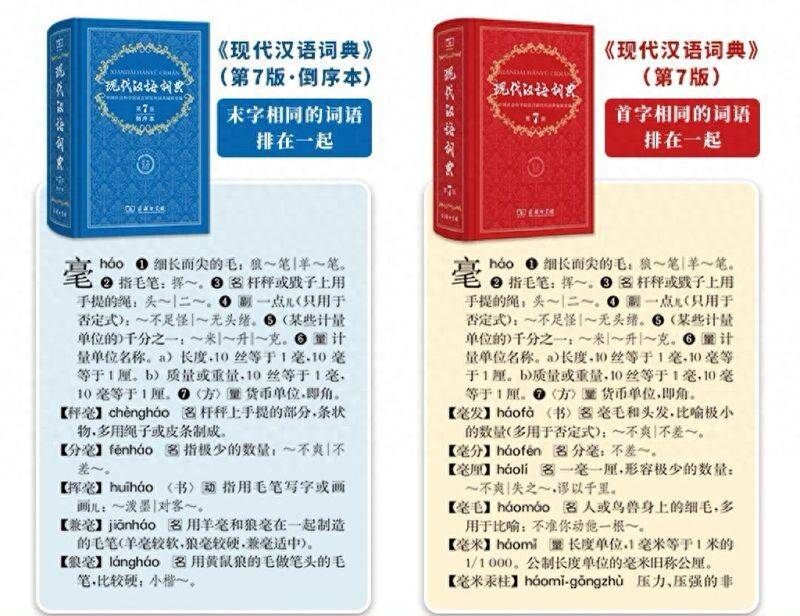
The organization of the modern chinese dictionary (version 7 in reverse) and the modern chinese dictionary (version 7). Bookshop for business
"reverse operation"
What's the reverse? How is it different from the conventional version of the modern chinese dictionary
The modern mandarin dictionary (version 7 in reverse) is responsible for the editing of chen yuqing's introduction, which is also known as the original version, organized by the word “first word”, and the latter by the word “last word”. This logical shift in organization has radically changed the way the dictionary is retrieved and the experience of its use。
For example, in the 7th edition of the modern mandarin dictionary, the phrase “the subject” “the subject” is the word “the subject”。
In the reverse version, the same reference to the word “problem” shows another picture: “the answer” “the subject” “the proposition” “the question” “the subject” is the end of the word “the subject”。
"from the first word to the last word, the language logic has changed." chen yuqing explains with a professional term, “temporals”, which begins with the first word of the word and ends with the latter. In linguistics, the combination of words that have the same end words and are semantically linked forms a `symmetry'.”
She gave a vivid example: the term “flower” ended in chinese. In the inverted organization, plant-like terms such as “orchids” “chrysanctues” “polls” and metaphorical terms such as “snowflowers” “shows” “pyrotechnics” converge under the word “flowers”。
“in the original, the words are scattered over different pages and the connection between them is not easy to detect; in the reverse, they are concentrated and clearly visible.” chen yuqing indicated that, in the inverted text, the reader would see a noun that ends with a "sub" word, an adjective that ends with a "un" word, a verb that ends with a "involved" word, etc., which naturally constitutes a "symological family"。
Research in modern chinese vocabulary generally confirms that the more formal compound of the “pre-modified core” structure accounts for the vast majority of modern chinese vocabulary. That is the value of the reverse。
Chen yuqing is a further example: “fire red” means “red as fire” and the core is “red”. For example, the words “blue sky” and “black cloud” and “green water” are the formal composites of the prefix, the prefix being the qualifying component and the later being the core lingurin。
“the reverse text reflects a web-based thinking structure, and when we look at words, we see more than words. And we can start with a phrase, and we can see a set of vivid chinese expressions, and we can explore a complete "syllable family." she said。
It can be said that this “reverse operation” in the dictionary world has really enabled us to move from “poor” to “rich”。
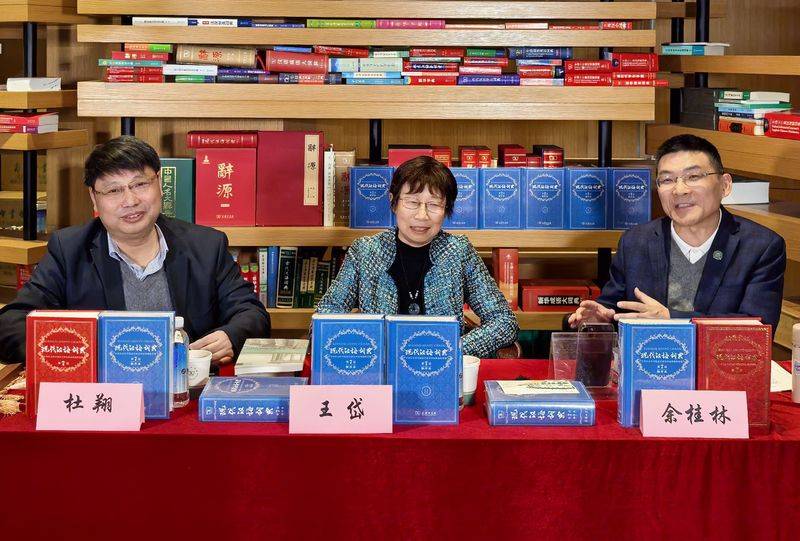
In march 2026, a double-tension book was published in the commercial print library. Bookshop for business
To whom
What can it do for us when walking backwards becomes a new perspective
The business bookshop offers four orientations: “multifacers” for students, “assistors” for writing in public, “hand hands” for poetry, and “helpers” for the study of vocabulary。
Chen yuqing believes that the reverse version is not only a search tool, but also a “language assistant”. For students, writing comes with “poor words” and with the same words at the end, the inspiration comes; for civil servants, writing is terminologically well-articulated, with the reverse text providing a rich and normative choice; for poets, the reverse book has been dedicated to the hymns, which facilitate the search for appropriate rhymes, which is equivalent to a modern hymn; for linguistic researchers, the latter provides an entirely new perspective, which helps to examine the structure of the vocabulary, relationships within the vocabulary, etc。
Senior and senior teacher at 80th high school, beijing from 35 years of teaching, this was the first time she had had contact with the dictionary, which was used in the sense that it was of great benefit to both students and teachers。
“the dictionary focuses on the understanding of a single word, and through the suffixing of the dictionary, students are able to visualize the semantic connection and pattern of the vocabulary, helping them to adapt the vocabulary quickly, achieve `one, one, one, one' and multiply the efficiency of memory.” wang di said. For example, under the word “pretty” in the reverse text, in addition to “pretty”, adjectives such as “pretty, gorgeous, beautiful, succulent, succulent” are included; under the word “heavy”, the word “sweet” is used to describe custom, the word “intoxicate”, the word “sweet”, the word “sweet”, the word “sweet”, the word “sweet”, the word “sweet”, the word “sweet”, the word “sweet”, the word “sweet”, the word “sweet”, the word “sweet”, the word “sweet”, the word “swealth”, the word “swealth”, and so on。
In addition, students can learn synonyms, synonyms, antiphrases and synonyms in reverse in their language. For example, under the word “incorporation”, “incorporation, melting, melting” and “degradation, decomposition” are synonymous, while under “incorporation, internalization”, “enhanced, weakened”, the word “incorporate”, the word “lightening, greening, beautification” is the same word. The concentration of these words in the dictionary has greatly increased the efficiency of the examination。
“more interestingly, the combination of the original and the inverted text can foster a free-minded and linguistic expression. When you know how a word begins, and how it ends, you understand it more firmly." wang tai said。
A lot of poets like the reverse. A member of the chinese writers' association, zou hua liang, has over the years created a large number of poems and lyrics, and he believes that the original is a “search dictionary”, more like a “read dictionary”。
"the reverse is like a beautiful maze. There are times when poetry rhymes, and it is impossible to find the right end words, and the reverse text quickly matches the words of the same hymns, the same symmetry and the same syllables, making poetry more open and precise.” according to ryu, the reverse sequence has transformed the poet from a “passive search for rhyme” to a “active rhyme”。
Moreover, chen yuqing believes that the rearrangement of the dictionary has made the cultural and encyclopedia more visible and has facilitated easier and more systematic access to humanities and scientific and technological knowledge. For example, the term “risk” combines such insurance as “property insurance”, “labour insurance”, “life insurance”, “social insurance”, and the word “micro” has the word “ms”, “ms”, “ms”, “ms”, “ms”, “ms”, “ms” and so on, and brings together the basic knowledge of hair pens。
"the rearrangement is like opening another door for us. I've got a lot of surprises in use, and i've been finding out about its treasure function. It is not only a search for words, but also a reading, cultural and encyclopedia. It is a tool that can be turned over at any time。
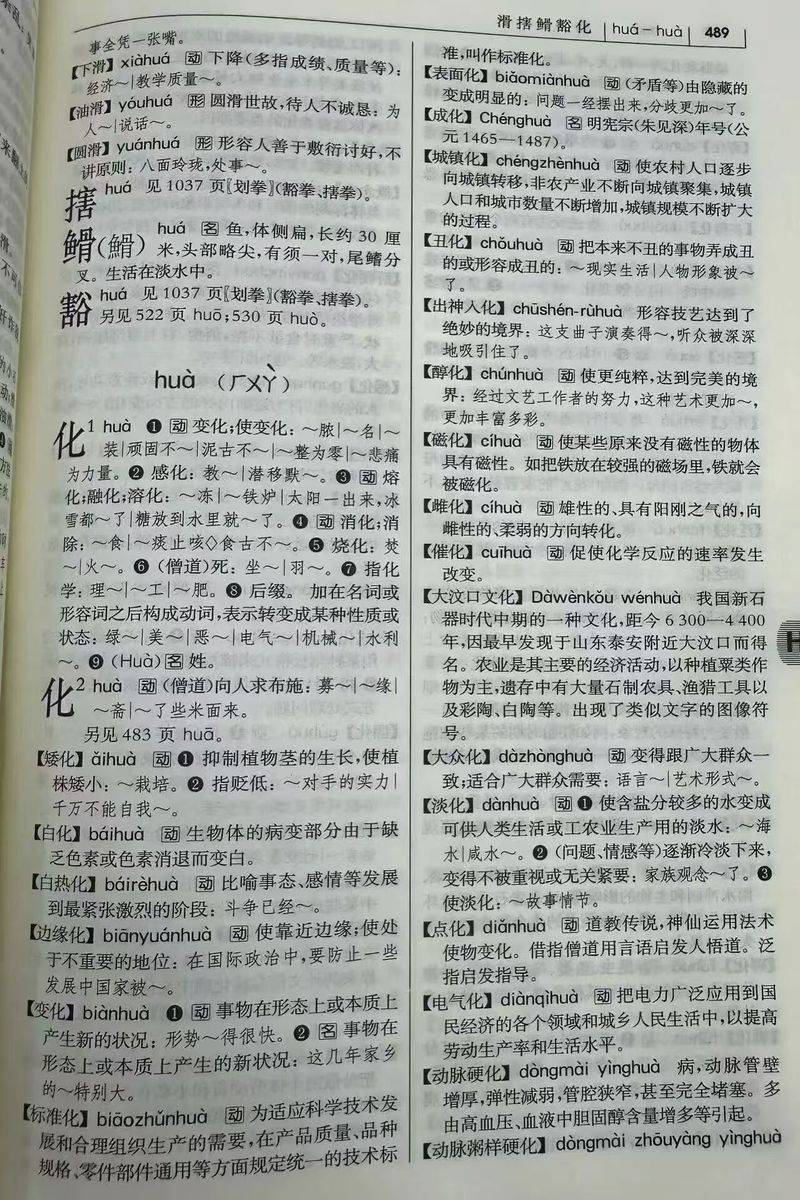
The modern mandarin dictionary, 7th ed. Bookshop for business
Language archives of the times
In fact, the modern chinese dictionary is not the first time that it has “reversely walked”. As far back as the 1980s, the literary studies magazine published an academic paper on the reverse dictionary. Since then, the dictionaries of the institute of linguistic studies of the chinese academy of social sciences have been compiled in accordance with the needs of society, using the 2nd edition of the modern chinese dictionary (published in 1983) as the basis, in a hymn format, and have been completed in the reverse modern chinese dictionary, published in 1987 by the commercial printing library, which has been running for nearly 40 years。
“the linguistic life of our people has changed dramatically over the decades, but the revision of the reverse text has not kept pace. The editorial office of the dictionary regularly receives letters from readers asking about the reverses. In 2018, the compilation of the modern mandarin dictionary (version 7 in reverse) was formally set up, taking into account the fact that reverse dictionaries still have considerable social needs. After eight years of hard work, this book has been expected by its readers for almost 40 years.” chen yuqing said。
The project team has done a great deal of work in processing the detailed presentation. For example, the word “head” at the end of the sentence is numerous and the reverse text specifically distinguishes the word “head” as a suffix from the word “head”. This requires an analysis of the relationship between terms, such as “head” in “caps, cages, buns, pillows”, which is a synonym and cannot be placed under “head” in the suffix by reading. A similar treatment is costly。
The modern mandarin dictionary has been in existence for 70 years now. In 1956, the state council issued a directive on the promotion of mandarin, requesting the institute of languages of the chinese academy of sciences to compile a medium-sized modern chinese dictionary with the objective of defining terminology norms. The first edition was officially published in 1978, with 56,000 words, and the first system established modern chinese language speech, font and vocabulary norms。
Today, 70 years later, the modern mandarin dictionary has cumulatively distributed over 70 million copies, one of the most basic language tools for our native-language learners。
The life force of the speech is to keep up with the times and keep changing. In 70 years, the modern chinese dictionary was updated in seven editions: in 1983, the second edition was fine-tuned; in 1996, the third edition, a substantial addition was made; in 2005, the fifth edition, a full-scale description of the term; in 2012, the sixth edition, an addition of nearly 3,000 words and an additional illustration; and in 2016, the seventh edition, more than 69,000 words and more than 400 new words。
“the modern mandarin dictionary has kept pace with the times, recording new words and removing old ones, not only recording the development of chinese vocabulary but also reflecting the changing times. For example, the word "contributive" was included in the sixth edition, while the seventh edition included "internet+" "new media" "artemisin" and so on. Words are received with strict considerations and not all new words are received individually, but rather to look at the stability of their usage.” chen yuqing said。
Every revision of the modern chinese dictionary, from “powerful” to “internet+”, from “artemisin” to “new media”, is documenting changes in chinese language life。
The publication of the inverted version added a new perspective to the era, reshaping our understanding of languages。
Chen yuqing quotes ludwig wittgenstein, author of logical philosophy: “the boundaries of language are the borders of the world”
“this phrase reveals the relationship between language and thought and perception. The inverted and sequenced words in the dictionary provide different perspectives and reflect different ways of thinking.” she said。
From the word "first" to the word "end", from the point of order to the point of backwards, what changes is not just the way we check, but the way we understand chinese. The next time you write a cardboard, you might want to try "go backwards" and see a different view。