The fine-tuning operation of freight rules is becoming the core competitiveness of electrical platforms. The paper system combusts the five broad design principles, ranging from priority layering and dimension binding to minimization, and dismantles in detail the path to rule-system set-up, system process design and core functional modules, revealing how best to balance operational strategy with cost-effectiveness through freight rules。

Core design principle 1. Priority hierarchy
The establishment of a system for calculating freight costs in which “special rules take precedence over general rules”, with a hierarchy of rules according to the weight given to the operation of the business, the pre-eminence of high-priority rules triggers and avoids conflict of rules, while at the same time safeguarding the precision of the operational strategy and the general rules as a standard frame of reference。
2. Principles of dimensional binding
All freight rules bind the core dimensions of the business (e. G., user, regional, category, etc.) to ensure that the rules match the depth of logistics, trading scenes, avoid cross-dimensional error triggers and enhance the precision of the rules。
3. Minimization principles
Incremental design based on the original core chain of freight calculations, with the addition of special rule query nodes, without subverting the original generic process, reducing development costs and system up-to-line risks and ensuring smooth operation of the original operation。
4. Efficient operating principles
The design of standardized batch operating capabilities and precise search functions around the core needs of the operational end batch configuration, quick search, easy management, lower manual operating costs and increase the efficiency of rule configuration。
5. Full chain traceability principle
Achieving log management for all rule configuration operations, covering operational actions, operating data, operators, operating time, supporting precision queries, ensuring operational safety and rapid problem screening。
Unable to display this outside the flybook document
Ii. Transport rule structure methodological methodology 1
(1) rules stratification logic
Based on operational fine-tuning needs and the weight of the business landscape, the freight rules are divided into two tiers: special freight rules and common freight rules, which are operational tailor-made tactical services, and general rules that are the bottom of the conventional trading landscape。
(2) priority-setting methodology
Logically sequenced according to the “operational strategy priority” >spectrum speciality > generic piping base”, typical priority reference (which can be adjusted to operational needs):
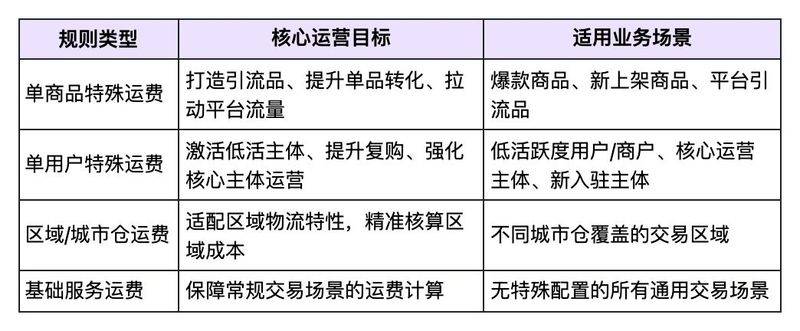
Single-category/commodity special freight rules > single-user special freight rules > regional/urban warehouse freight rules > basic services municipal freight rules
(3) core design elements
2. Matching of applicable scenarios
In line with the operational objectives of the operation, the “rules-tactical precision” is achieved by matching the applicable scenarios at different levels of rules, typically by:
General framework for system process design
Using as a core starting point the “doorshop/user list (including additional purchase) triggers freight”, a serial verification process using “pre-special rule query, followed by general rule bottom” is used to ensure that the rules trigger precision, process is not redundant, and are adapted to all electrician freight calculation scenarios。
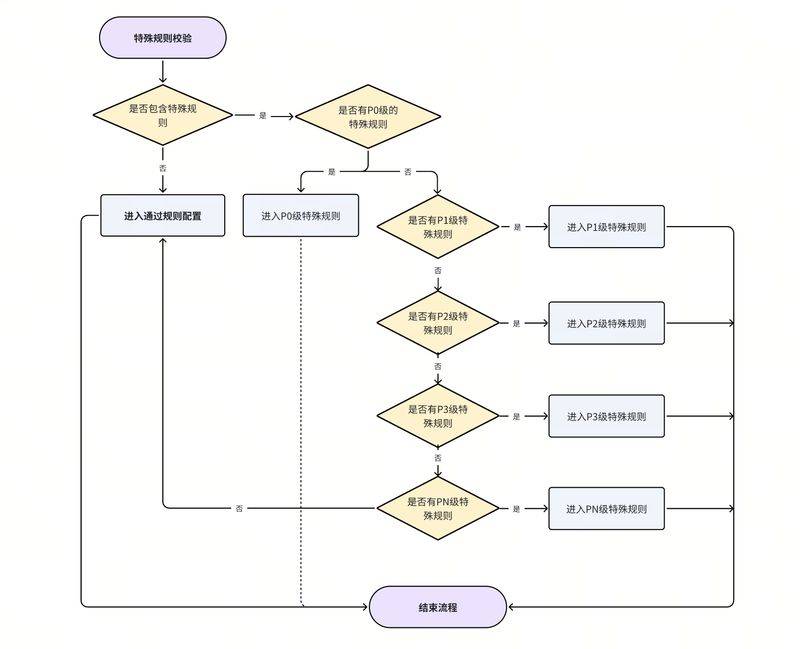
General process steps (s-e) special rules level i validation: ask whether the current subcategory/commodity is allocated a special freight rule (which binds the core business dimension) or, if so, enforces the rule and terminates the calculation; otherwise, enters the next step; special rules level ii validation: ask if the current next user/businesser has a special freight rule (which binds the core business dimension) and, if so, enforces the rule and closes the calculation; otherwise, enters the next step; special scene rules verify: ask if there is a special logistics scenario for freight rules, and if so, enforce the rule and end the calculation; otherwise, move to the next step; generic rules go to the bottom: if no such special rule exists, direct implementation of the generic freight calculation and completion of the process. All validation nodes of the core elements of the process design are based on a double validation of the "core business dimension (e. G., special areas) + rule subject (commodity/user)" to ensure that the rules are accurately activated; each node is judged only by the "programming rules" that terminates the process, avoids invalid calculations and increases the speed of the system's response; and maintains the calculation logic of the original generic rules by adding an incremental node only to achieve seamless compatibility with the original system. Iv. Methodology for the design of the core functional modules
The five core functional modules are designed around the full life cycle of the freight rules “assigning-managing-enforcement-retroactive”, with the modules synergizing each other to achieve fine-tuned management and efficient operation of the rules, and the module design needs to fit the operational needs of the operational end, taking into account efficiency and ease of use。
1. Rules configuration access design
(1) principle of integration of access
Harmonizing all freight rules entry points, avoiding the cumbersome operation caused by the dispersion of multiple ports, and creating sub-entry points according to the subject of the rules (commodity/user) to achieve “classification, uniform management”。
(2) core design elements

2. Rules configuration list management
As the central page of the rules management, the centralization, quick retrieval and ease of operation of all special freight rules is achieved, and the design needs to take into account the “information presentation integrity” and “operational ease”。
(1) basic information design
(2) design for retrieval and presentation
(3) operational functionality design
3. Batch import/export functional design
To address the volume operating needs of multiple subjects (commodity/user), to design standardized batch operating capabilities and to achieve rapid batch configuration of rules and data reconciliation, the core is standardized templates and rigorous validation logic。
(1) standardized template design
(2) batch import design
Import limits: sets the maximum number of bars to be imported single times, matching the system to the actual needs of the operation; validation logic: perform a triple check automatically before import without giving a clear hint to avoid an invalid configuration:
(3) batch export design
Supports the export of full volume rule data and core dimension id data, matching operational end data reconciliation with secondary editing requirements。
4. Distribution route linkage management
Delivery lines (e. G., procurement warehouse-distribution warehouse) are the core binding dimensions of the freight rules, and modular designs need to be configured, bound and managed to ensure that the rules match the logistics landscape accurately。
(1) initialization of lines
Configure default lines for core logistics scenarios, auto-initiating systems without manual configuration and lowering operational thresholds
(2) line custom configuration
(3) design of circuits and rules
Operational logs and computational rules optimization
(1) operational log module design
(2) optimization of the rules for calculating freight
Clusion of steps: clarifying business performance objectives, combing the core business landscape, setting the hierarchy of rules and setting priorities; process design: based on the original freight calculation process, adding a new special rule validation node to complete the process design and review; functional development: developing rules configuration, management, batch operations, logs, etc., as required by the core functional module, with a focus on ensuring that rules are accurately activated and volume operating efficiency; test validation: full testing of all rule scenarios, including rules triggers, freight calculation, bulk import/export, logback, etc., to ensure non-rule conflict and calculation errors; greyscale upper line: first, collecting operational-end feedback and optimizing operational experience in small-scale business landscapes; full-scale: once the greyscale certification has been completed, full-scale go-live functionality is provided, along with operational operations manuals and end-of-service training to ensure smooth operations. 2. Optimizing the data-based operation of the subsequent iterative period: the introduction of a new freight rule-based effects analysis module, data such as the main transformation, order volume, buy-back rate after the entry into force of the statistical rules, to provide data support for operational strategy adjustments; the allocation of time-bound rules: the time allocation function of the new rule to take effect/failure, to support time-limited freight-concentrating activities and to enrich the operation; and the expansion of the rule-based scene: based on the existing core business dimensions, special freight rules that extend the dimensions of regions, time, user class, etc., support more sophisticated operational strategies; multi-end adaptation: ensure that the freight rules are accurate at all transactional ends, such as small programs, app, pc, etc., and achieve full-end experience consistency. Core value extraction
This fine-tuned approach to the design of operating rules, centred on the development of a “configurable, operational and scalable” system of freight rules for electrical platforms, achieving three core values:
At the operational level: build a fine-tuned freight operational capability for the two dimensions of “commodity/class+user” to support customized operational strategies to achieve core business objectives such as piloting, activation and repurchase, while reducing labour costs through bulk operations and increasing operational efficiency; at the system level: achieve uniform port management of freight rules, address problems of port fragmentation, conflict of rules, computational deviations, improve system management efficiency and stability, while applying the principle of minimal adaptation, reduce development and up-line costs; at the operational level: provide the basis for subsequent business outreach, regional operations and fine-tuning operations of the platform, while achieving a balance between logistics costs and operational gains through accurate freight accounting。