This paper is for consumer science only and does not constitute a purchase proposal, all of which is shared with industry common sense and has no advertising intent。
Most people with glasses have had these problems: there are two pairs of glasses in the counter, one 300, one 2,000, which looks like it, and they can see it. Why is it seven times worse? Is it expensive to collect an iq tax, or is it cheap to steal real food

We'll talk about it in plain language today, from mirrors, frames, services to brand premiums, one floor open, and you'll never be fooled by the price difference again。
First-time breakout zone: price differential iq tax with “cost structure different” at its core
Many people's first reaction is that “the expensive is the pit man”, which is not exactly. The price of glasses has never been as simple as the "scope + frame" but has been determined by the cost of raw materials, process costs, brand premiums, door shop operations and light services. The difference between 300 and 2000 is essentially a difference between the inputs of these links, not “the more expensive the better”, but also “the cheaper the better”。
A set of publicly available cost data for the industry (for example, general near-sighted glasses):
• 300-dollar lenses: mirrors are mostly the base of national production (1. 56. 61 refraction rate) at a cost of approximately $30-50; mirrors are general alloys/tr90 at a cost of about $20-40; real profit space is limited after rental, manual and operational sharing
• 2000 dollar-price lenses: the lens is mostly imported high-end money (1. 67/174 high refraction rate, blue light/variant colour/progressive multi-focus) at a cost of approximately $200-400; the lens is a titanium alloy/pure titanium/light luxury brand price of approximately $150-300; plus brand premium, high-end store operation, refined services, and overall pricing is naturally higher。
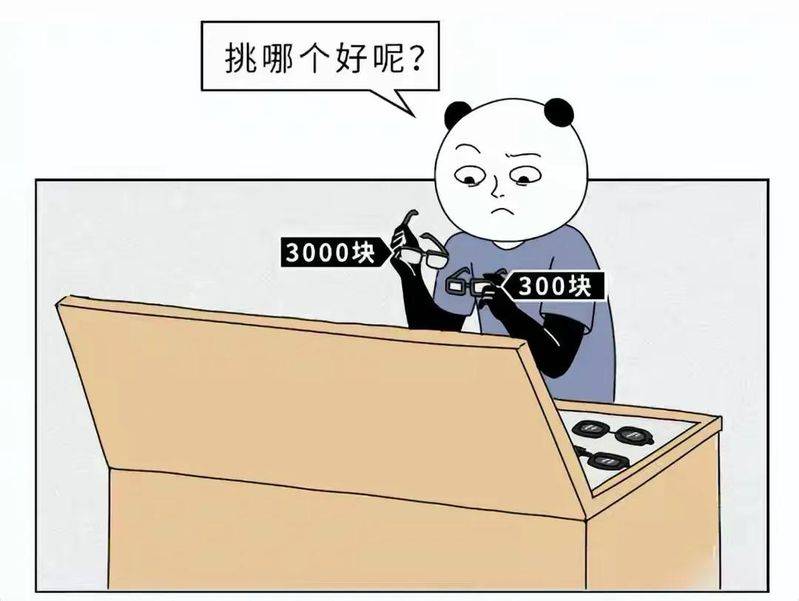
In other words, 300 glasses are “just enough” and 2,000 glasses are “seeking experience and quality”, the core difference between which is hidden in every detail。
Ii. Mirrors: a hard-priced battle, a penny and a penny
The lenses are the “heart” of the glasses and the largest difference between 300 and 2000. Let's say it's four dimensions: refraction rate, material, function, process。
1. Refraction rate: the higher the degree, the more visible the difference
The refraction rate is simply “the thinness of the lens”, the higher the refraction rate, the thinner and lighter the lens, the more comfortable it is to wear it。
• 300-bit: lenses with a basic 1. 56 or 1. 61 refraction rate, suitable for low near-sightedness of 300-600 degrees. If the degree exceeds 800 degrees, 1. 56 lenses will be thicker than the bottom of a bottle, crushing the nose, grinding the cheeks and making them more visible
• 2000 dollar: most are mirrors of 1. 67 or 1. 74 high refraction rate, as well as 800 degrees, 1. 74 lenses close to 30 per cent and 20 per cent less than 1. 56, which are not tiring for one day。
By way of example, the same 800 degrees of near-sightedness, the edge of the 1. 56 lens can reach 8 mm thick, while the 1. 74 lenses are about 5 mm thick, look like low near-sighted glasses, and look and comfort differently。
2. Material and perceivability: expensive lenses, looking clearer
• 300-dollar position: mostly common resin lenses with a light rate of about 90-92 per cent, which tends to be slightly yellow, mist, especially driving at night, and prone to dizziness
• 2000 dollar position: mostly for the import of high-perfort resin or mr-series materials, the perforation rate is 98-99 per cent, close to the natural vision of the human eye, better access to things, and when driving at night, the dazzling of street lights and carlights is significantly reduced and the eyes are less tired。
In addition, the “abbey number” of high-end lenses (an indicator of the clarity of mirror imaging) is higher, and sightings do not deform, and rainbow lines do not appear on the edge, and are more comfortable to wear over time。
Functional layer: expensive lenses, a “multifunctional one”
Now the lens is not "just able to see" anymore, but it's a combination of practical features:
• 300-dollar position: a maximum of base blue light, many of which are “colour blue light” and viewing things yellow may also affect screen colour
• 2000 dollar: multiple functions can be performed “blue light + uv + fatigue + water plume” and are “membracing techniques” that do not affect light penetration. For example, tsai's drilled cubic membranes, and the retinad membrane, not only prevent scratching and grinding, but also make it easier to wipe them with fingerprints, oil stains and more easily。
There are also transchromatic lenses, progressive multi-focus lenses (which are suitable for medium-sized and older people to look closer), which are largely unavailable at 300-dollar and, if any, of much lower quality。
4. Crafts and goods control: expensive lenses, smaller errors
• 300 bits: mostly bulk production, relatively liberal standards of product control, lens margin error, dispersive axis error, which may be within ±2 degrees, but may be dizzy for sensitive populations, although meeting national standards
• 2000 dollar: using precision grinders and digitized processing, the error can be contained within ±0. 5 degrees and each lens is subject to multiple tests to ensure optical stability. For example, personalized lenses, based on the visual path, are finely sharpened, more adhesive and more visual。
Iii. Lens: more than a shelf, the key to comfort and durability
Many people think that the frame is "just a good-looking one," but the material, the process of the frame directly determines your experience with glasses and is an important source of poor prices。
Material: from “pressing” to “light”
• 300-bit: mostly ordinary alloys, tr90 or plastic boxes. The normal alloy frame is heavy and long-duration nose-pressed, red-marked and rusty; the tr90 frame, although light, is easily deformed, is loose in a year and a half and requires frequent adjustments
• 2000 dollar: mostly pure titanium, beta titanium, titanium alloy or high-end frame. Pure titanium frames are as low as 8-10g, half as normal alloy frames, are not tired for a day and are corrosive, insensitive, and do not deformed for five to eight years; high-end frame frames are delicate, of good quality, difficult to fade, and appear to be more hierarchical。
2. Processes and designs: expensive frames, hidden in details
• 300 u. S. Places: welds are rough, chains are loose, nose butts are ordinary rubber, long yellow, hard, and dirt is easy to hide
• 2000 dollar: the introduction of seamless welding, laser engraving, smooth and durable chains, nostrils are silicone or memory material, are attached to a nostrils, are not easy to drop and can be replaced free of charge; many light luxurious brand frames are also designed for anthroponomics, adjusted for face-based radians and are more compatible and difficult to remove。
Brand premium: you bought more than a shelf, but also a sense of identity
For example, the frames of raepen, corz, guzz, have their own brand premium, the same pure titanium, branded and two to three times the price. This part of the premium, which is for brand design, taste and social attributes, is not an “iq tax”, but it is not necessary to pay for this part for people who seek to use it。
Iv. Doors and services: 300 for “glasses” and 2,000 for “eye health management”
Many ignore the fact that the price of glasses also includes services such as light testing, processing and after-sales, which is the most easily underestimated gap。
Photocopy: 300 for "measurements" and 2,000 for "personal test light"
• 300-dollar position: most of the light tests are “computer light test + plugin test”, completed in 10 minutes, only close-sighted, dispersible, without taking into account your eye habits, the angles on which you wear and the pupil's high pupil distance, and the glasses may be “readable but worn long enough”
• 2000 dollar: it takes 30 to 60 minutes to conduct an “integrated photo+visual examination”, not only to measure the measure, but also to check your ability to regulate, aggregate function, eye balance, to fine-tune the parameters according to your face, wear habits, and even to make “a gradual multi-focus customization” of “personalized pupils” to make the glasses more relevant to your eye。
For example, those who regularly look at computers, the high-end light test suggests “lighting down” to reduce near fatigue; those who drive the car adjust the mirror optical centre to make the night vision clearer。
Processing and after sale: 300 for “one-size-fits-all” and 2,000 for “life-long maintenance”
• 300-bit: the processing is mostly semi-automatic, with a general accuracy, with a “seven-day swap” after sale, exceeding the time, and fees for the adjustment of frames and the replacement of nostrils
• 2000 dollar: use of fully automated digitized processing equipment, with greater precision, after sale, “life-long maintenance” — free-of-charge mirror adjustment, replacement of nostrils, cleaning, even scratching of mirrors, with discounts for new ones。
For example, you've been wearing it for a year, you've lost your frame, you'll get a free adjustment at the high end store, you'll get a yellow nostrils, you'll get a free change。
3. Operating costs of the door shop: the better the location, the higher the price
The same lenses and frames are available at twice the price at the malls and community shops. These costs are added to the price of glasses when there are high rents, renovations and large numbers of service workers in the malls; the cost of renting small community shops is low, running costs are low and prices are naturally more pro-people。
Five, how do you choose? Three practical suggestions
After all this, should we choose 300 or 2,000? In fact, there is no absolute "good" but "suitable" for three practical suggestions:
1. Visuality and demand: low near-sightedness does not require high-end pursuit
• if you are a low near-sighted person below 300 degrees, the daily course, the work, the 300-500-dollar national lens + the normal frame is sufficient, fully meets the needs and there is no need to spend the money
• if you have a high near-sighted view of more than 600 degrees, or if you regularly look at computers and drive a car, choose a medium-high-end lens of 1000-1,500 yuan (e. G., national rate of 1. 67/174 + blue light), light, thin, comfortable and long-term eye-friendly
• if you are a middle-aged person, need a progressive multi-focus lens, or have a special visual need, the 2,000-dollar high-end customized lens is more cost-effective, because the normal lens does not meet your needs。
Avoiding the brand trap and giving priority to the parameters
Do not be fooled by "import brand" "light luxurious frame" and focus on these parameters with glasses:
• mirror refraction rate: based on degrees, low near-sighted 1. 56. 61 is sufficient and high-sighted 1. 67/1. 74
• mirror material: priority is given to mr-8/mr-10, with high perforation and millability
• functions: blue light, ultraviolet light selected according to needs and there is no need to pursue “full functionality”
• mirror material: the pursuit of light, durable and pure titanium/beta titanium, the pursuit of pigmentary selection of high-end plates and the use of regular tr90。
For example, it's also a “blue-proof lens”, homemade moon, connett, and imported zaius, with little difference in base money, with a lower price of half and a higher value for sex。
Find the right channels, save half the money
• community glasses store: highest value for money, low rent, transparent frame prices for mirrors, suitable for those who seek them
• online mirrors: many brands now have online flagship shops, such as kyoto, the official glasses shop, the same lens frame, which is 30-50 per cent cheaper than the line, and can be matched with spectrometric glasses if you have accurate photometric data
• business fairs: more specialized services are available to people who are suitable for experience and after sale, such as first-time glasses, high-profile, personalized customizations。
At the end: the essence of the glasses is “the best fit for oneself”
What's the difference between $300 and $2,000 glasses? It's the difference between foundation and quality:
• 300 glasses that meet the basic need for “reading things well” and are of high value and suitable for most people
• the 2,000-dollar lens is based on the search for lighter, thinner, more comfortable, more durable, better service and experience for people with special needs or quality。
No one is “higher” than anyone, and no “iq tax” says that the key is to know what your needs are and spend it on a knife。
Next time you have glasses, don't be scared of prices, don't be blind, think about your own measurements, use your eyes, then look at the parameters, choose the channels, and you'll be able to match the right and cost-effective glasses。
I want to talk to you later:
How much did you get for the most expensive glasses? What do you think is the best price for glasses? You are welcome to share your experiences and views in the comment section。
Focus on me, replying to the key word, "specify the hole" , i put together the latest mirror parameters control table, the frame mass selection guide, and the online sub-spectrum-saving techniques into a complete graphic manual, which i will share with you free of charge, so that next time you will have glasses, never again, and at the lowest cost the most appropriate glasses。