The gif animation has been a popular material in the operation of the website, in the construction of stations from the media and in the layout of the text. Dynamic gif is more powerful than static pictures, able to visualize operating processes, product details, demonstration steps, and effectively raise page dynamics and lower user reading thresholds. However, it is easy for many operators to ignore the problem: the unoptimized original gif is generally oversized, single-portrait maps are in short order, the server bandwidth is heavily occupied and the loading speed of the web site is slowed down. For website operators, the rational use of the gif compression tool to optimize animation material is one of the least costly and most effective ways to optimize the web page。

I. Negative impact of uncompressed gif on websites
Many upload the gif directly using the original document without any compression, which appears to be intact, while many conceal the dangers. The gif format itself supports only a maximum of 256 colours, with raw materials often containing a large amount of redundancies, blank frames and redundant pixels, which are not valid data that will increase the volume of the file。
First, the bulk of the gif will increase the loading time of the web page, and the browser will need to consume more traffic to download the animation, especially in the context of the mobile end weak web; second, uncompressed kinetic maps will consume server resources, increase the consumption of bandwidth on the site and increase long-term operating costs; finally, slow loading can affect the capture experience of the search engine and indirectly reduce the score of the web site seo, leading to a decline in ranking。
In addition to this, some platforms have document upload restrictions, and gifs above the specified size cannot be uploaded, or are then forced to be re-compressed by the platform after uploading, resulting in irreversible problems such as ambiguity, colour blocks, and distortion。
Ii. Optimization of gif compression tools (business must understand)
The formal gif compression tool is not a crude downgrading, but rather relies on professional algorithm intelligence to remove invalid data. The mainstream compression tool uses the lzw no-lose compression algorithm, using a framework differential analysis, to retain only part of the image change, automatically delete duplicate frames, blank pixels, redundancies, and reduce sizes without seeing a physical change。
The common optimisation logic consists of three points: first, to streamline the palette and to reduce unnecessary colours to reasonable ranges; second, optimize frame structures, remove static duplicate frames, and retain key dynamic frames; third, do not zoom in pixels, and reduce invalid pixel occupation by removing excess margins。
Iii. How to correctly use the gif compression tool for website operations
1 opens the "gif tool" - "gif compression" feature portal for gif images uploaded
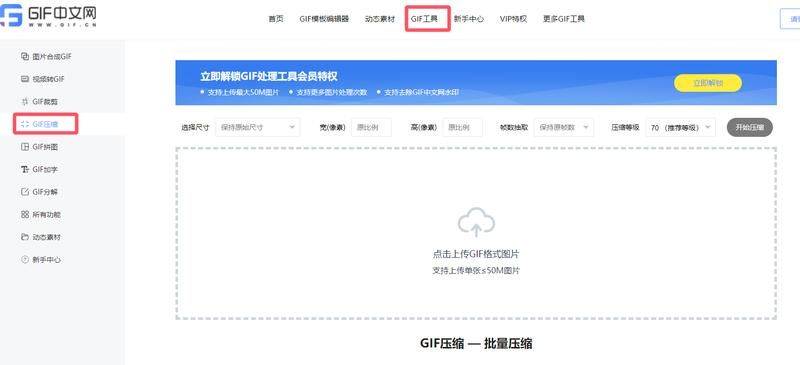
2 dimensions are custom, then enter width and height, select compression level or frame extraction, click " start compression"

3 after the compression is completed, click to see the preview effect, save the picture and finish the download。

Iv. Advantages of website operations following compression of the agglomerations
Using gif compression tools, most animations can be reduced by 40 per cent - 70 per cent - with virtually no paint loss. (b) a significant increase in the speed at which web pages are loaded, which reduces the rate at which users exit; and a reduction in server bandwidth pressure resulting in long-term savings in operating costs; at the same time, it complies with the upload rules of the major platforms and avoids forced compression by the platform leading to the collapse of the painting。
In general, the gif animation is a cross-section of high-quality content on the website, while the gif compression tool is an essential support tool for operations. A few simple steps, without the need for technical expertise and complex software, would allow for the optimization of the aerodynamics, balancing the quality, volume and load speed, and would be a practical means of improving the quality of the website and optimizing user experience at a low cost。