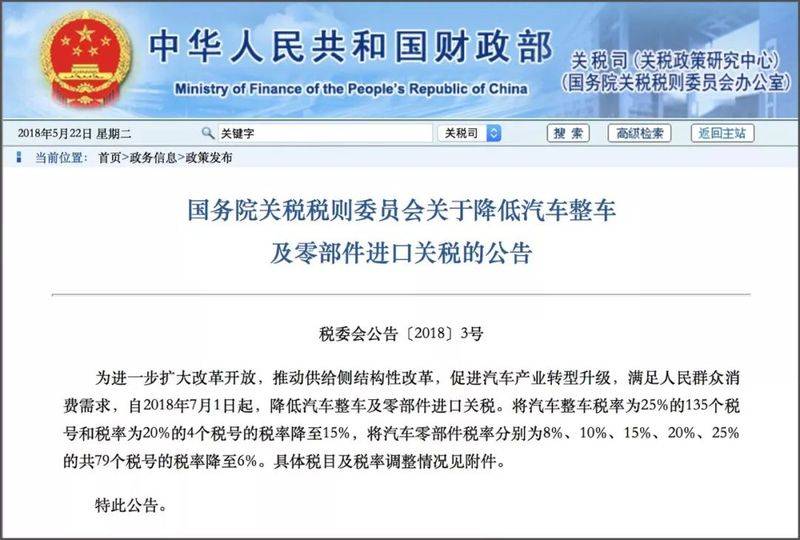
On the afternoon of 22 may, the ministry of finance announced a downward adjustment in the import duties of the car from 25 per cent to 15 per cent, with effect from 1 july。
This was followed by a downward revision of the vat rate from 17 per cent to 16 per cent on 1 may。
I. How much is the price of imported vehicles expected to decrease
Compared to a 1 per cent reduction in vat, this tariff reduction is much larger, at 10 per cent. So what's the theoretical drop in the price? Let's just say the answer: about 8%. In other words, 1 million imported vehicles are expected to be sold at a lower price of 80,000。
How do you figure it out? First, an imported car is subject to three taxes before it reaches consumers: customs duties, excise taxes, value added taxes. The customs rate, combined with these three taxes, is the tax-bearing cost of the vehicle:
Including tax cost = customs + customs + excise tax + value added tax
The formulas for calculating the three main taxes are as follows:
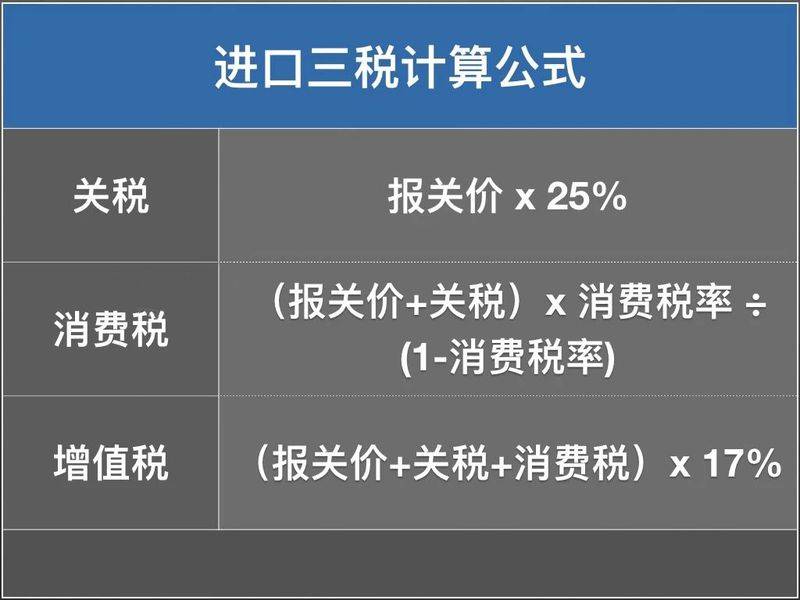
Since the vat rate is fixed at 16 per cent, while the consumer rate fluctuates with the size of the charge, the formula for including the tax cost price changes when tariffs fall from 25 per cent to 15 per cent, as follows:
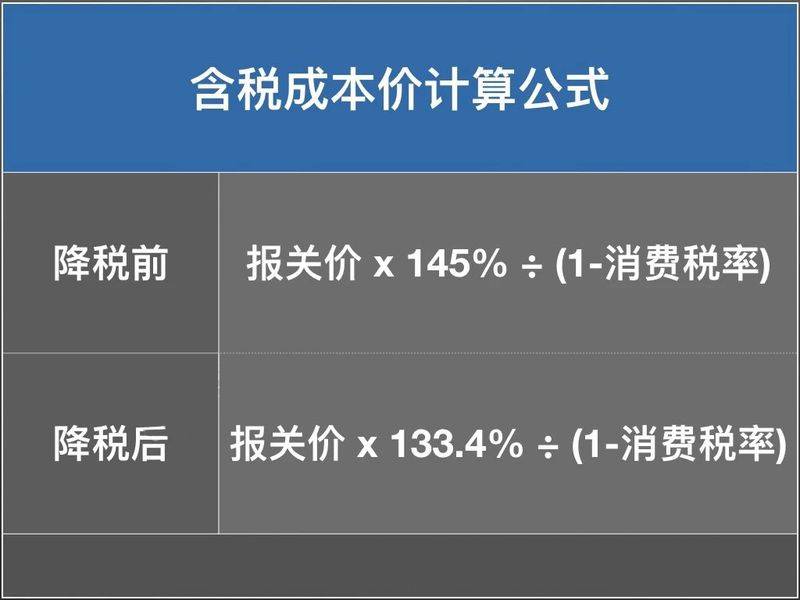
At the new cost, divided by the old cost, 133. 4 was divided by 145, resulting in 0. 92. In other words, the tax-inclusive cost is 92 per cent of the pre-tax rate, so the price of all imported vehicles can theoretically be reduced by 8 per cent。
However, the total cost of automobile imports, in addition to the tax cost, includes miscellaneous items such as financial costs, storage costs, logistics costs, personnel costs, etc., which are not subject to reduced tariffs, so it would be understandable if the final price decrease was less than 8 per cent。
In particular, the vehicles that are now declared customs have been taxed at the old rate, and losses are inevitable if the price is reduced by 8 per cent。
As a result, there will be virtually no applications for customs clearance of imported vehicles until 1 july。
Ii. What is the decrease in the total tax rate on automobile imports
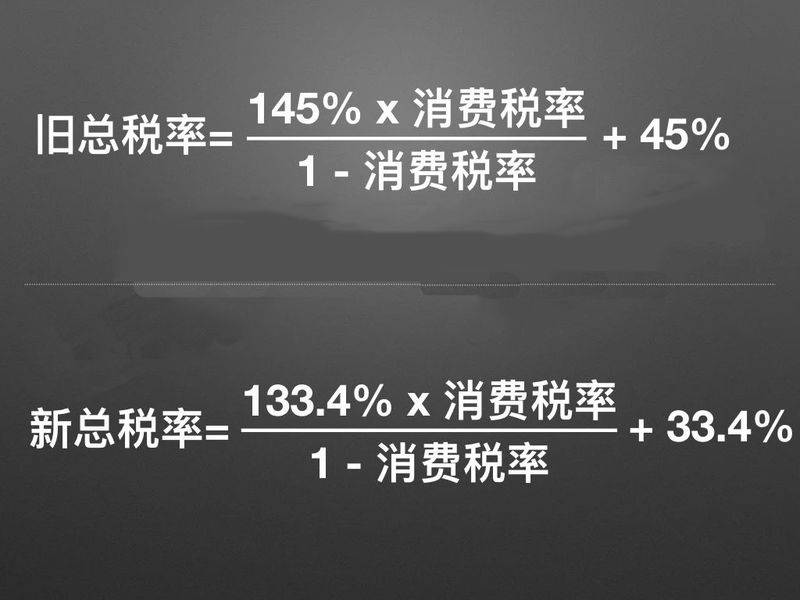
The theoretical decline of 8 per cent is calculated from the perspective of the price of the final sale, and for importers, how much will their total import tariff fall when purchasing cars abroad? Let's look at the formula for calculating the total rate before and after the tariff drop:
With regard to parallel imported vehicles, the price downturn began early this year, with the exception of toyota’s middle east version, where prices were strong because of tight supply, most of the other parallel imported vehicles, whose prices had been consistently low or even partial, had been sold at a loss, including tolls, mercedes gls 450, range rovers, etc., which were already at a loss and were unlikely to fall by another 8 per cent。
As a result, the price of parallel imported vehicles is not expected to be as large as that of medium imported vehicles。
Of course, even an 8 per cent reduction in the official price of the medium-size car would not rule out that the medium-size 4s store would, by narrowing the margin of preference, insulate part of the official price reduction. In the long term, however, the 8 per cent drop in the price of medium-sized imported vehicles can be expected, after all, market competition persists。
Iii. Will there be tax increases on united states-produced imported vehicles
On 4 april, the department of commerce issued a bulletin on the imposition of customs duties on selected imports originating in the united states, stating: “the date of implementation will be subject to the imposition of customs duties by the united states on my goods.”
Does the u. S. Import cars impose customs duties
The possibility is very low. Because this tax reduction means that trade friction is over。
Would the downward revision of tariffs lead to a decline in the starting point of the super-luxury car excise tax (the “luxury tax”) as well? The answer is no。
Because the starting points for luxury taxes are affected only by vat rates and not by tariffs. So the starting point for luxury taxes will still be $1. 58 million, but the cars you'll buy for $1. 5 million in the future will be much higher than before the tax cuts。
Iv. Nationally produced vehicles are not affected
The whole import tariff was reduced, not directly related to the national vehicle. However, this time, in addition to the whole-car import duty, import duties on spare parts decreased, including spare parts at 8 per cent, 10 per cent, 15 per cent, 20 per cent and 25 per cent of a total of 79 tariff numbers, all of which fell to 6 per cent。
As a result, future production costs will be reduced by lower domestic production rates and relatively large imports of domestic vehicles, such as prado, but it is estimated that not many will follow official price increases. Rather, lower future prices for imported vehicles may put pressure on domestically produced vehicles at the same price, leading to a greater margin of preference for domestically produced car terminals。
Some ask how much the price fell
Industry sources noted that the impact of tariff reductions on final car sales prices involved a number of factors, including distributor strategies, supply-demand relationships, etc. The margin of preference varies depending on the size of the brand and the coolness of the car, depending on the outcome of multiple games. As things stand, lower tariffs have a greater impact on the price of luxury cars and a limited impact on the overall market price system. In the long run, however, this crowding effect will be transmitted downward and the industrial chain will eventually be balanced。
However, there is also a reminder from industry that part of the reduced tariffs will not necessarily be fully concessional to consumers. “although tariffs are to be reduced, the cost of importing cars from abroad may increase. As tariffs fall and more customers are interested, the total number of cars produced in foreign markets is largely fixed and the supply is short of demand, and the price will inevitably rise.”
Why is the official down, but the cost of buying a car not necessarily down
Let's pick up a simple chestnut: a car has a model - a car 01, with an official guide price of $300,000 and a terminal discount of $50,000, so that consumers actually buy naked cars for $250,000. Following a $20,000 reduction in official fees, the steering price for car a01 became $280,000, but the terminal discount would not remain at $50,000, but would be reduced to $30,000. Thus, the price of a naked car is $250,000, and there has been no change before. If the concession is reduced to $20,000, the price of a naked car is even $10,000 more than before the official drop. And almost all the cars are preferential at the terminal。
Summary:
So tax reductions are not necessarily price reductions. Tariffs are only one factor influencing prices, depending on car manufacturers, suppliers, wholesalers, and how much will be reduced. They judge the market with a price strategy. A good car girl wants to buy it and enjoy it sooner than by driving on her beloved little wife。