The day of 23 april, when the pavilion was set on fire, it was lifted all over the night, and the wheel rose, with only two words — the lead — as a result of the cross-cutting of the entire white ring。
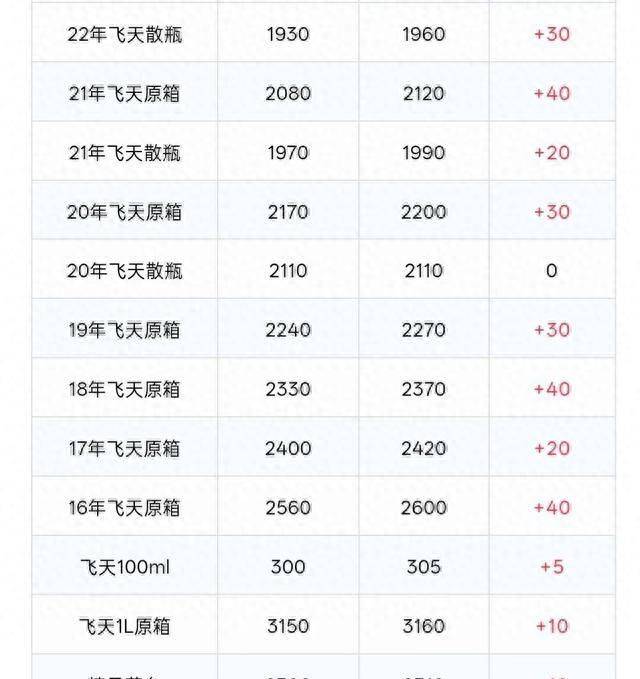
A few days later, the market did not immediately cool off, but instead stabilized its middle and its price layered upwards, accelerating the reordering of the white wine structure。
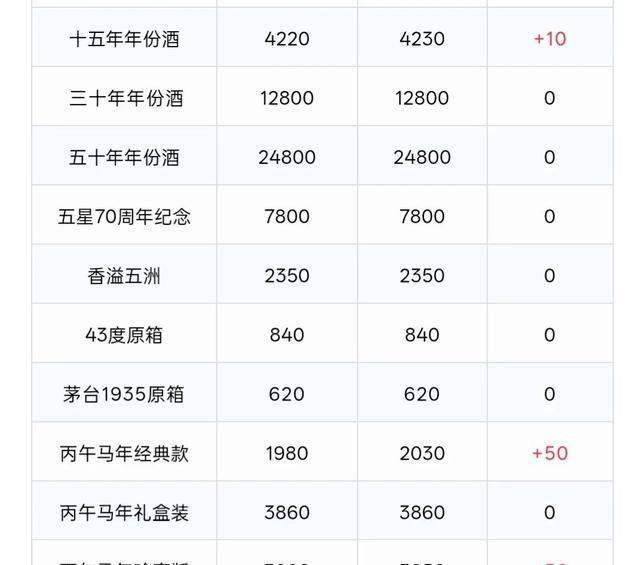
At that moment, it was not a short-term situation, but a new start on the price mechanism。
From that moment on, things didn't happen suddenly. On 31 march, the official price of the sale contract was adjusted from $1169 to $1269 in guizhou, and the retail price of the self-employment system was synchronized from $1499 to $1539, a seemingly mild move that directly triggered the chain reaction of the wholesale chain. At the beginning of april, the dispersed bottles flew at a daily rate of $1730, followed by a roll at $1665。
Such fluctuations are not the result of a fire, but of a real game of supply and demand。
More crucially, the official pricing adjustment, coupled with the discharge of direct sales on the i-max line, is equivalent to crowding out the “float space” of the past layer-encoded channels, reducing the arbitrage of the cow and increasing the visibility of end consumption。
This change marked a new phase of dynamic regulation, not just by slogan, but by market reform。
Beyond flying, the price of old wine is more pronounced. In 23, 22 and 21 years, the price per day jumped by $340, and in some areas it was even 10 per cent higher than the official guidance line。
The reasons for this are straightforward — stocks are tight。
The number of real goods in circulation in the old wine market would have been limited, the demand for consumption would have been released after spring, collections and gifts would have been combined, and the old days would naturally have been worth more than cash。
The scarcity of old alcohol determines greater price elasticity, a typical “stock-driven pattern”: the less expensive, the more expensive it is。
Once again, there has been no loss of heat since the start of the year, and the classic editions, the popular editions and the box are almost on the market。
The official instruction price was $1899, 2499 and $3789 respectively, but the second-tier market peaked at $6899。
The surface is a collection heat drive, and in fact a cultural premium works。
This saloon was designed with a twilight tone and a brilliant style, and these visual elements attached to the wine the quality of “art” and the special symbolism of the year, making the purchase of wine a ritual of participation。
What is even more noteworthy is the anti-nursing effect of this cultural superstition on the whole brand of the mill - it revives the emotional identity of high-end consumer groups。
A bottle of wine closes the relationship between the brand and the people, which is the deep reason why the pail can always sustain the premium。
Twenty-four aromatic wines are amazing。
Lichun still reports $13,000 per bottle, and the gas reserves remain strong。
In the view of many practitioners, such products have long been alienated from the normal consumption logic and have entered more art collections。
Price stability is a sign of high market recognition and the existence of cultural series, which also serves as a support point for the diversified layout of the hut. On or about 20 april, terminal monitoring revealed a small average increase in the production of the huts, but still led to high-end plates, while the fragrances, such as the five grains liquids and the old cellars of the canyon, remained close to $845, in sharp contrast to the price of 818。
This gap is reflected in the market mentality — in an uncertain macro-level environment, where funds tend to flow to certain assets, which is represented by this certainty。
The second key to stability is access to low levels of stocks and a healthy payback rhythm。
Unlike the “pressurized lifting” of the past, the price up this time was based on real deliveries。
The official direct sales outreach, the increase in experience fairs, and the number of orders for i-chats exceeded a million, creating a new ecology: real consumers are bought, and high-facility products are sold. The sum of $17,254 million was collected in 2025 by the maotai battalion, behind which it was the bottom pillar of steady and steady fighting。
Prices naturally have long-term resilience when brands enter “a virtuous cycle of marketing structures”。
From a strategic point of view, the increase can be in three stages。
The first phase is a stimulus period, with official price increases combined with consumption at festivals, and markets are expected to be lit; the second phase is a transitional period, with channel price adjustments, with some regional price differentials flat; and the third phase is a balancing period, with a premium on old and cultural wine and a return to rationality。
But the logic of the three steps is based on “scarceness” — only if there is a market consensus on what is scarce, and only consensus can transmit price signals。
That is why, while the quality of the five grains is not lost, prices are less volatile: it is structurally stable and not dominated by scarcity。
The release of demand for festivals is an important trigger for short-term behaviour, as white wine consumption remains cultural。
Between the two sides, the gift scenes, the party scenes were intense and the gift properties of the huts were consolidated。
On the other hand, when the heat of the collection is rising, especially when middle- and high-value populations are seeking anti-inflation assets, the squawk is an alternative to financial goods。
This trend towards financialization, while risky, does support price spreads in the short term。
However, it cannot be overlooked that regional price differentials and operating costs are still accumulating。
The difference in wholesale prices between cities can be over $60, while transport and storage costs increase, resulting in a slight slowdown in price transmission。
It is expected that these imbalances will be gradually restored, with subsequent enhanced coordination of official channels, thereby making the market more stable。
From a consumer point of view, new wines are suitable for purchase on demand or short-term collections。
Official increases in prices have increased costs, but have also reduced the risk of prior exposure。
Old wine, salivating wine and abdominal wine remain long-lined and the key is to distinguish between channels and authenticity。
Now the pavilion is not bought earlier than it is bought, but who can see far — the rhythm, the logic, the demand。
In the long run, the high-end white wine market is becoming fragmented。
The pao continue to extend along the value chain to the cultural and collection ends, while the fragrances, such as grains and liquids, rely on stable supply plates, which form a distinct gradient。
The market will be more and more adapted to the pattern of a “high-coloured, strong-loved dish”。
The structure is like the white wine industry's thermometer: every swing in the pavilion is reshaping the confidence order throughout the industry。
In conclusion, last april's pail was a process of “quantitative resonance”。
The slight increase in new alcohol reflects market flexibility, and the strength of old and raw wine reflects the power of scarce assets。
Official price adjustments have brought about a new balance, and optimization of the channel structure has ensured that the increase does not get out of hand。
The festivities window could also release some of the demand in the short term, with prices likely to shock slightly; in the long run, brand scarcity and consumer upgrading would continue to dominate。
In the face of this ongoing high-temperature situation, what matters is not to guess heights, but to understand the logic behind it。
For ordinary consumers, buy rationally, drink comfortably; for collectors, look calmly and hide carefully。
After all, no matter how fast it goes, it's always that bottle that really opened up, not the price premium on the shelf。
In other words, this journey is a test not only of the market, but also of the heart。
Do you want to believe in price or real value
This is probably the biggest deal left to everyone。