Journalists today learned from the national commission for development and reform that the domestic price-fixing window for finished products will open at 2400 hours on 21 may. According to the price monitoring centre of the national development commission for reform, the price increase in international oil prices has fallen considerably during the current round of price-adjusted oil prices (8-24 may-21 may)。
From 2400 hours on 21 may, the price of domestic gas and diesel fuel was increased by $75 per ton and $70 per ton, respectively. On average, the national average, petrol 92, petrol 95 and diesel 0 were increased by 0. 06 per litre。
I'm going to write you a check. I'll spend an extra $3 on a 50-litre petrol tank。
Current cycle of price-adjusted oil products
International oil prices are rising and falling
International oil prices have increased and declined during the exchange cycle, influenced by the stalemate in the negotiations between the united states and the islamic republic of iran, the continued obstruction of navigation in the strait of hormuz, the deepening of production in the middle east and the accelerated de-diversion of global stocks, with average prices in the current cycle generally higher than in the previous round. The first was the deadlock in the negotiations between the united states and iraq, which pushed up the geo-risk premium. The differences between the two sides on the core issues had resulted in the delay in the second round of negotiations and the confrontation had exacerbated market concerns. The second is the continued obstruction of navigation in the strait of hormuz. The establishment of the persian gulf straits authority (pgsa) in iran has institutionalized the control of the straits and transformed the right of passage into a geo-drive weapon; at the same time, over 20 united states military vessels have imposed a naval blockade on iran, forcing 89 merchant ships to reroute as of 19 may. Global energy transport corridors are severely blocked and continue to sustain international oil prices. Third is the deepening decline in production in the middle east and the accelerated de-diversion of global stocks. Projections by the united states energy information agency (eia) for may indicate that crude oil production in the gulf states declined by 8. 92 million barrels per day from march to may, 1,054 million barrels per day and 107. 5 million barrels per day, respectively, with a projected global crude oil supply shortfall of approximately 2. 6 million barrels per day in 2026. Data from the international energy agency (iea) show that in march and april there was a cumulative reduction of 250 million barrels of globally observed oil stocks, equivalent to an average of about 4 million barrels per day, a record reduction。
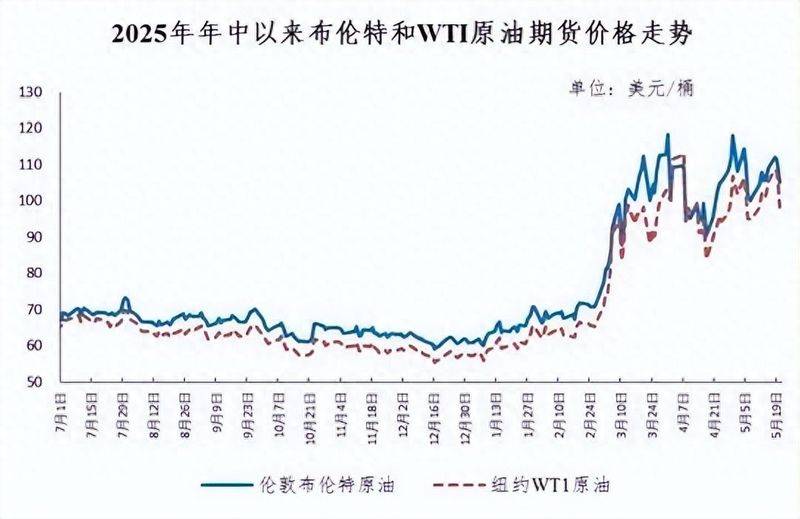
The price monitoring centre of the national development reform commission analysed the evolution of the united states-iraq situation as a central factor influencing current international oil price trends. In recent days, the united states has increased its pressure by announcing the postponement of the military strike scheduled for 19 may for two to three days and its readiness to restart military “option b”. Iran, for its part, strongly warns that a strike will open up a new front to fight back. The current situation is at a volatile stage, with increased volatility in international oil prices, and around 22 may will be a critical observation period for the direction of the situation in the united states and iraq, requiring close attention to follow-up developments。