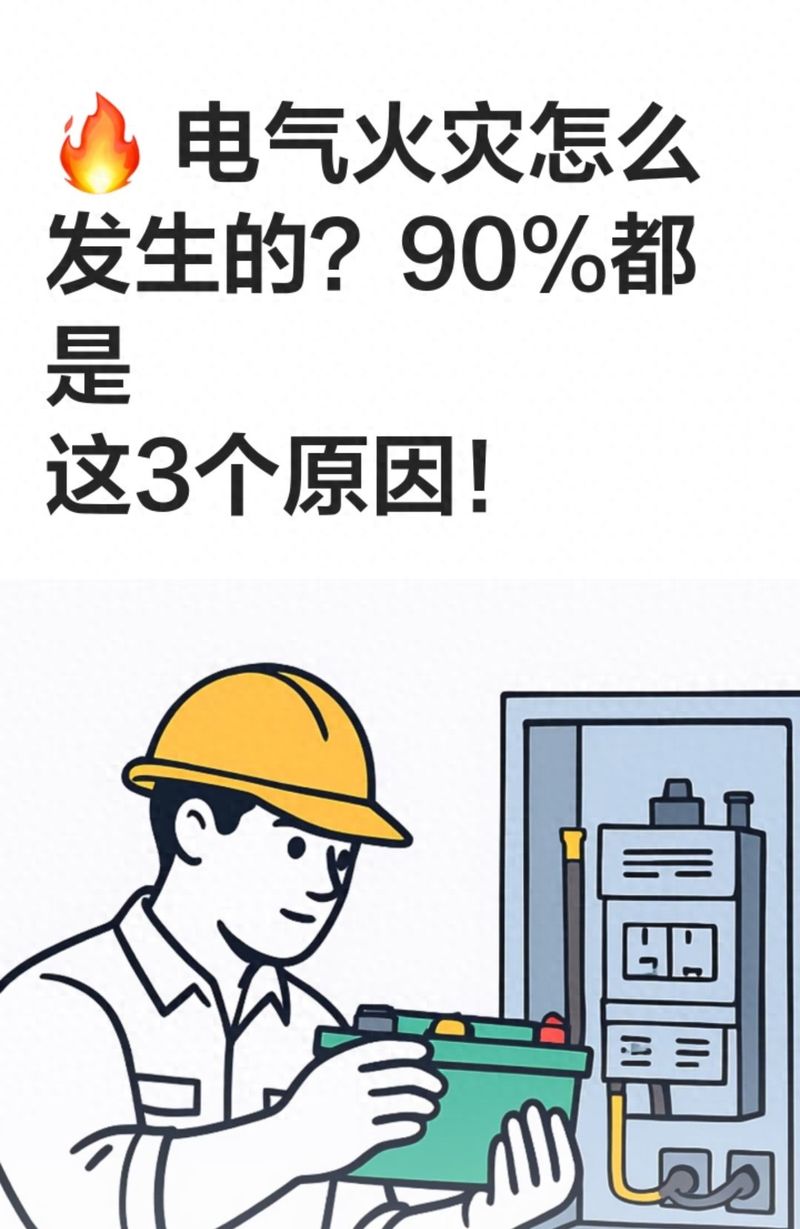
When it comes to domestic fires, many people feel very far away from themselves, with the usual plug-in and the electrical cords coming up. Based on data published by the national fire service, one out of every three fires in the country was caused by electrical failure, accounting for more than 30 per cent, the largest “killer” of domestic fires。
Even more worrying is that the vast majority of electrical fires are not accidents at all, but rather accidents that we have chosen one step at a time to fix, use electricity, select switches, and use falsely buried hazards. Many families burn, often just because a line is fine, a switch is big and a bail is missing。
Today, in this article, i use the most glamorous words to tell the three most common and easy-to-do mistakes of household electrical fires, and to tell the right thing once and for all. Without professional terminology, without selling products, without intimidating people, with a common sense of life-saving practicality, each household can check itself against the risks of electricity。
I. Short lead: the most common and hidden cause of fire
The first reason why there was a fire on the family circuit was because the wire was selected. And that's what the decorator used to say, "there's not enough lines."。
Many people do not know that the power lines have a “bold” component, but rather that they are not expensive. The electrician, in order to save money and money, took a roll of wire and for a long time buried in the wall。
Why are the wires on fire
In short, the wire is like a pipe, and when the pipe gets thinner, the water explodes; when the wire gets thinner, it heats。
The air conditioners, water heaters, electromagnetic furnaces and electric heating are “power-intensive” and the currents are increasing instantaneously. If the power lines are too thin to withstand such a current, the insulation skin will be roasted, smoked, short-circuited and, finally, directly lit。
And the worst of these fires — wires hidden in the walls, behind cabinets, on the ceilings, without first seeing the smoke — are already burning up when they are discovered。
What's the home route to be safe? ♪ take this directly ♪
I put together the most common and standard combinations of families, and made a direct comparison between renovations and electricity, and never stepped on the pit:
- lighting lines (room lights, bedroom lights, corridor lights): 1. 5 square lines + c10 open
- normal plugins (rooms, bedrooms, study rooms): 2. 5 square wires + c16 open
- air-conditioning hangers/coolers: 4 square wires + c25 empty
- kitchen special (e. G. Electromagnetic furnaces, electric cookers, ovens): 4 square wires + c32 open
- thermal water heater, high power wall hanger: 6 square wire + c40 open
Special reminders:
Kitchen and air conditioners are the most powered places in the family. Many family kitchens were set on fire because of multiple power appliances operated simultaneously。
Ii. It's an open-air campaign. It's more dangerous than the line
Second fatal error: too big an empty selection。
A number of owners and electricians have an error zone: "the larger the open, the safer it is, it's not easy to jump."
That's a terrible mistake, and it's very dangerous
What the hell is that
It's empty, it's the fuse of the circuit, and it's only one job: to protect the wire。
When the power is too large and the wire is about to burn, it must jump off the switch immediately and keep the wire warm and unfired。
It's a big, empty election. It's like, "the fuse is wire."
What happens if the wires are 2. 5 squares, with a maximum of 16a currents, and you're equipped with c32, c40
- the wire's hot and soft
- the current's out of line
- but it's empty. It doesn't feel. It doesn't jump
The end result is that the wire is burning and the switch is still on. And that's the most typical "pathetic running."。
Principle of correctness: empty currents, electrical wire safety flow
Remember this golden rule
- 1. 5 squared line
- 2. 5 squared line
- 4 squared line
- six squares
If the electrician gives you any space, he must refuse. It's not for you, it's for your family。
Iii. Aging circuits + no leaks: the greatest danger to old houses
The third reason for the high incidence is the ageing of the wire and the absence of a leaking shield。
In particular, older houses with the highest risk of living for 10 years or more。
How terrible is the ageing of the circuit
Wire insulation skins become fragile over time, crack and fall
Copper cores are oxidized, electrically resistant and more heat-prone
Loosing the interface will set fire, electric sparks will lead directly to the burning of wood boards, foams, cabinets。
A lot of old houses jump from their electricity peaks in the summer, smell of burning, and hottened their slots, actually calling the police。
There's no insurance, no electricity, no fire
Leakage is the last line of defence for household electricity。
In case of power failure, short circuits, electrocution, it is able to break power in 0. 1 seconds, much faster than a human response。
If there's no leak:
- electrical failure. People get electrocuted
- wire fires, direct combustion
- short drive. It burns
Two survival habits that have to be done
1. Old lines that have been powered for more than 15 years are recommended for full replacement and are not available
2. The home must be secured by a leak and must be divided and not be equipped with one head start off
Once a month, you press the "t" key that's missing, and change immediately
Fourth, apart from these three points, these electric bad habits are dangerous
In addition to redecorating hard wounds, the usual habits of life are silently creating the risk of fire:
1. A load of high-power appliances with plugs
Plugboards have rated power and are combined with electromagnetic furnaces, electric fire pans, ovens, heaters, direct overloading of heat。
2. Wires entangled, pressed under cabinets, mattresses
Wires are pressed, heat cannot spread, and the surrounding flammable material is burned slowly。
3. Use of flower wires, poor quality wires, non-labelled outlets
Cheap line insulation thins, copper cores, heat in months。
4. Expiration of electrical service
Laundry machines, water heaters, electric thermal blankets, ageing internal circuits, and extremely short circuits。
V. A more secure modern programme: protection of smart electricity
Household electricity is now entering a safer phase, and many households are beginning to use smart openings/smart leakages。
It's not a necessity, but it can significantly improve security:
- real-time monitoring of currents, voltage, temperature
- overload, overheating, early warning of electrical failure
- remote viewing of mobile phones, remote blackouts
- i can find out if electricity is normal at home
This is particularly relevant for the elderly, children's, rental and elderly。
But remember:
Smart equipment is a "subsidiary" and it is the lifeline that is based on a linear path, blanks and leakage. It's not good to be smart。
Vi. Home circuit self-checking list: 5 minutes of rapid screening
I've prepared a simple self-check for you, and i've looked at it, and i've got it in my heart:
1. Kitchen, air conditioners, separate circuits, empty
2. Whether wires are fine enough to conform to standard
3. Is the open size matched to the wire? Off
There's a leak on every road in the house and a regular monthly jump
5. Has the old house wire got hard, cracked, hot, smelly
6. Plug-in panels are not linked and overloaded
7. Power-intensive appliances cut off in a timely manner when they are not available
With these seven, the risk of electrical fires in the home can be reduced by more than 90 per cent。
Vii. In the last place: there's nothing wrong with safety, there's no luck with electricity
A lot of people think, "my house has been working like this, and nothing happened."。
But the fire was never “will it come” but “will it be sufficient to accumulate”。
The vast majority of the annual family fires in the country could have been avoided。
It's not bad luck. It's just a line, a switch, a little leak。
Electricity, it's easy to live; it's wrong, it's the source of the fire。
It is to be hoped that every household will be able to focus on the safety of the circuits, and that it will be able to fix the wires, the switch will not be broken, the insurance will have to be installed and the equipment will be changed in time。
Peace is the best feng shui in the family。
This is a general knowledge programme on household electricity safety and is intended only for daily study purposes and does not constitute any professional recommendation for renovation work, electrical modifications, equipment selection, etc。