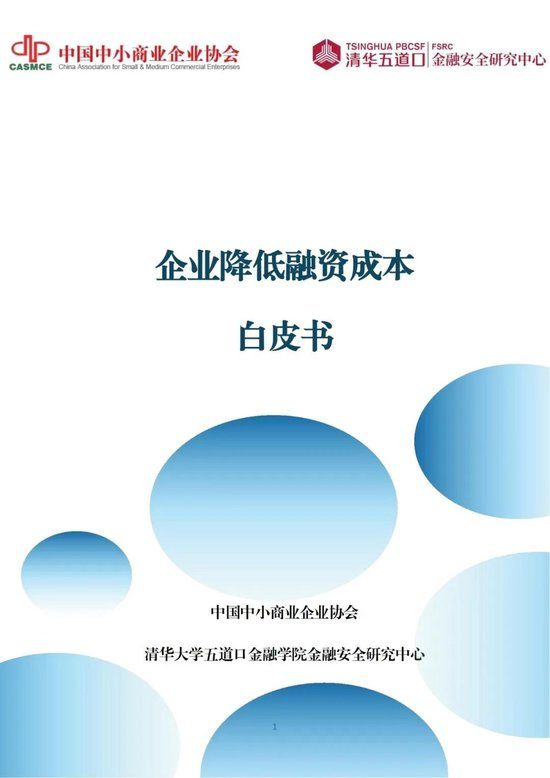
On 26 september 2025, the chinese association of small and medium-sized business enterprises, in association with the financial security research centre of the qinghua university school of finance, published the white paper on reducing financing costs for enterprises (2025) (hereinafter “the white paper”)。
The china association of small and medium-sized business enterprises, as a national industry association at the level of 4a, is an important link between government, business, social and sme services. It plays an important role in integration, service, advocacy, advocacy and self-regulation. It has the important function of serving the growth of small and medium-sized enterprises (smes), promoting entrepreneurship and innovation。
The centre for financial security studies of the university of tsinghua school of five-song finance, with financial security as its core area of study, is working on systematic and forward-looking research to promote the deeper integration of financial security theory and practice. The centre focuses on key directions such as financial security, financial planning, business efficiency reduction, data asset management and listed corporate governance, and undertakes in-depth theoretical and practical research. At the same time, cooperation platforms for financial security exchange have been actively developed, bringing together the resources and wisdom of a wide range of actors, working to create the country's leading financial security research institutions, providing intellectual support for high-quality national financial development and contributing to the development of financial security strategies。
This joint white paper is expected to serve as a bridge between the academic community and industry, policy makers and practitioners; to work together to build a secure ecosystem for sme financing so that the theoretical results fit the real needs of the enterprise and are dynamically appropriate; and to stimulate broader and deeper exploration of a sustainable development path that is both integrated into global capital and firmly rooted in security. The white paper aims to provide smes with practical financing strategies and security safeguards to help them move forward in a complex and volatile financing environment。
Background to the publication of the white paper
Against the backdrop of the accelerating re-engineering of the current global economic landscape and the deep evolution of the technological revolution, high financing costs have become key bottlenecks to the development of chinese enterprises, especially smes。
As a nuanced vessel of the national economy, smes contribute more than 60 per cent of national taxes and 70 per cent of technological innovations, but have always faced the challenge of “difficult and expensive financing”. This high cost of financing not only squeezes the profits of enterprises, but also profoundly affects their technological upgrading and market competitiveness。
The rational allocation of financial resources and the accurate injection of capital “live water” into the very foundations of the real economy, especially the dynamic small and medium-sized enterprises, have become a strategic mission that is both holistic and urgent. Reducing the cost of financing is not simply a concession, but ultimately a symbiosis between finance and industry by optimizing financial ecology, reshaping credit systems and innovative service models. This is not only a “necessary course” for the survival of enterprises, but also a “necessary answer” to structural reforms on the financial supply side。
Continuing challenges to sme finance
The world today is going through a century of dramatic changes, and the global economic landscape, the paradigm of scientific and technological development and geopolitical forces are undergoing a profound and extensive reshaping. These changes have had a profound impact not only on the external environment for our development, but also on the internal structure of the domestic economy and society. Against this background, the limitations of traditional financing models have become increasingly apparent and it has become difficult to adapt to the diverse and innovative business patterns of the new era. This is mainly reflected in the following three areas:
The mismatch between economic transformation and asset structure
In the past, corporate finance relied mainly on tangible assets such as land, plant and so on as collateral. However, with the rise of the digital economy and high-tech industries, a large number of “new quality productivity” enterprises have emerged as “light assets”. The core assets of enterprises are no longer traditional steel concrete, but intangible assets such as intellectual property, patents, data, brand names and human capital. Despite the enormous value of these intangible assets, in traditional financial assessment systems there is a widespread dilemma of assessment, registration, mortgage and disposal, creating a huge financing gap。
The “digital divide” caused by information asymmetries
Despite the age of data, smes tend to be fragmented and fragmented in terms of business and transaction data, creating “information isolation”. It is difficult for financial institutions to obtain the true business performance and credit risk of an enterprise in a cost-effective manner and to construct a clear image of credit, which can only be translated into high financing costs. Asymmetrical information, poor quality and quality enterprises are treated equally, leading to difficulties in financing quality enterprises and reduced market efficiency。
Structural conflicts between “supply and demand” of capital
Innovation takes time, r & d requires inputs, and smes need to be able to accompany their enterprises through the high-risk, long-cycle r & d phase of “durable capital”. However, short-term profit-orientated financing in real markets remains dominant, leading to structural distortions between capital supply and demand for new quality productivity. Many potential innovative projects often miss the best opportunity for development because they do not have access to financial support commensurate with their value. In the face of these challenges, we cannot wait passively, but instead take the initiative to change and reshape the concept of financing and the strategy of action。
Iii. Relevants and values of the white paper
The value of this white paper is reflected in both theoretical forward-looking and practical guidance. The theoretical dimension: it is not a mere literature review, but rather an attempt to integrate the theory of financial security with a multidisciplinary perspective such as the digital economy, industrial development and enterprise strategy, and to build a framework for financial security analysis based on chinese practice and with a forward-looking vision. This framework meets both the theoretical need to explain real-life issues and the logic that underpins the practical application of subsequent corporate finance and policy formulation。
At the practical level: on the one hand, it provides chinese enterprises, particularly small and medium-sized enterprises, with a clear “finance guide” and a “cost optimization tool” covering debt structure optimization, diversification of access options and specific strategies to use policy-oriented financial instruments to reduce hidden costs to help enable firms to develop in a complex environment. On the other hand, it provides a sound decision-making tool for national regulatory authorities to improve their financial regulatory policy systems and improve their financial risk prevention and disposal capabilities。