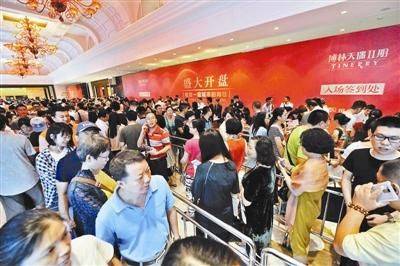
Shenzhen city trade ring growth of 48 per cent in may as a figure/cfp
Over the past 30 years, chinese residents have been managing their wealth through the savings and real estate eras, where banks and real estate have helped to manage wealth and add value to assets. Since 2014, however, for the first time, the share of wealth from real estate has dropped to less than 40 per cent, while for the first time, financial assets have become a major source of increase in the wealth of the population, which means that we may be entering a new era — the financial one。
Since 2014, the share of wealth from real estate has declined for the first time to less than 40 per cent, while financial assets have for the first time become a major source of wealth increase for the population, implying that markets may be entering a new era — the financial one. Recent shocks in the stock market, where funds are said to have left the stock market and to have returned to the market, have turned out to be the opposite, with long-term chinese capital entering the financial sphere and no longer attractive
Status
The rise in market prices is of concern
Since 2014, the government has introduced a number of property stimulus policies, including the lifting of restrictions on purchases in more than 40 cities between april and september 2014, the cancellation of three mortgages in september, the easing of the terms of the provident fund loan in october, and the three interest-rate cuts in november 2014 and march and may 2015, while at the end of march, 5 ministries jointly launched a new property deal to stimulate demand for property from the eligibility, interest rates and down payment levels。
According to seaton securities analysts, there must be courage and a number of policy stimuli have borne fruit, with 30 cities having an increase in real estate sales from 11. 9 to 29. 5 per cent in march to 40. 6 per cent in may 2015, while 100 city house prices were reduced by narrow and negative rates in may. After more than a year, the real estate sector is the first to have a “cost up”。
According to zhang daewei, the chief analyst of china's real estate, the recovery in the real estate market has been remarkable in the context of the continued emergence of a new housing market policy and the proliferation of incentives from the central bank to the local level. In addition to residential needs, the most important decision-making on home purchases is expected housing prices. In the course of many years of real estate development in our country, economic regulation policies have been the main factor affecting real estate prices, while credit policies have been the most influential ones. Credit lines and interest rates can be said to be the norm in the real estate market。
Problem
There is doubt that recovery will last
In stark contrast to the “harmonious” situation of “high-cost rises” in the real estate sector, there has been frequent news since 2014 of the bankruptcy and reorganization of small housing in cities on the 3rd and 4th line and the “runaway of the boss”。
The hing yuen industry, which used to be ningbo's largest home-owner, has now broken its financial chain and become unindebted; weinzhou's midtown construction group, which used to be more than 500 people, has now applied for bankruptcy and reorganization; and the presidents of the dragonstone and golden century, who are “runaways”. The prospects for small-scale housing in the four-line cities are not promising。
According to the intercom securities, the current round of national real estate sales grew in negative terms from march 2014, with a short rebound in may and june following the cancellation of the purchase restrictions, a further decline in july, a short rebound in november and december after a decline in interest rates and a further decline in real estate sales in the first two months of 2015. Policy incentives may boost improved demand in the short term, but in the broader context of declining demographic dividends, which mean that the total number of people buying housing peaks, the sustainability of improved property sales remains questionable。
Analysis
It's still hard for the developers
At the beginning of 2015, the target number of new job openings has been revised downwards by mainstream real estate operators, as can be seen from the pessimism of industry in terms of industry prospects. By way of example, huanco has significantly revised its target value for new construction from 2. 23 million square metres in 2014 to 1. 81 million square metres, a decrease of up to 25 per cent, as has the golden land group and commercial properties. This is the first time since 2008 that the three major real estate operators have collectively reduced their annual target of new construction space。
At the same time, in the embarrassing situation of high-pressure and small profit margins in third- and fourth-line cities, more regional developers have had to turn their attention to first- and second-line cities for profit reasons. By 2014, for example, it had been established mainly in three or four-line cities and its performance had been at the lead. However, since 2010, the total volume of the project has continued to increase, but the average volume of the project has been declining. Under pressure, towards transformation, on 9 april 2015, the quinoa took the chee-din district at a high price of $608 million and announced to the outside world that the northwards are the first and second-line strategic directions for 2015。
Intercom securities indicate that changes in the supply side of the real estate sector are reflected not only in the objectives of enterprise development and the choice of strategic directions, but also in the flow of talent. The stagnation of real estate expansion in 2014 led to a sharp reduction in intra-enterprise promotion opportunities, over-representation of senior managers, and an increasing number of executives who did not appreciate the prospects for industrial development, as well as the emergence of opportunities in the context of the internet+, resulting in the departure of senior managers in the real estate sector to “opt in other areas”。
Interpretation
Is the house attractive
Over the past 30 years, chinese residents have been managing their wealth through the savings and real estate eras, where banks and real estate have helped to manage wealth and add value to assets. Since 2014, however, for the first time, the share of wealth from real estate has dropped to less than 40 per cent, while for the first time, financial assets have become a major source of increase in the wealth of the population, which means that we may be entering a new era — the financial one。
Former residents used to go to banks, usually to save money or to find bank loans to buy a house. But now that we go to the bank, we can see that the bank is selling everything but savings, money, insurance, trust, money, etc. Intercom securities indicate that 17 per cent of the additional wealth of the population in 2014 came from bank management, 16 per cent from deposits, 12 per cent from equities, and the rest from trusts, funds, insurance, etc., which means that the age of diversification of the population's wealth allocation has arrived and that demand for financial assets is rising sharply。
On the other hand, compared with the rate of return on assets, the current rate of return on rent in cities such as beijing and shanghai is at best 2 per cent because housing prices have never fallen. If the money is put in the bank, the current base rate for one-year deposits is 2. 25 per cent, but since the deposit is capped at 50 per cent, and in fact more than 30 per cent, it has a maximum return of about 3 per cent per year。
In financial markets, the current representative five-year period of aa-class corporate debt yields still at over 5 per cent, with many blue-collar pes roughly 20 times, inversely, an implicit rate of return of 5 per cent, i. E., potential returns for both stock and debt markets far exceed real estate and deposits, and financial assets remain the preferred option for future household wealth allocation。
Projected
The share of financial assets will continue to rise in the future
According to research carried out by haitong securities, the total assets of china's inhabitants currently stand at about 300 trillion, of which about 60 trillion, or 20 per cent, are savings, while the total property value of the population is about 20 trillion, or 70 per cent, and the total financial assets of the population of all types is about 40 trillion, or only about 10 per cent, which is seriously low。
Only about 25 per cent of the market value of the $6 trillion stock market is resident. In the united states, real estate accounts for only around 30 per cent of household wealth, deposits for about 10 per cent and financial assets for nearly 60 per cent of all categories. From a quantitative point of view, there is considerable room for improvement in the proportion of financial assets allocated by chinese residents, and the transfer of family wealth from deposits, real estate to financial assets has only just begun. Reporter, fan fai
Related news
The city's going up again in june
Monitoring by the china institute of indexing studies showed that, as at 30 may, 29 cities with a focus on monitoring in may had an area of 1,923 square metres, representing an increase of 19. 6 per cent in the ring, or 41. 5 per cent in the same year。
In addition, there has been a marked improvement in the status of transactions during the first five months of the year, reaching a total of 76. 63 million square metres, an increase of 14. 6 per cent over the same period last year. Different types of cities show different performances. In particular, the first-line cities are the most prominent “head sheep”。
Shenzhen's performance was most remarkable, with a trade volume of 581,000 square metres in may, an increase of 48 per cent in the ring ratio, or 143 per cent in comparison with the same period; shanghai's performance also remained bright, with a trade volume of 209,000 square metres in may, a 95 per cent increase in the same period and a sustained high level of turnover; and beijing and guangzhou trade volume growth remained around 50 per cent high。
According to zhang daewei, the chief analyst of china's original properties, economic development is uneven, public resources are uneven, industrial layouts are uneven, population is uneven, inventories are uneven, trades are uneven, policy incentives are uneven, and housing prices rise unevenly. The cities of beijing, shanghai and shenzhen have all re-emerged the japanese cd-rom since 2014, reducing the supply of land for housing in the first-line cities, in which case the first-line cities have become leaders in the current round of market recovery。
As a result of this period of warming, the time of de-mining of first-line urban stocks has clearly fallen. Of the four front-line cities, beijing alone still accounts for more than 20 months, guangzhou has fallen to 14 months, shenzhen and shanghai to 12 and 11 months, respectively, and overall to the march-april level last year. On the other hand, the situation in the cities of the second and third line remains bleak. Second-line urban commodity housing stock was at an all-time high compared to march this year, with a small fall in april but still high. Third-line cities have a small fall in stock, but they are still high and significantly above first- and second-line cities。