In the bay of pine, a million acres of “marine pastures” welcomed the abalone harvest. Jung sung-sung
In the past few days, china's largest abalone farming base, china's “bowfish country”, and the yangtze river, have re-opened the abalone harvest season — more than a billion abalone harvests — and have begun to be marketed in large quantities to markets across the country。
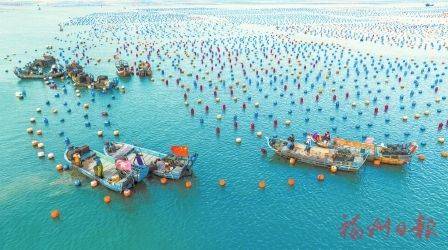
Yesterday, journalists entered the pine bay area of lianggang county, where they found more than 800 hectares of abalone farm, with a red, orange and blue-phased plastic float with a cage of fat and juicy abalone, which stretches from the sea to the sea, shaking with waves, like a moving landscape, and a colourful collection。
“this year, the abalone harvest was a good one, at a good price, and could be sold at around $90 per kilogram.” every day, at 5 p. M., su gwangping, the abalone farmer in the bay village of lower miyagi, and his companions arrived on time on a fishing boat at the “marine pasture” about 2 kilometres from the village, where they raised a abalone cage held in the sea, and removed the ropes and placed it on the board. As soon as the abalone cage is stacked and piled up, the fishermen bring it to the docks and leave it to specialized personnel for sorting, cleaning, frameing, weighing, and weighing。
“the quality and taste of the abalone is high, and the market has a good resonance, and we come here every year to play cards so that we can taste them all over the country as soon as possible.” when the abalone was weighed out of weight, he waited for the purchaser, lee jie hao, to take a good shipment immediately, and then shipped the abalone overnight through live water transport vehicles to large agricultural markets in fuku, xiamen and shanghai。
Lower miyagi is a high-quality abalone production area in liangjiang county, producing approximately 35,000 tons annually, accounting for 60 per cent of the total abalone production in the county, with more than 40 per cent of the town's workforce engaged in abalone farming and related industries. “it is now the season of abalone acquisition, with a daily abalone sales of about 180 tons.” the secretary-general of the lower miyagi township party, thongbo, told journalists that the abalone harvest would last for about three months and was expected to end in early october。
As a living water product, large-scale listings in a short period of time also face the problem of avoiding price-pression by buyers and effectively safeguarding farmers ' earnings. "we have adopted a `farmer + cooperative + sales company' development model that leads to a large number of fishers." pine bay. The abalone farm is based on efficient farming, efficient management, development of high-quality and good breeding and production, as well as market research and guidance for a wide range of abalone farmers.” teng thongbo, together with the abalone industry association, focuses on the purchase and retail prices offered by the main distributors and publishes timely information to guide farmers to the orderly production and production of their produce。
The joy of the harvest is also spreading, unleashing a strong “bow”. This will be done in the light of the scale of abalone farming in and around the town, with a view to improving all aspects of abalone selection, processing, refrigeration and logistics, creating a abalone experience hall and a specialized abalone trading market, connecting the abalone products of the ganges directly to the market and gradually developing a market-based, autonomous abalone bargaining mechanism。
The town ate “abalone”, a microcosm of lianjiang county setting up a “big food view” to make the fish bowl more stable. Journalists have been informed that last year the river abalone farming area reached 22,000 acres, yielding 5. 42 million tons, with a value of approximately $6. 5 billion, forming a coordinated whole-industry chain of abalone seedlings, farming, processing, circulation, bait production, catering, and cultural brigades, with a value of nearly 10 billion yuan, with tens of thousands of practitioners. Lianjiang is currently working on an industry-wide chain of “one abalone” from origin to consumer tables, as well as through the logistics routes established by the national oceanic fisheries base and the modern logistics city of fukuzhou, to set up a “buy the world, sell the world” trading platform that will drive “bow abau to the world” and further develop what is needed for a strong ocean economy. (reporter lin man-soo, correspondent wu shifa)