Types and dimensions of containers commonly used in cross-border transport
The widespread use of containerized shipments for cross-border transport and the understanding of their type and main size are essential for logistics operations。
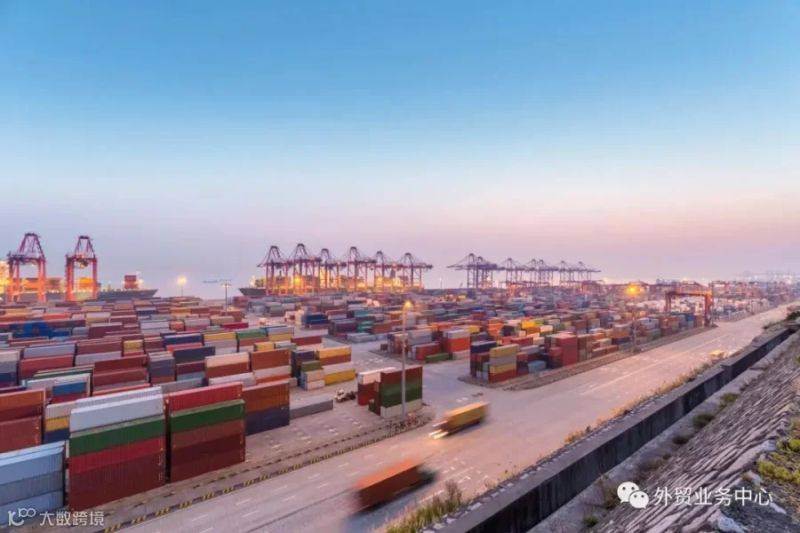
Main types of containers
1)** dry container (dry container)**: the most common container type, applicable to general groceries transport without temperature control, also referred to as “drybox” or “panel”。
2)** bulk container (bulk container)**: specially designed for the loading of bulk goods such as powders, particles, etc。
3)** liquid container (tank container)**: used for the transport of liquid goods such as chemicals, edible oils, etc。
4) ** refrigerated container (reefer container)**: equipped with refrigeration equipment, with low-conductive heat materials for the interior wall, applicable to the transport of frozen and fresh goods at temperatures between -30°c and +30°c。
5)** car containers**: specially designed for transport vehicles, capable of double loading。
6)** animal container (pen container)**: ventilation, feeding and excreta disposal systems are available for live animal transport。
7)** veterinary leather containers**: bilayered substructure, capable of storing liquids leaking during transport, applicable to wet goods such as skins。
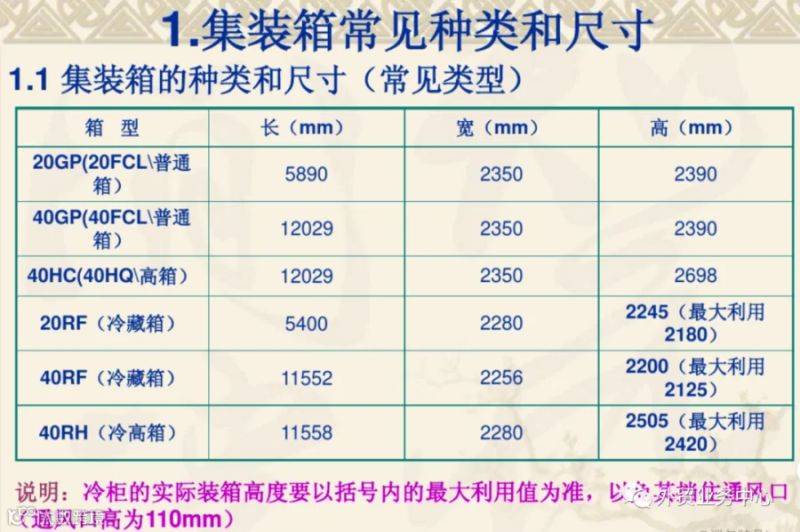
Ii. Main mside and directors of standing containers
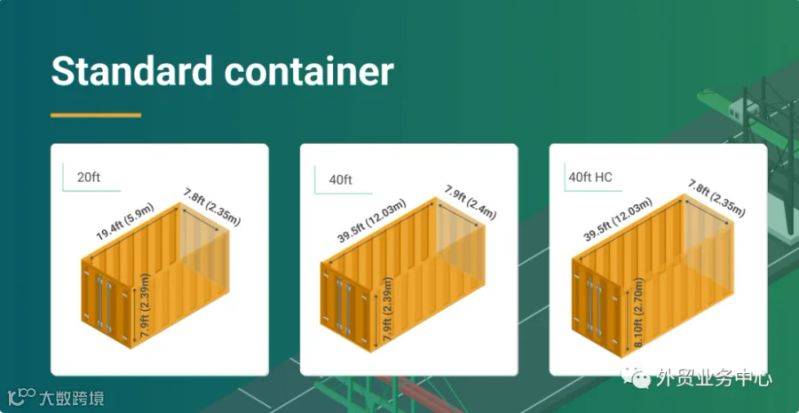
International standard containers (iso/intermodal containers) are widely used for sea, land and iron multimodal transport, with uniform sizes to facilitate stacking and handling。
1) **20-foot pantry (20gp)**: outer size 20 x 8 x 8. 5 feet, inner diameter approximately 5. 89 x 2. 35 x 2. 39 metres, volume approximately 33 cubic metres and gross mass approximately 20-24 tons。
2)** 40-foot pantry (40gp)* *: outer size 40 x 8 x 8. 5 feet, inner diameter approximately 12. 02 x 2. 35 x 2. 39 metres, volume approximately 67 cubic metres, suitable for light-throwing。
3)** 40-foot high cabinet (40hq)* *: outer size 40 x 8 x 9. 5 feet, inner diameter approximately 12. 02 x 2. 35 x 2. 68 metres, volume approximately 75 cubic metres and gross weight generally 26 tons。
4)** 45-foot high cabinet (45hc)**: approximately 13. 58 x 2. 34 x 2. 68 m content, approximately 29 tons gross and 86 cubic metres volume。
5) **20/40 ft penthouse (ot)**: the top is open to accommodate super-high cargo, with a 20-foot content of about 31. 5 m3 and 40 m3 of about 65 m3。
6)** 20/40 flat rack* :: no side walls and roofs suitable for transport of ultra-wide and overweight equipment, with a maximum load of up to 36 tons of 40 feet。
1 foot = 30. 48 cm, 1 inch = 2. 54 cm。
Common box size (cbm) calculations:
– 20gp: 6. 096 x 2. 438 x 2. 59 ≈ 38. 5 m3, with actual loadings of approximately 30 m3
– 40gp: 12. 192 x 2. 438 x 2. 59 ≈ 77m3, with actual loadings of approximately 65 m3
– 40hq: 12. 192 x 2. 438 x 2. 89 ≈ 86m3, which actually loads approximately 75 m3。
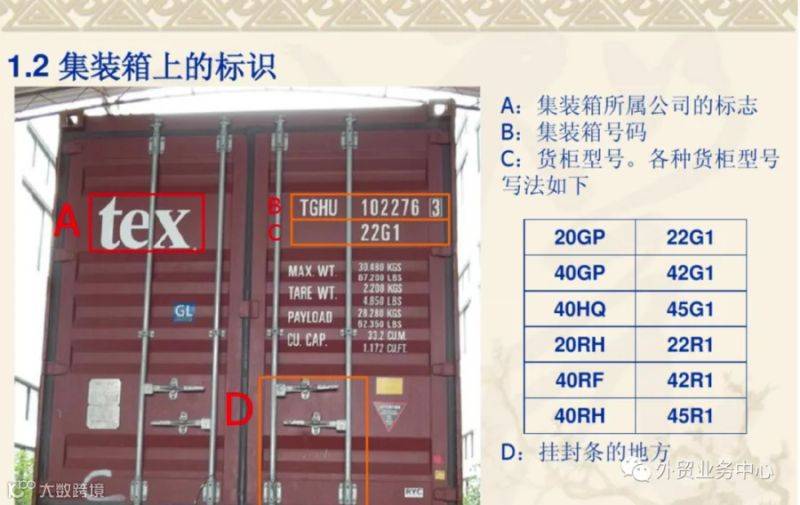
Common container container type codes and naming rules
Take 20 feet, for example:
– dry container: gp, 95 yards 22g1
– high box: gh/hc/hq, 95 yards 25g1
– hanger: ht, 95 yards 22v1
– top box: ot, 95 yards 22u1
– refrigerator: rf, 95 yards 22r1
– cold high box: rh, 95 yards 25r1
– tanks: tk, 95 yards 22t1
– framebox: fr, 95 yards 22p1。
Name order:
– box code initial “g” for general
– the second letter “h” is for high
– the first number of 95 yards is 20 feet for "2", "4" 40 and "l" 45
– the second "2" in 95 yards is pg (8. 5 ft) and the "5" is high (9. 5 ft); if the 40hq code is 45g1, it is not 45。
Note: “95 yards” means the un/iso standard 95 version container type code。
Importance of container size standardization
The global container size is highly uniform to ensure compatibility between different countries and modes of transport. Standardization improves port handling efficiency, facilitates stacking and multimodal transport, and avoids transport delays and increased costs due to disruption of size. Regardless of the source, container sizes of the same specification guarantee the reliability of the transport。
What's a trunk
Dry containers (dry container) are used mainly for the transport of non-temperature-controlled dry goods, such as electronics, clothing, bags, grain bags, etc. Boxes are made of steel or aluminium, sealed for water, with no internal temperature control equipment, and are not suitable for fresh, refrigerated or chemical transport. The floors are mostly water-resistant plywood to prevent wet air and pest intrusion。
Key pre-use inspection items vii. Special container types and uses
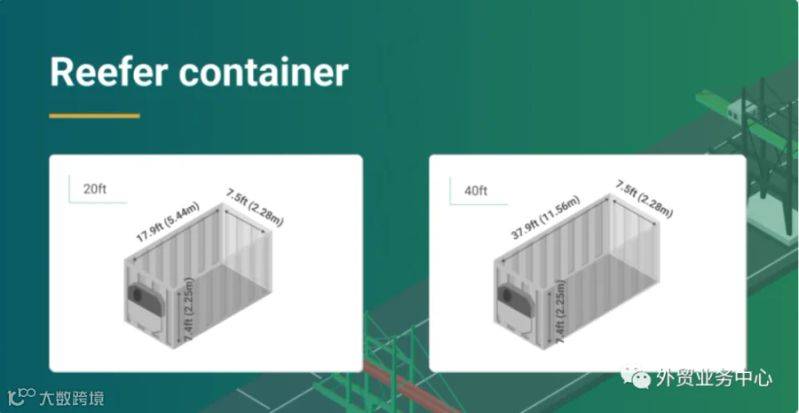
Refrigerated containers: a stand-alone refrigeration system with a t-type wind tank on the floor to safeguard the cooling cycle. The operating and maintenance costs are higher for temperature-controlled goods such as pharmaceuticals, dairy products, meat and fruit。
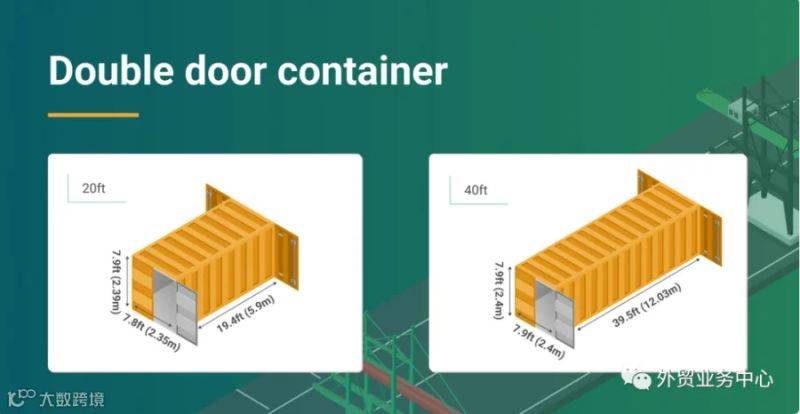
2. Double-door container: double-door doors are set up at both ends to facilitate forward and forward handling of vehicles and increase efficiency. It can also be used for building sites to form “tunnel-like” corridors, commonly known as “tunnel boxes”。
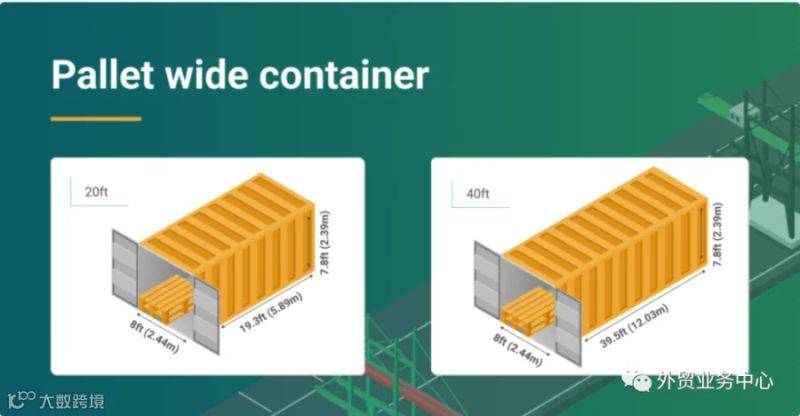
3. Tray dry container: designed specifically for the european standard tray to ensure that the pallet is closely organized and to prevent movement in transport, applicable to 40-foot and 40-foot-high containers。
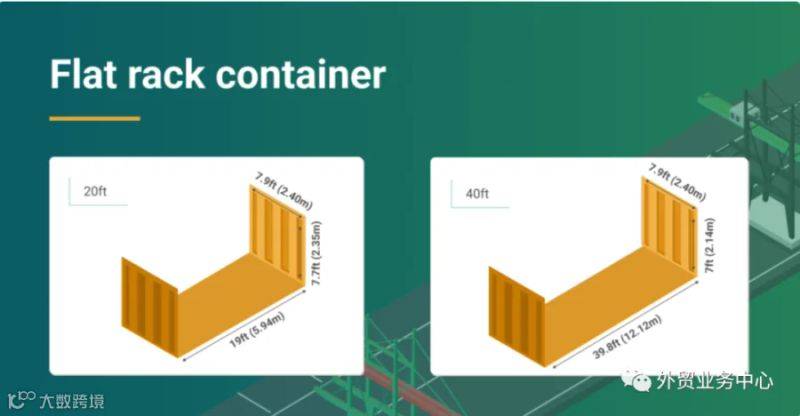
4. Frame cabinets (flat rack): side-walls without roofs, which allow the top or side to carry super-large cargoes such as heavy machinery, transformers, etc. The new frame cabinet can carry 40-50 tons, but cannot be stacked。
Distinction between transporting and storing containers
Containers in transport are subject to harsh maritime environments with greater structural strength and preservative properties to ensure the safety of high-value cargo such as chemicals, electronics, new vehicles, etc. Storage containers, on the other hand, have relatively low tolerance requirements and are mainly used for land warehousing。
Essential knowledge of shipping containers: 30 critical issues detailed
Containers used for transport must meet strict requirements and be certified accordingly. Among them, the csc safety convention card (csc plate) is the required document to demonstrate that the container is suitable for sea transport, along with key data such as container weight, last time of inspection and owner information. Only containers that are qualified for inspection are eligible for shipment。
Storage containers
Containers used for cargo storage need not meet all the standards for transporting containers, but must have windproof water (wwt) features. Such containers can be made of different materials and require relatively flexible sizes, as long as they meet the need for safe storage。
Most of the containers are decommissioned containers and continue to be used after refurbishment. The boxes should be selected to check for integrity and to ensure that they are non-destructive, severely dentified, on-the-ground imbalance or lock failure。
The following are some of the 30 common questions about shipping containers:
Large cabinets, cabinets, double backs: large cabinets usually refer to 40-foot containers (40gp/40hq) and 45-foot special cabinets; small cabinets refer to 20-foot containers (20gp); doublebacks refer to a trailer transporting two 20-foot containers simultaneously. (c) collar boxes and whole boxes: a lcl means a container shared by multiple cargo owners; a full container (fcl) means a container or containers owned exclusively by individual cargo owners. Common specifications: high counters and tablets: high cabinets are 1 foot higher (about 30. 44 cm) and are the same length and width. Self-heavy and heavy: 20gp weighs about 1. 7 tonnes and 40gp about 3. 4 tonnes; heavy boxes refer to containers that have loaded goods, compared to empty boxes. Empty boxes (charts): unloaded containers are referred to as empty boxes; in guangdong, hong kong, etc., they are referred to as “charts” because they are “empty” and “venom”. “tigi also weighs” means the recovery of empty boxes and the return of heavy boxes. Rear and landing boxes: rears point to the delivery of heavy containers from the field station to the warehouse for unloading (import); reloading of heavy boxes to the station (export). Empty trunks and empty boxes: empty trunks point to extract empty boxes from the site to load (export); empty boxes point to unload and return empty boxes to the site (import). Dc cabinet type: dc is a dry container (dry container), including a standard box type of 20gp, 40gp, 40hq, etc. Ot cabinet type: ot is open top, with no fixed structure at the top and unbroken tents. Semi-opening: refers to special designs that can be opened on one side of the side of a container. Bill of lading number: supplied by the freight forwarder for the lift box, which may be the owner's list (mbl) or the bill of lading (hbl) number, and is to be used in conjunction with the voyage of the name of the vessel. Box number/box number: the only number in the world, consisting of four letters +7, the first three being the main code of the box, the fourth being the u, the next six being the serial number and the last one being the verification code and the declaration form being required. Lead seal: the seal number used to lock the door of the container is provided by the shipping company and is usually purchased at a fee (approximately $50/per cent). Export process: export is declared at the empty container factory for loading. Import process: after customs clearance has been completed, heavy containers are extracted from the site and shipped to a designated location for unloading. Empty drive: the vehicle was unable to load when it arrived at the loading point and had to return to the site in empty boxes. Rewinding: moves the upper container to extract the lower one because it is necessary to check or assign a number. Container station: the terminal or the surrounding area used for stacking and container management is handed over by the driver on the basis of the station receipt. The bill of lading contains information on the bill of lading number, the name of the ship, the weight of the container, the name, number of packages, gross weight, volume, number of boxes, issuer and signature. Delivery care: identify export/import nature, box type, volume, weight, location, site, agreement requirements, time of arrival and special needs. Orders: information needs to be clear and accurate, in particular the name of the ship, the voyage, the bill of lading number, the address, the telephone, the special requirements, etc., so as to avoid errors of operation due to lack of clarity. Equipment handing over: the equipment handing over is required for the export of the suitcases, as a certificate for the lifts, entry and exit points and return boxes. Station lot: usually until 10 pm, but service orders usually end at 9 pm and import operations are scheduled in advance. Overload and overweight: overload means that the goods exceed the vehicle load limit; overweight means that the goods exceed the container's own limits. Boxes and unboxes: they point to carrying empty boxes for loading; they point to carrying heavy containers for unloading. Re-entry: refers to the transport of goods to and from each other, avoiding traffic and improving transport efficiency. Charges for weights: tolls are charged on highways based on the actual load weight of vehicles. Box loss: maintenance or compensation costs incurred when the imported container was unloaded and found to be damaged. Water washing: the cost of cleaning the contents of the boxes because they are unclean。