How do you figure the vehicle should be replaced with a battery
Vehicle cylinders, which are the core power source for start-up systems and electrical equipment, tend to show marked signs of decline in performance. Timely determination of whether the cylinders need to be replaced would avoid difficulties such as half-way anchorage. The following is a detailed description of the method of judgement from the three dimensions of day-to-day observation of phenomena, specialized testing techniques and years of use。
I. Preliminary findings through daily car usage
This is the most intuitive, tool-free way of judging, and it is only by taking care of the details of the use of the car that it is possible to detect traces of the deterioration of the cylinder:
1. Unusual signal at start-up
Start delay: once the key has been inserted or the start key has been pressed, the engine "carton" is activated in 1-2 seconds instead of responding in an instant, indicating that the capacity of the bottle to store the power is reduced and that sufficient currents cannot be provided quickly。
Commencing sound anomaly: a weak acoustic sound associated with a “twig” at the start, or a weak engine rotation, slow speed, may be insufficient voltage to drive the starter to normal work。
Launch failure: multiple attempts to activate are still non-reactive, and the dashboard light is significantly darkened at the approximate rate that the battery has been depleted or completely disabled (after failure of the starter)。
2. Abnormal performance of electrical equipment
Lights are down: large lights, dashboard lights are significantly darker, air conditioning is turned on, and the after-sound brightness is further reduced, suggesting that the cylinders are not stable to provide electricity。
Equipment malfunctions: slower up and down of electric vehicle windows, delayed middle-control lock reaction, light flashing in the interior of the vehicle, and frequent break-ups of equipment such as vehicle-borne navigation, bluetooth, etc., may be associated with the unstable voltage。
The power supply was reduced after the fire went out: only the lights or sound, which could have been maintained for more than 30 minutes, were darkened and the equipment shut down within 10 minutes, indicating a significant decline in the battery storage capacity。
3. Changes in the appearance of the cylinder itself
Body drums or deformations: the expansion, drums and even cracks in the cylinders are a manifestation of the heat evaporation of internal electrolytic fluids and the severe sulfurization of the polar plate, which means that the cylinders are approaching the end of life and have a risk of leakage。
Leaks or corrosives: observed vials are active at pyrotechnic levels, and if white, green powdered corrosives or liquid seepage occurs at the bottom of the shell, causing poor exposure to the electrodes, acceleration of the failure of the vials, first to clean up the corrosives, and then to replace them if they continue to suffer from frequent power losses。
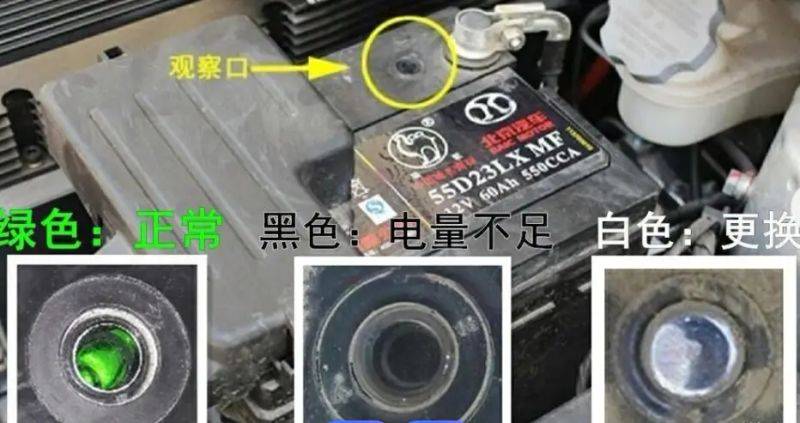
Watch the car bottle eye
Watch the bottle eye
Some of the cylinders are easy to judge and have observation holes, commonly known as “the eye”. The way to observe the eye of a car bottle is determined primarily by colour。
Electron colour criteria
Operational steps
Positioning eye: usually at the top right corner of the cylinder, some brands may be indicated. Static observation: check the engine after it is shut down to avoid charge-state interference. Environmental requirements: ensure sufficient light and, if necessary, light-voltage to support observation。
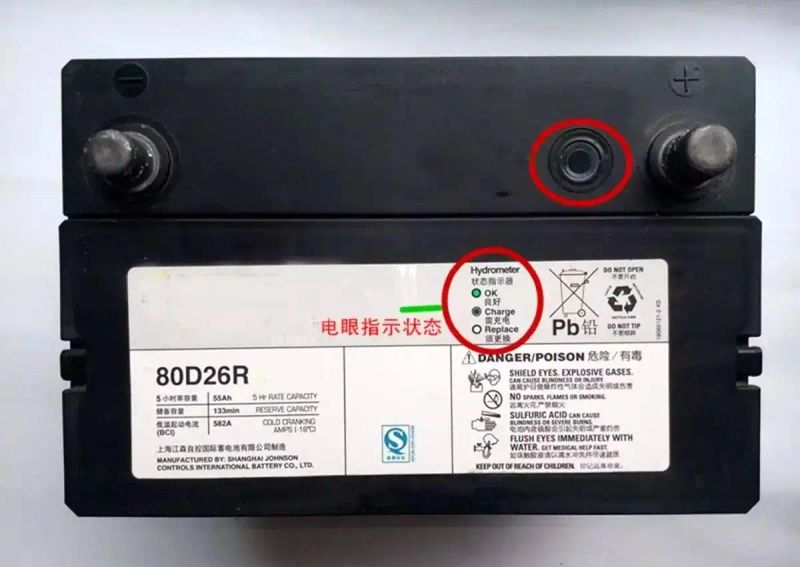
Car bottle eye
Attention

How do you figure the vehicle should be replaced with a battery
Ii. Precision testing with specialized tools
If daily phenomena are not apparent or if the remaining life of the cylinder is to be confirmed, the following specialized tests may be used:
1. Universal meter detection of voltage
Means of detection: under a vehicle's outburst, a red pen will be used to transmit a positive (+), a black pen negative (-) and normal voltage will be in the range of 12. 4v-12. 7v; when the engine is activated, the voltage shall rise to 13. 5v-14. 5v (generator charge)。
The test is that the voltage is less than 12. 2 v at the time of the fire out, indicating that the cylinders are in deficit and need to be recharged and then re-observated; that the voltage remains below 12. 4 v or below 13 v after start-up, indicating a deterioration in the performance of the cylinders and that replacement is considered。
2. Electrobarometer detection capacity and health
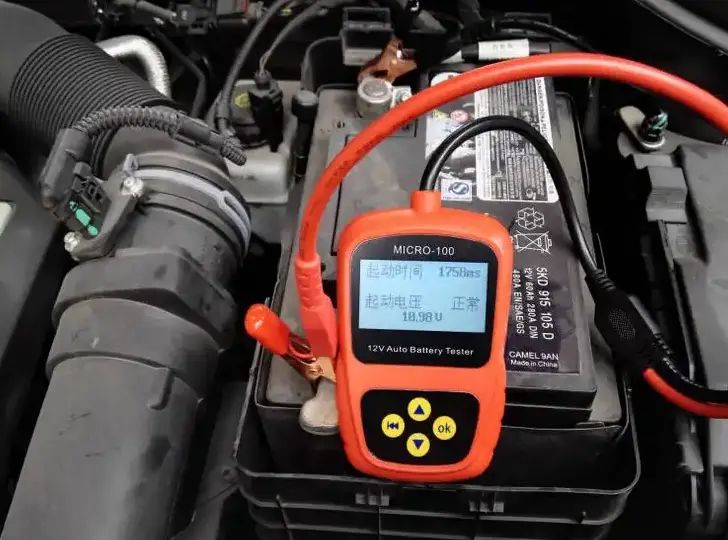
Bottle detector
Detected content: specialized cylinder detectors can read the “residual capacity (ca)” and “health status (soh)” of the cylinders, which are cold-started currents of the cylinders and directly affect the cryogenic start-up capacity。
Criteria: if the state of health (soh) is less than 70 per cent, or if the residual capacity (cca value) is less than 60 per cent of the rated value, even if a vehicle can be activated temporarily, it is likely that it will fail at low temperatures, high loads (e. G. Air conditioning, large lights) and is recommended for timely replacement。

How do you figure the vehicle should be replaced with a battery
Iii. Years of use and environment of use of reference bottles
1. General useful life
Normal lead acid cylinders have a normal service life of 3-5 years, which may be reduced to 2-3 years if the vehicle is used at a low frequency (e. G., only 1-2 times per week) and is chronically in a power deficit; if used at a high frequency and fully charged, the lifetime may be extended to more than 5 years。
Note: if a bottle has been in use for more than 4 years, it is recommended that, even if there is no apparent anomaly, one or two professional tests be performed annually to avoid any sudden malfunctions。
2. Accelerated recession in harsh environments
Temperature: the temperature is below -10°c in winter and the capacity of the bottle is reduced by 30-50%. If it travels frequently at low temperatures (e. G. Less than 10 minutes per drive), the battery cannot be fully charged, it accelerates ageing。
High-temperature environment: temperatures exceeding 40°c in summer vehicles, faster evaporation of electrolytic fluids in vials, polar plate oxidation, and possibly shorter lifetimes of 1-2 years。
High load use: long-term opening of equipment such as air conditioners, large lights, refrigerators, etc., or frequent start-up engines (e. G., repeated start-up during traffic jams) increases the battery burden and accelerates performance decline。
Iv. Emergency administration and care
In the case of half-way start-up difficulties, they can be temporarily resolved by “grid start-up”, but on call they are required to go to the maintenance shop to test the cylinders in a timely manner: if the charge is restored, they may continue to be used temporarily; if the charge is followed by a frequent loss of power, it will be replaced to avoid another anchoring。
For the replacement of cylinders, products matching the original vehicle battery model and the cca value are selected to avoid overcapacity or too small an impact on the vehicle circuit system, while care is taken to rematch electronic equipment (e. G., car computers, remote keys) for some vehicles after replacement。
If you are unable to judge by yourself or need to change your battery, you can call 400 0808,775, and the senior master can relieve you of your worries。