The price of wheat is shaking
In recent days, domestic wheat prices have hit high levels, reaching a national average of 1. 65 yuan per pound at the beginning of november, the highest ever。
On 24 october, in a study conducted by the agency, the rice-listed company kming food (sz:002661) stated that the cost of the company's wheat purchases had increased steadily since 2020, that the average annual cost of wheat purchases in 2020 had increased to $2,400/ton (us$1. 2/sick) in 2021, to $2,600/t (us$1. 3/sick) and to more than 3,200/t (us$ 1. 6/sick) in the second quarter of 2022, and to around $3,100/sick in the third quarter。
In recent interviews with the interface, the manager of the shandong monument industries stated that the current price of wheat purchased by the company had risen by 0. 08 pounds in october, mainly from nearby large farmers。
As to the reasons for the increase in the price of wheat, he said: “seen the high price last year, the people sold it”
According to a first financial interview with the chief analyst of the ministry of agriculture and rural development for the early warning and monitoring of wheat markets, cao hui said that the prices of the new season's wheat scales were high, the pre-construction costs of the food staples were higher, the demand was higher, and farmers at the grass-roots level were always more aggressive。
Another reason is the phased supply constraint. According to cao hui, farmers in the production areas are busy with harvests, food sales are reduced and new outbreaks are being spread, affecting trans-regional logistics transport and leading to a phased supply constraint。
On 30 september, a number of departments, such as cdrc and the ministry of agriculture and rural affairs, announced a minimum acquisition price of $1. 17 per pound for wheat in 2023, a three-year increase from $1. 12 per pound in 2020. The lowest purchase price for wheat this year was $1. 15 per pound, but the price of wheat in many places was actually far above the lowest purchase price, reaching 1. 40-1. 50 per pound。
On the demand side, the cooling of the weather, increased demand for flour and skins, and the high level of wheat purchases by milling enterprises have also contributed to the recent rise in wheat prices. Moreover, the higher prices of wheat have attracted many traders and buyers to take advantage of post-market developments and have come to share a piece, not excluding the possibility of competing acquisitions and higher prices。
Wheat for feed increase
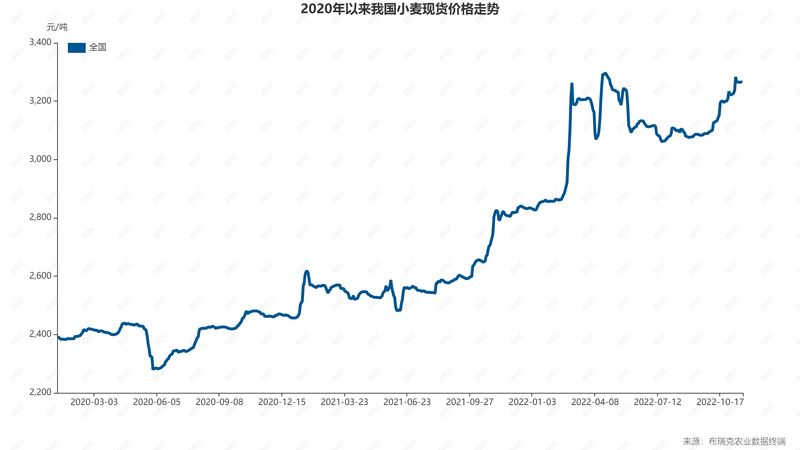
In the last two years, domestic wheat prices have shown an overall upward trend, and according to the brick agricultural data terminal, prices have increased slightly in the preceding period since new wheat came on the market in june 2020, but since the fourth quarter of 2020, wheat prices have repeatedly updated their historical peaks. At the beginning of november, the national average price of wheat reached 1. 65 yuan per pound, an increase of about 30 per cent over the previous five years。
Source: brick agricultural data terminal
“the cost of wheat cultivation has increased as a result of the increase in the price of labour, agricultural resources and the rise in the price of wheat cultivation”, lim jiu-dou, director general of research of the brick agricultural markets, said in an interface interview: “plus the large amount of wheat available in the country in lieu of maize for feed in 2020-2021, which led to a decline in wheat stocks, the main reason for the increase in wheat prices in the last two years.”
According to an investor study conducted on 2 november, the price of wheat is influenced by the cost of crop cultivation, harvests, national policies, etc., while the price of wheat is also linked to the price of maize。
According to the forest state administration analysis, in the fourth quarter of 2020, the prices of maize were significantly higher than those of wheat, and there was a marked increase in the willingness and actual quantities of wheat to replace maize as feed, leading to a dramatic increase in wheat prices in early 2021. From the fourth quarter of 2020 to the first quarter of 2021, the state auctioned nearly 41 million tons of wheat in aggregate for wheat feed。
Beginning in the fourth quarter of 2021, the continued rainfall in northern china delayed the harvest of maize, coupled with a large amount of wheat for fodder processing since the second half of 2020, a decline in stocks and a significant rise in domestic wheat prices, updating the historical highs。
In july of this year, the market began to focus on the availability of grain for domestic feed, with international maize, sorghum and barley imports being inverted, ukrainian corn and barley being blocked, domestic pig prices rising to 22-24 dollars per kilogram, farm profits reaching a thousand dollars per head, and markets were extremely optimistic about later prices, resulting in the delayed production of pigs and even second-rate fertilizer, followed by a significant increase in demand for fodder, an increase in maize and soybeans, and a renewed fear of domestic food supplies and a renewed rise in wheat prices。
In response to an institutional study by the company dated 24 october about the 0. 4 per cent decline in the mĀori ratio in the single third quarter of 2022 (sz:002661), the price of wheat purchased in the third quarter increased by more than 20 per cent each year, mainly as a result of the increase in the cost of raw materials。
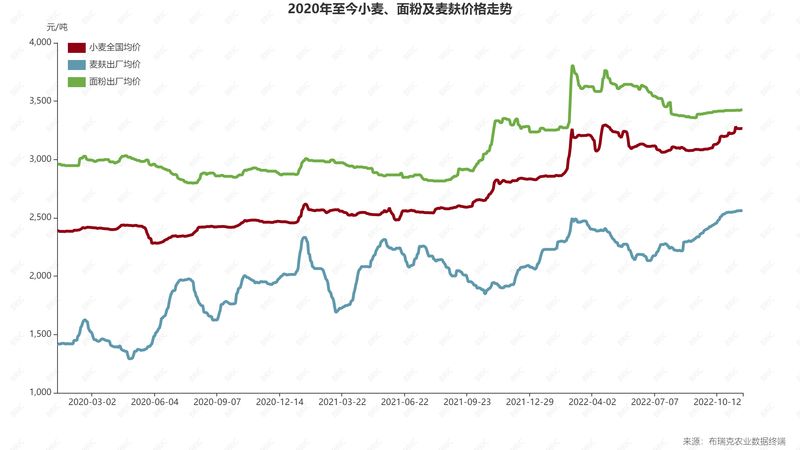
The rise in wheat prices is transmitted to flour and millet. In the first half of 2021, the price of wheat was high owing to strong domestic feed demand, mainly under pressure from rising wheat prices. By the second half of the year, the high price of wheat mills could not be transmitted downwards, and the cost pressure was transferred to flour, which in march 2022 rose sharply to $3,800 per ton. The price of flour has now fallen to $3450 per ton, benefiting from a new strong rise in wheat prices after june, which has been driven by a large share of wheat prices, and the average price at the mill now stands at $2570 per ton。
The kming food (sz:002661) increased sales prices for various product series in july of this year by about 5 per cent on average. According to the company, all the previous price increases were due to large increases in wheat prices。
Source: brick agricultural data terminal
The international situation affects wheat prices
Changes in the situation in the black sea food corridor have also led to fluctuations in international and domestic wheat prices。
The executive director of the chinese omega industries reported to the interface that the company had purchased some of the imported wheat from china côte d ' ivoire, which had increased by 0. 1-0. 15 yuan per pound in prices of imported wheat compared to the end of october, and had increased more than domestic wheat prices。
The russian-uu conflict at the end of february and the sharp rise in international wheat futures prices at the beginning of march, which rose to 1,400 cents/brunches, have already been significantly overstretched. This was followed by a rapid decline, a fall of 1,000 cents/pears for about half a month, a continuous rebound at the beginning of may, one to 1,300 cents/pears, followed by a long decline, mainly due to the departure of food from ukraine in the black sea region, the increase in wheat production to varying degrees in china, russia and india, the pre-market concern about the disappearance of international wheat supplies, and the fall of international wheat futures prices to 750 cents/pear in mid-august。
Markets then started trading, the continued drought and high temperatures in europe led to a reduction in food, international wheat prices continued to rise for nearly two months, and on 10 october prices rebounded at a rate of 950 cents/brunch. However, as chinese autumn grains were largely abundant and united states soybean and maize production was higher than previously expected, international wheat fell back, and on 16 november international wheat futures prices fell to 800 cents/brunch。
During the first three quarters of this year, the net profits of the rice-coated oil-heading company, the golden dragonfish (sz:300999), to the shareholders of the listed companies, decreased by 36. 07 per cent over the same period, owing to a sharp rise in prices such as soybeans, the company's main raw material, in the first half of the year. At an investor video conference on 31 october, the company stated that the prices of commodities such as soybeans and wheat are now influenced not only by supply and demand fundamentals, but also by a number of uncontrollable factors, with global inflation, the ukrainian crisis and extreme weather conditions leading to higher prices of raw materials for large commodities。
It should be noted, however, that in the case of wheat alone, domestic and foreign wheat price linkages are not significant. According to lin, china imported 9. 71 million tons of wheat in 2021, accounting for only 7. 2 per cent of the country's total wheat production, domestic wheat rations were fully self-sufficient and had a well-developed reserve policy, and international wheat prices were not significantly linked to domestic wheat prices. Since 2000, there have been three waves of significant increases in international wheat, leading to small increases in domestic wheat prices. The current international situation has more or less an impact on the market climate than on domestic wheat prices。
Domestic imports of wheat actually used for food production have stabilized at between 3 and 4 million tons per year, with varieties mainly of ultra-feasible and condensed wheat meeting the structural needs of domestic wheat。
How long will the price increase for wheat continue when the cost of raw materials for rice-faced enterprises increases? According to an institutional study conducted on 24 october, the company predicts that wheat prices may show a high volatility trend in 2023 and that if wheat continues to rise significantly in the follow-up, the company will not rule out further price increases。
According to lin, wheat development depends on the overall demand for domestic cereals, but the potential for further increases in wheat prices is diminishing unless there is a severe drought in the country's winter wheat sector between december and january of next year, with a greater likelihood of small up-front shocks before spring。