“technology processes have reached their limit, and the core of future acceleration is at the diagnostic end. Digital +ai to free pathologists from simple and repetitive work and to give time back to suspicious cases.” zhang zhihong, deputy director of pathology, china medical society, and director of pathology, jiangsu people's hospital, stressed the need to improve the system of professional training in pathology and to fill the human resource gap. At the same time, high-quality pathological resources are being pushed down through medical associations, etc。
C. T., blood routine, why wait days? This is the confusion that many patients experience when they visit. Health times journalists surveyed hospitals to learn that general pathological reports usually take three days and complex pathological reports often wait more than 10 days。
The pathological diagnosis, recognized by the medical profession as the “kind standard” for diagnosis of diseases, is the ultimate basis for tumour styping and treatment programming. Could this report come out soon? Health times journalists interviewed pathologists at mcha hospitals to open up the business dilemmas that patients were waiting for。
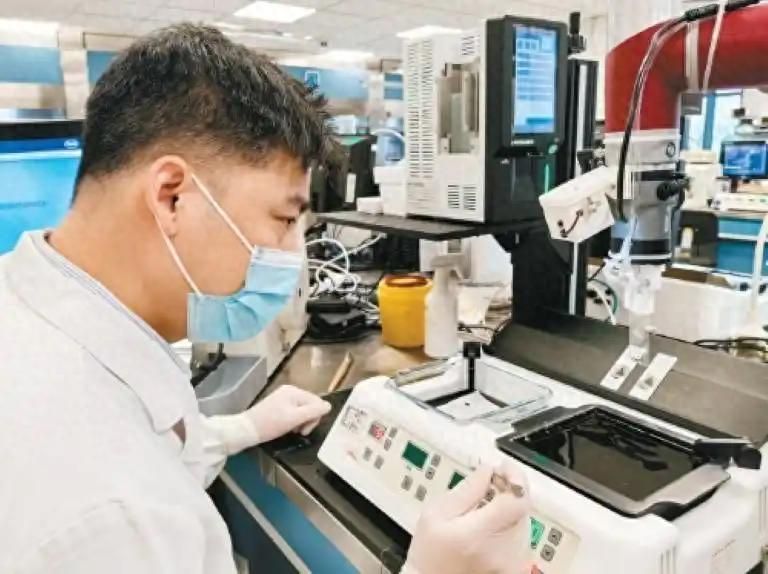
On 2 may, the medical section of the saijin hospital of the air force military medical university, in conjunction with the multimedia laboratory of the chinese university of hong kong, jointly developed the first global “smart pathology recovery system”, which is operated by a technician, li qi fei. Interviewee for map
"on these 12 days, i'm waiting for a trial."
The 38-year-old chen moe (alias) still remembers that for 12 days waiting for a pathological report, every minute is painful. As a result of repeated abdominal pains and bleeding, he performed a gastrointestinal examination at the local sanchae hospital, where the doctor pulled four tissues from his intestinal tract and sent the pathology section and informed him that “regular 3-5 days to report”。
On the day he waited, he updated the hospital procedure every few hours. On the third day, the report had not been updated, and he went to the pathology window to consult and was given the answer that “samples are being processed and difficult cases need to be postponed”. On the fifth day, abdominal pain increased and the clinicians were able to prescribe only hormone medication to mitigate symptoms. It was not until the twelfth day that the report, which was marked as a “suspicious case + immunisation test”, was finally released and he was diagnosed with crohn's disease. "on these 12 days, i'm waiting for a trial." chen moo said that every additional day, there was a greater sense of risk。
Such anxiety is not an example. According to a reporter's survey, many of the patients who sent gastrointestinal lenses, stabbing biopsies and surgical removal of specimens felt that the waiting period was a little longer, with some patients suffering from blind medication, repeated examinations, inter-hospital consultations, etc。
“clinically, a number of patients are anxious about the pathological results, sometimes even passing time to judge their condition, and are worried about whether they have a serious condition or a cancer cell if they find a pathological report for more than three days. Some even go to other hospitals for registration.” dr. Yao xiaohong, director of pathology, first hospital, military medical university of the army, told the journalist that “the routine puncture sample is limited to three days in accordance with the requirements of the pathology subject, and if it approaches the hour, the system automatically marks the pathology as purple and alerts the physician to the urgency. If a suspected pathology is likely to be transferred to an immunization group examination and a clinical clinic, the pathological reporting period will be extended. However, long waiting periods do not mean that the condition must be serious, and many pathologies, after a series of examinations and comprehensive analyses, find that they are not serious or common.”
The national commission for health and welfare's indicators of medical quality control in pathology professionals (2024 edition) clearly states that: three working days for the report of an epipsy, five working days for the report of a surgical removal of a large sample, and five difficult cases for immunisation, molecular testing, may be extended by the norm。
Technology processes cannot be compressed
The birth of a pathological report is marked by the fixed, dehydrated, sliced, microscope-viewed, difficult to receive, and special tests at the six cores of the spectrum. Mr. Zhang ji-hong, deputy director of pathology of the chinese medical association and director of pathology at jiangsu people's hospital, explained that behind the “slow” pathology report was an elaborate project that cut across cells and molecular layers and had itself been “uncompressable”, also known as the “time shackles” within the industry。
The first “time shackles” are “fixed” to cells. In the case of oesophagus cancer, for example, stomach mirror work is subject to repeated clamp-up on the tumour surface of a sample of 3-5 tissues, which must be immediately contained in 10% of the neutral buffer ff liquid, which is essential to prevent cell deformation, self-solvation and necrosis. Small specimens, such as gastrointestinal lenses, punctures, etc., are fixed for 6-12 hours; large specimens, such as tumors, organs, etc., for surgical removal, are fixed for 12-24 hours。
The deputy director of pathology at the central medical hospital in chanlo, shaanxi province, stressed that the organization had to be fixed within 30 minutes of being removed, otherwise the cells would melt and the entire specimen would be destroyed。
The second phrase, “time shackles”, is “bone change” for tissue. In fixed cells, tissue fluids are filled and must be replaced with liquid paraffins by alcohol dehydration, transparency of dibenzophthalm and three steps immersion of paraffins, so that they can be permanently preserved. This process is based on full automatic dehydrator and takes 6-16 hours depending on the size of the specimen。
“there were young technicians who accelerated the dehydration process, causing the organization to become fragile and to re-create slices, rather than delay much longer.” according to zhang ji-hoon, pathological wax blocks need to be preserved for more than 15 years, and only standard processes can guarantee the quality of specimens。
Once the wax is made, the technician will cut it with a slicer to 3 micrometres - 1/20 to 1/30 for hair silk. Slices are wrinkled and fractured and cannot be used for diagnosis. The slices are attached to the film and go through the 12-step process of dyeing he, which takes more than three hours. It takes 1-2 days to complete all the above technology links. This means that the technology process itself accounts for more than half of the reporting cycle, which cannot be compressed at this time。
Talent gap and overload
When the technical process is completed, the slice is delivered to the pathologist. Regular cases such as gastrointestinal flesh and chronic inflammation can be diagnosed by doctors within 10-20 minutes and prompt pathology reports. However, in difficult cases such as inflammation, lymphoma, rare neoplasms, malignity and necrosis, doctors are required to read the film over and over again, even in conjunction with clinical and video doctors, and to perform immunisation or genetic tests, each of which is accompanied by a specific test, the reporting cycle is extended accordingly。
Zhang ji-hoon shared his experience with the film, “i usually leave complex and difficult pathologies to the end, and at the quietest hour of the night, one day from 6 p. M. To 11 p. M., only four difficult cases were completed in five hours, each of them like a very difficult mathematical question.”
“a pathological diagnosis often involves dozens of pathological slices, each of which doctors need to judge under a microscope. There are suspected cases that are rare, that cannot be judged by young doctors, that often require review by experienced doctors, and that have a very large overall workload.” according to zhang zhihong, in the case of the pathology section of the people's hospital in jiangsu province, 40 doctors treated a total of 1. 5 million slices per year。
"my doctor works from 8:00 in the morning until 8:00 in the evening." the chief of pathology at beijing university's 1st hospital, dr. Kurosaki, said:。
Behind high-intensity work is a shortage of talent. Pathologists are one of the most scarce jobs in the country's medical profession. According to the report " survey and reflection of the state of the pathology of 3,831 hospitals in 31 autonomous provinces and municipalities, 2016-2019, published in 2020 by the chinese medical institute, there are approximately 18,000 to 20,000 registered pathologists nationwide, with one pathologist per 70,000 population, and a talent gap of over 100,000 measured by national bed allocation criteria。
There are many reasons for the shortage of pathologists. One of the reasons for this is the low level of awareness and treatment in society. The pathology is chronically marginalized, with a marked gap between the income of doctors and that of clinical doctors, and a low level of professional attraction; second, the education system is short-sighted. Medical colleges do not have a pathology specialty, and pathologists can only be selected from undergraduate clinical medicine, with no specific training pathways; third is limited grass-roots development. The low number of cases in primary hospitals and the lack of teachers make it difficult to increase operational capacity。
It is necessary to develop a pathologist who is experienced in all fields and who is confident in issuing a report, at least 10 years of work。
“a number of municipal and district hospitals do not have advanced tests, and suspicious pathology samples are subject to external molecular testing, resulting in patients having to borrow a piece for consultations at a higher hospital or to deliver specimens outside the hospital. The patient travels back and forth, further prolonging the waiting period.” yao xiaohong indicates that the poor state of technology in the pathology at the grass-roots level not only makes the patient time-consuming but also causes some cases to be misdiagnosed, missing, and ultimately increases the stress of treatment in higher hospitals. This is also an important external factor in the “slow” pathology report。
Breaking the industry dilemma of pathology diagnosis
“the pathological diagnosis is the sounding of a hammer, which directly determines the procedure for surgery, chemotherapy, targeting and treatment, rather than once. Several doctors told journalists that, in the face of immediate process and industry dilemmas, the pathologists were working to break down the industry by digitalizing, ai-aided, policy-enabling, process optimization, and keeping to the bottom line。
“ai cannot replace doctors, but rather share the work of repeating machines, allowing doctors to concentrate on difficult cases.” in may of this year, wang chul, member of the commissioner-designate for pathology of the chinese medical association and director of pathology at the saijin hospital of the air force military medical university, developed the first global smart pathology film system, which simulates artisanal fishing through mechanical arm, 300 milliseconds of rapid decision-making, addressing the problem of the dependence and inefficiency of the production chain and improving the quality and speed of the slices from the source。
Zhang ji-hong, for small specimens such as gastrointestinal lenses and mammograms, has introduced a 24-hour rapid-reporting channel at jiangsu people's hospital, using special process rapid-treatment techniques, priority production and reading, first producing qualitative pathology reports and then supplementing the full diagnosis of immunisation。
During the “fifty-five” period, the state will advance the development of a pathological teleconsultation platform to connect resources at the grass-roots level with those of the san ace hospital and to design solutions to the problem of resource inequality at the top. In the face of a “slow” pathology report, a number of pathologists gave advice。
Yao xiaohong indicated that the hospital could mark pathology for long periods of time on pathological reports such as gastrointestinal lenses, which were sent in real time through software. Patients should consult on their own initiative, without receiving a report for more than five days, and can consult the pathology window。
“technology processes have reached their limit and the core of future acceleration is at the diagnostic end. Digital +ai to free pathologists from simple and repetitive work and to give time back to suspicious cases.” zhang zhihong stressed the need to improve the pathology professional training system to fill the talent gap. (b) to promote the sinking of quality pathological resources and the homogenization of pathological diagnosis at the grass-roots level through medical associations and remote consultations。
The han family, for its part, recommended the establishment of a pathology department at medical colleges to enable students to access pathology from an early stage and to study pathology. The treatment of pathologists has also been improved and the training of specialists in pathology has been enhanced。
A pathological report containing the organization's rigidity, the fineness of the slices, the focus of the doctor's review, and the caution with which the diagnosis is difficult. Zhang ji-hoon indicated that pathological reports are slow in the process, are slow in the shortage of talent and are slow in the fear of life. With digitization and the fall of ai technology, the industrial dilemma of pathology reporting is gradually being solved。