Before you know how to play turbo, let's have a little turbo
1. Turbo structure
The full english name of the turbine is turbocharger, or turbo。
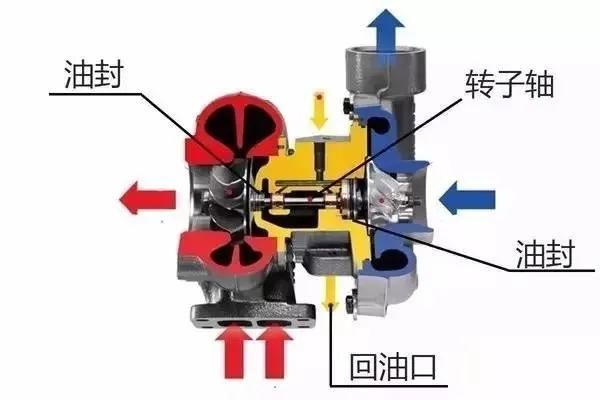
The left red cavity, known as the turbine or turbine exhaust side, rotates its leaves at high speed after being subjected to high-temperature, high-pressure motor exhausts, which drive the leaves through the leftmost pipe in the chart, which is also the driver of turbine work。
The middle yellow part is a moving axis (shaft), the function of which is to transfer the rotational power of the turbine leaf as little as possible, with a “stop bearing” on each of the two ends of the axis to stabilize it, and, of course, there is also a cooling or oil road + waterway。
The blue right cavity is called compressor, which is driven by the spin power of the convulsive side of the turbine. The leaves rotate, when fresh air is inhaled from the centre of the air, and when the centrifugal force from the fan turns towards the edge of the outer shell, the air is also condensed from the blue mouth in the top right of the picture, to the middle cooler or to the air-saving door。
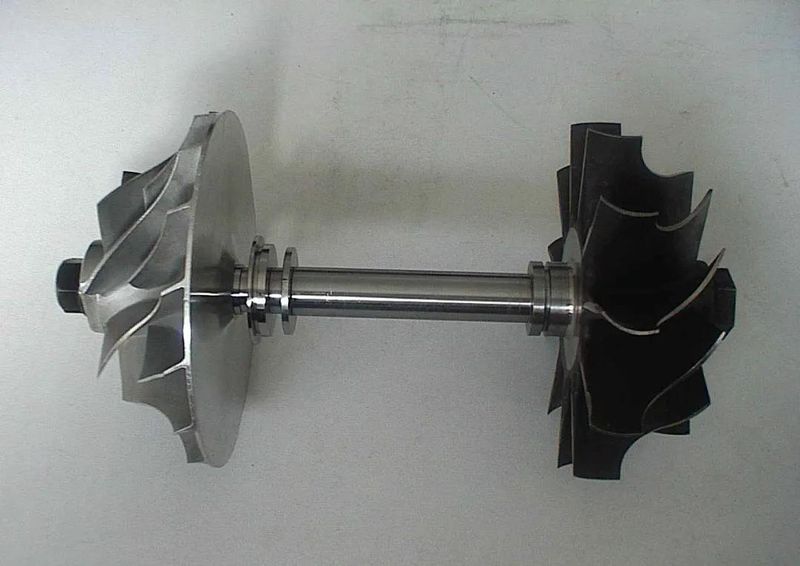
We also introduced the core components of the turbine pressurizer: the leaf
The bright side on the left is a condensed wing, and the black wing on the right is a waste wing. Ip
Turbo status
The main heat charge to turbine boosters is the high temperature exhaust accepted on the turbine side, which generally reaches 800 ~ 900°c. Even if the leaves use poorly heatable materials such as titanium alloy, the heat will be transmitted to the compressed side by bearings, together with the flow speed of the high temperature exhaust nears the sound speed, with the leaf turning at 200,000 turns per minute, even if the bearings are charged with cooling, even with roller bearings that reduce friction heat, which is surprising, so the leaves and bearings will be repaired or replaced after some time of use, which is the basic common sense used by turbine boosters。
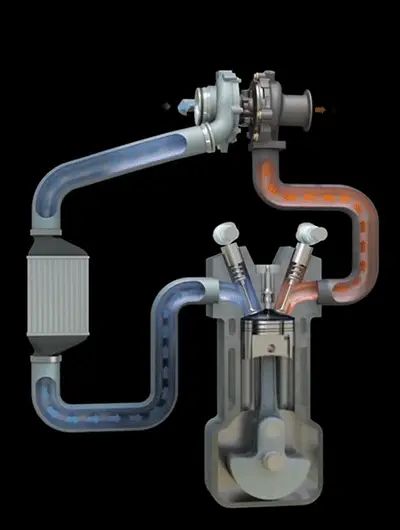
Work flow charts for the entire turbine pressurized engine, following the direction of the arrow: 1, air intake; 2, compressed air; 3, middle chillers cool for compressed fresh air; 4, enter engine combustion chamber; 5, exhaust; 6, enter waste gas side fan-drive rotation; 7, enter exhaust tubes。
3. Small history of turbine applications
The turbine booster was invented and patented by swiss engineer alfred büchi in 1905, and its first practical application was on board the aircraft, while the first turbine booster engine appeared on the napier leon xii engine in the 1920s, which was used on the diesel engine by rudolph diser, a german national, in 1912, while the widely recognized gas turbine booster today appeared on the v8 engine of aluminum 215 in 1962, known as “turbo-rocket”; the first european turbine booster model was the m31 (1990cc) engine on bm 2002 turbo in 1973; and the first japanese turbine booster model was the cedric and l20et engine on gloria, which was introduced in 1979。
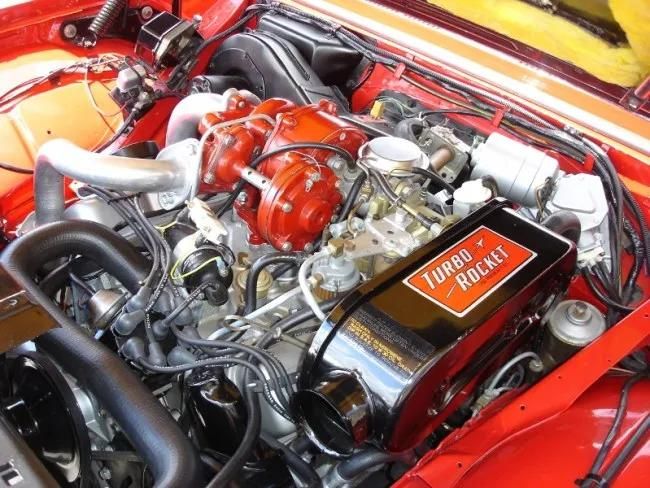
In 1962, oldsmobile launched the first v8 engine, turbo rocket, with a horsepower of 215 and 4600, and the turbine began to enter positive pressure in 2000 with a maximum boost of 0. 34 bar。
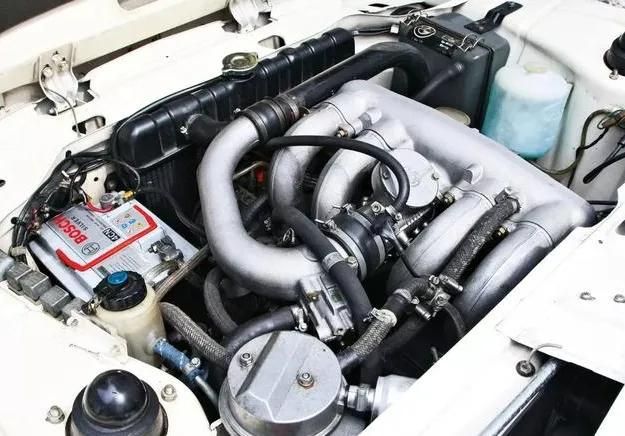
In 1973, bmw carried the first european turbine booster, code-named m31, using kkk's turbine booster, with a very low compression of 6. 9:1, with a mechanical fuel jet, generating 170 horsepower at 5,800 turns。
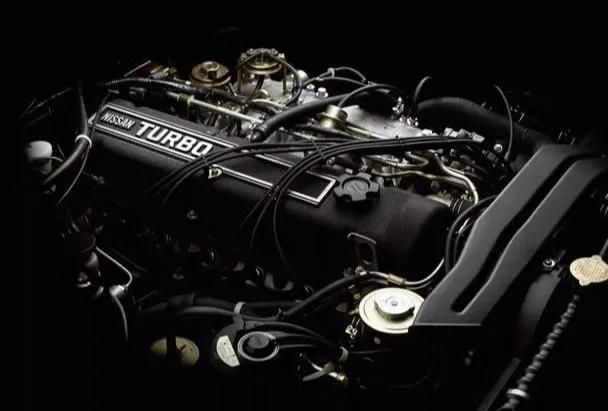
Japan, one of the three largest regions of the world's automobile industry, had only first launched a gas turbine engine in 1979 with the l20et straight-line six-cylinder engine on the duke, but the engine was not equipped with a medium cooler, with a maximum horsepower of 145。
Although the history of the use of turbine boosters on cars has been for decades, this has not been a smooth journey. Prior to the second oil crisis, there were different perceptions and trends among car manufacturers about the use of turbine boosters, and more of them took into account the idea of extracting as much power as possible under certain exhausts, so there was also a paralytic set of 1. 5 litres of formula 1 1 055 for output of more than 1,000 units (e. G. Ra166e's v6 engine in honda) in the 1980s, and on the back of this round, the high-energy turbine booster engine that began to rise in the 1990s became a belief and affection in many cars (e. G. Cosworth ybt engine in ford escort, 4g63 engine in mitsubishi, etc.). In 2005, the general public began a wave of turboization (ea211 and 1. 4 litres of tsi double-pressure engines), which, combined with the direct-jet technology in the casks, enabled small-voltage engines to acquire power parameters similar to larger charge engines, which cannot be said to be a compromise and maintenance of the earth's ecological environment. Of course, turbo = high performance remains a potential driver for many users who buy turbine-type boosters。
Tips
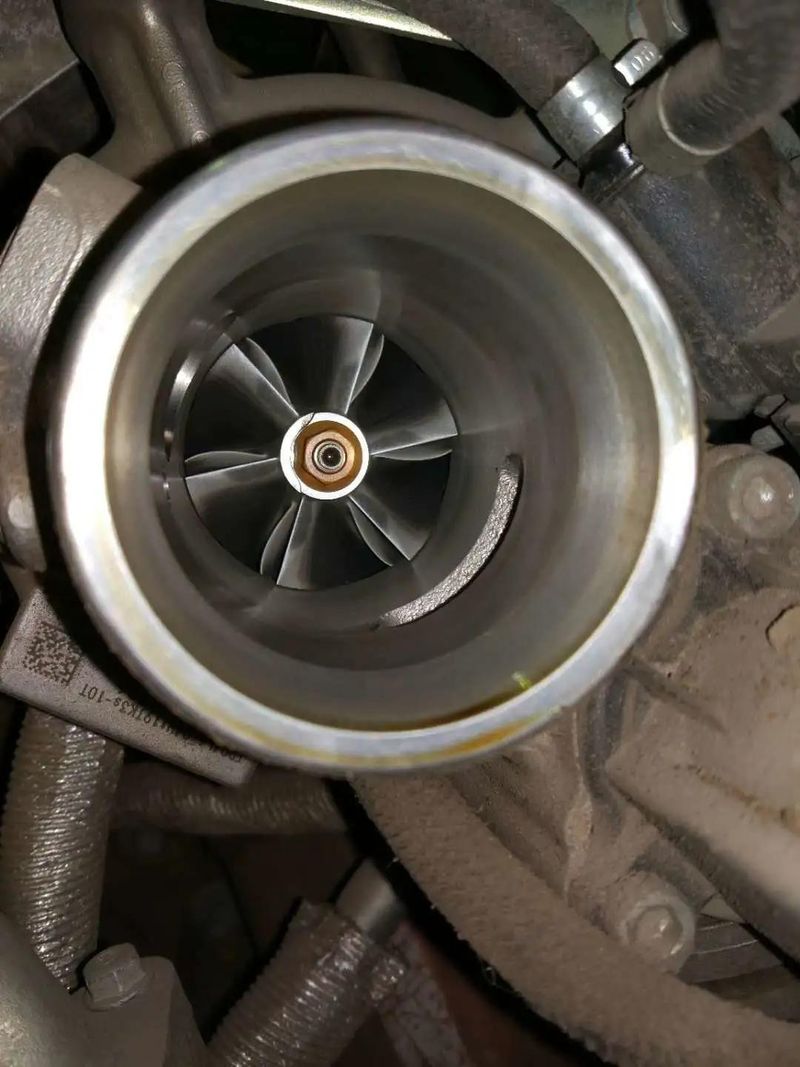
The owner's friends wanted the turbine to be used longer, or suggested that the turbine booster should be cleaned regularly, that the oil mud accumulated on the turbine blades should be removed, and that it should be avoided, resulting in a turbo-leaf loss, and that the turbines should have a longer life。
In addition, medium chillers can be cleaned, which act as cooling and compressing air and accumulate oil sludge in long periods of use. Due to the large area of exposure of the medium chiller and the greater amount of residual oil sludge, this can seriously affect air cooling and compression, thus reducing the performance of turbine pressors and reducing engine power。

In general, about 20,000 kilometres, 4s would recommend a turbine booster system clean-up to ensure that the turbine booster system is not overhauled。