On 28 august, when the people's network nanchang (journalist hourly rain) started school in the fall of 2025, the education department of nanchang city published a fee rate for the opening of school in the autumn of 2025, requiring district and district fees to be strictly in accordance with the prescribed projects, standards, increased management of fees for services provided by primary and secondary schools and increased management of fees for private schools。
The education department of nanchang city reported that since the autumn semester of 2025, all public kindergartens no longer charge child care and education fees for children in the previous year. Private kindergartens are subject to a reduction in child care and education costs corresponding to the local level of exemption for the same type of public kindergartens, after which children who were in the kindergarten in the previous year are charged a portion of the child care and education costs above the exemption level, and are not charged full child care and education fees, and are not charged for child care and education beyond the school term, but are not paid back。
Compulsory education is fully covered by financial security, and public compulsory schools are free of tuition fees and fees. The fees for public general high schools are implemented in accordance with documents published by departments such as the jiangxi provincial development commission。
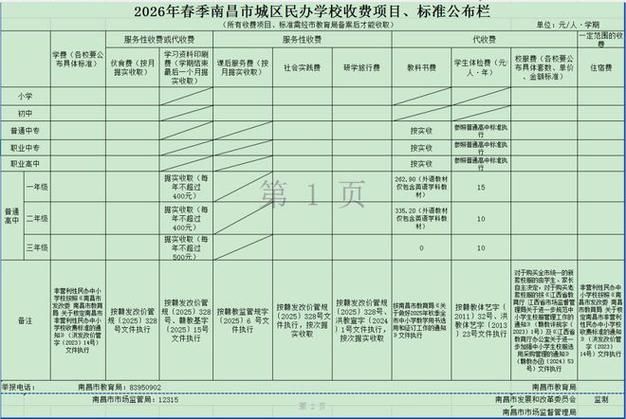
The education department of nanchang city has published fees for primary and secondary school services and alternative fees and standards。
Food: school canteens run on their own initiative are charged to students who eat at school on a voluntary and pro bono basis, as a service charge. If the school is contracted to operate a canteen or chooses to provide meals at an out-of-school feeding unit, the cost of meals is administered as a fee and is collected centrally by the school, not directly by the contractor or the out-of-school feeding unit, and the school is not allowed to derive any economic benefit from the cost of meals. School canteens are set up to publish food bills on a regular monthly basis and are self-inspected for social supervision. School fees should actively promote online forms of contribution, such as “the right to service”. Directly charged by the school, the cost of meals is deposited into an approved fund account for the school or other account specified by the equivalent financial department. The cost of meals may not be transferred to a personal account, public funds may not be held in private or collected by groups or individuals such as teachers, family councils, canteen management management teams, etc。
After-school service fee: service fee for compulsory education. These include after-school hosting and after-school activities. After-school service fees for primary and secondary schools are strictly enforced in accordance with the relevant regulations. After-school service fees (after-school care and after-school interest activities) in urban areas remain the same as those set by the previous district, development area and bay department of management, subject to government-directed price management, subject to the principle of the voluntary nature of students or parents, subject to the principle of pro bono and non-profitity, are paid monthly contributions, paid at the end of each school year on the basis of an actual settlement, and the balance is refunded in part in proportion to the student's attendance. Schools in the districts (districts) are strictly prohibited from expanding at will; after-school services should be scheduled on the day of school and after the completion of the national curriculum and school programme, the end time should be linked to the normal hours of work in the locality. School services such as early school attendance and self-study, midday lunch breaks and evening self-study for students are not included in the after-school service. The compulsory participation of students is strictly prohibited; the burden on students is increased; the excessive charging of fees in the name of after-school services is strictly prohibited; and after-school services are prohibited for institutions and persons who do not qualify. After-school service fees for primary and secondary schools are limited to compulsory education schools, and general high schools are not allowed to make extras and charges for double-curricular and holiday service. The expenditure for after-school services is carried out in accordance with the regulations published by four departments, including the nanchang city education board。
(c) social practice fees: students are organized by schools to carry out out out-of-school activities (off-sites, cinemas, exhibitions), which are personal and subject to uniform payment by the school and are paid for as a service charge, which can be collected from the students on a sequential basis。
Travel costs for studies: there are various ways in which students and students can be financed for study and study travel, partly service-related fees that should be borne by the student or the student's parents, collected from students on a voluntary and not-for-profit basis, and reduced fees for students from poor families。
Textbook fees: compulsory schools in both urban and rural areas have a unified “two-and-one-off” policy, and national and local curriculum textbooks are distributed free of charge to students. The cost of textbooks at the upper secondary level, including digital audio-visual materials with textbooks, is a surrogate charge and is collected strictly at prices approved by the relevant department。
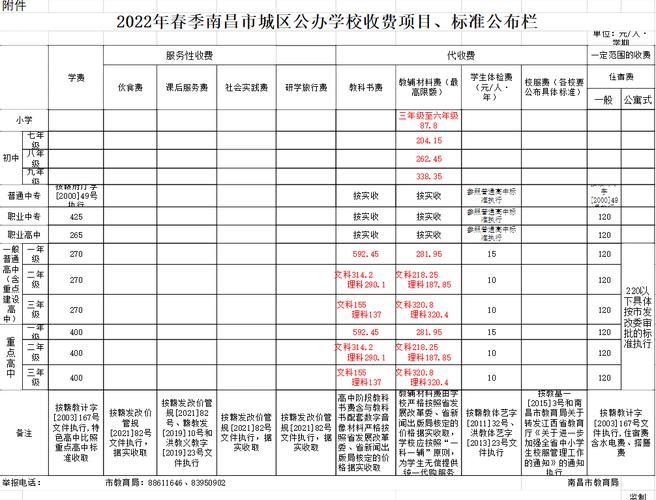
(c) printing of learning materials: in addition to completing the established educational activities in general secondary schools, schools may charge a fee of $1,400 higher, $2,400 higher and $3,500 higher to compensate for the cost of printing of school materials, on a voluntary basis, by students using schools or commissioning third-party printing of paper and learning materials (including extracurricular work such as after-school consolidation and refresher courses). Schools that are able to print are charged a service fee and schools that do not have printing conditions are charged a surrogate fee. The fee for printing of learning materials must be based on the voluntary principle of the student or parent, and it is strictly forbidden to impose or disguise the provision of learning materials to students and to charge fees; the principle of pro bono and non-profit must be adhered to, and the cost of printing of learning materials must be charged by the school for the last month at the end of the school term, which in principle does not exceed one half of the annual rate。
Medical examination of students: the organization of a student's examination in a compulsory school is financed from the school's public funds and may not be collected from the individual student. The fee for the organization of medical examinations for students in upper secondary schools is a surrogate fee and is implemented in accordance with projects and standards established by the relevant departments。
School uniforms: school uniforms are paid on their behalf. From the fall of 2025, new city-wide uniforms were introduced for students at the beginning of the primary and secondary school years where the contract for the supply of school uniforms expired. The students and parents decided on how and how to buy them, and they could choose to buy them in the market, or they could acquire them at a school uniform display platform in jiangxi province. Students in non-primary grades may continue to wear their former uniforms or voluntarily buy new ones; schools whose contracts for the supply of school uniforms are still in the contract period must consult all new parents in writing, etc. If parents prefer to buy old school uniforms, schools must be carried out strictly in accordance with the relevant documents (specific policy advice: nanchang city assessment centre: 0791-86783547)。