In the first half of this year, the minibus went to a four-line city study called ebein, and called for an internet car on the way to the hotel, a new energy car. On the way, we found three electric cars in 10 cars. New energy vehicles have such a high penetration rate in a four-line city。
When we arrived in the old city, we asked the driver: "did you see the power of the electric car
Master was quiet for a while and said, "i don't understand this, but now oil prices are too expensive to make money. I've just changed the car, and it cost 100 grand." he pointed to the logo on the steering wheel, "it's a five grain fluid."
Indeed, oil prices have been at a high level this year as a result of the russian-ukrainian conflict, depriving many of the bottom line of “95 fill”. Although oil prices had begun to fall in august, opec+ had decided to cut production significantly and oil prices had risen. Just in the past week, international oil prices have reached their largest single-week increase since march this year。
This year's domestic adjustment was characterized by an increase of “11 by 7” and an overall increase. On 10 october, oil 92 and gasoline 95 were still in the “eight dollar era”。
The price of oil has risen, but there has always been a “discovery” for china's carowners: international oil prices have risen and we have gone up, and international oil prices have fallen, and we have been right. When oil prices were the highest this year, there was also a story on the internet:
“in 2008, international oil prices were $147 and domestic oil prices were $6. 3; now international oil prices are $114 and domestic oil prices have exceeded $9. Is the barrel expensive?"
Why is this happening? Is the bucket really expensive? Is the domestic oil price really high
From 4 per cent mechanism to 50 yuan mechanism
The first is the existence of an unreasonable pricing mechanism。
We know that the oil price market in china has not been liberalized, but has been regulated by administrative means. In order to achieve rapid international convergence, we have introduced a 4 per cent floating mechanism. This means that international oil prices have risen by 4 per cent, followed by domestic manufactured oil prices by 4 per cent; international oil prices have fallen by 4 per cent, and we have fallen by 4 per cent。
But those who fired stocks would find out that that's not how it works。
For example, the price of crude oil, which had originally been $100 per barrel, had increased by 4 per cent to $104 per barrel. Domestic oil prices then rose by 4 per cent, from $5 per litre to $5. 2 per litre。
After some time, international oil prices fell and fell back $100 per barrel. What was the drop? Or 4%? Wrong, 104 = 3. 85%. As the 4 per cent threshold was not reached, domestic oil prices would not fall, still at $5. 2 per litre。
Over time, international oil prices have returned to $104 per barrel, rising by 4 per cent to $5. 4 per litre。
After some time, international oil prices fell back to their original $100, falling below the 4 per cent line, and domestic oil prices remained unchanged at $5. 4 per litre。
As you can see, international oil prices have not changed, but domestic oil prices have risen from $5 per litre to $5. 4 per litre, an 8 per cent increase. According to this pattern of rise and fall, one day oil prices will break the ceiling. This pricing mechanism is clearly conducive to higher prices rather than lower prices, which ultimately leads to a rising oil price base。
You say that doesn't make sense. It doesn't make sense. What do we do
In 2013 and 2016, the national development commission, which decided on the price of finished oils, re-engineered the price-fixing mechanism for finished oils, such as the setting of regulatory zones, changing the frequency of price-fixing to 10 working days, and, in particular, replacing the 4 per cent floating rate adjustment mechanism with “no adjustment when the range is less than $50 per ton, to be added to or offset against the next price-replacement”。
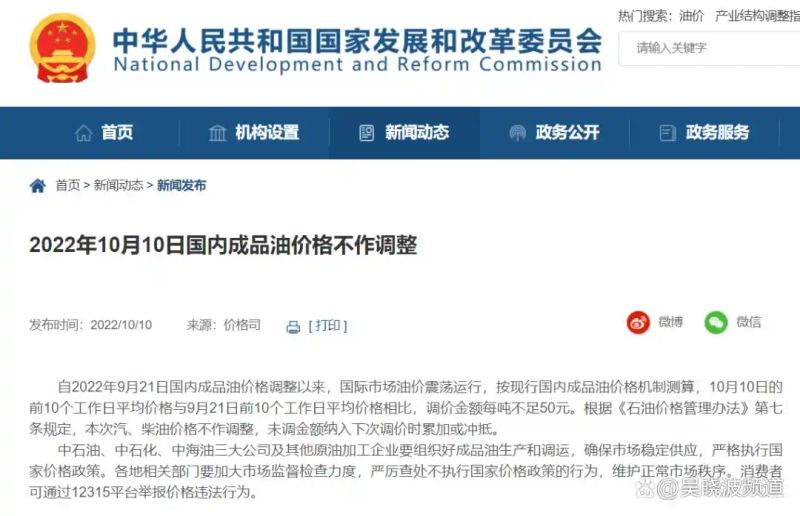
As in the latest round of price increases for finished products, on 10 october, no price adjustments were made due to the fact that the international price of crude oil did not fluctuate to $50 per ton. This was also the first time since 2022 that oil prices for finished products had been “grounded”. After the elimination of the 4 per cent mechanism in 2013, domestic oil prices fell in several rounds。
It is worth mentioning that cdrc has also set up oil price control zones: a ceiling of $130 per barrel and a floor of $40 per barrel。
It means that even if international oil prices rise to $500 per barrel, we will not, in principle, follow, or increase less, with $130 per barrel as a ceiling, and the ministry of finance will subsidize the refinery. But if international oil prices fall to $10 per barrel, our oil prices still have to be set at $40 per barrel。
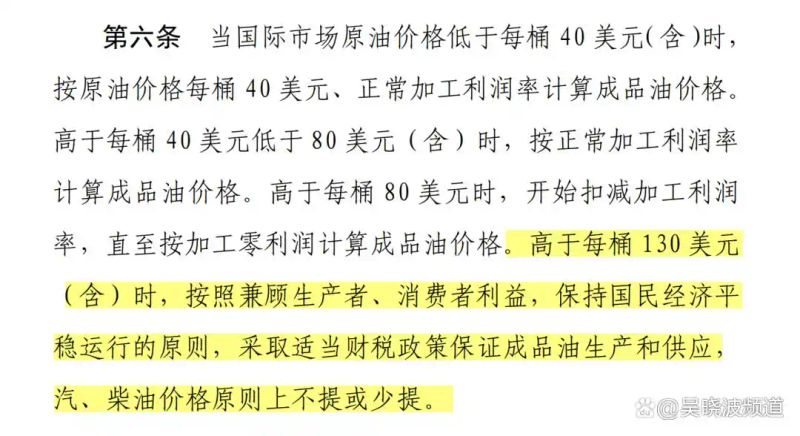
Chapter ii, article 6, of the uncitral oil price management scheme
This mechanism has the advantage of avoiding inflation from high oil prices. But whatever the fall in international oil prices, china will keep “floor price”. So if you look at the international oil prices of the calendar year, you will find that, starting in 2008, only once above $130 per barrel, and under $40 per barrel, is widespread。
Is the barrel expensive
The second factor is taxation and taxation. We say oil prices are expensive, and perhaps barrel prices. “drums” generally refer to taxes and fees。
According to the world energy site, all countries purchase oil at the same price on the international market, but the difference in gasoline prices is related to taxes and subsidies。
Between 2014 and 2015, the ministry of finance and the national tax administration increased the product consumption tax three times in a period of 45 days, against the backdrop of tight fiscal revenues and a “13-time fall in oil prices”. At the time, the policy had generated a great deal of public opinion, focusing on the three-day shift of taxes, and was it contrary to the principle of “fixion” of taxes? Will the taxes collected and the vast circle be subsidized by oil companies
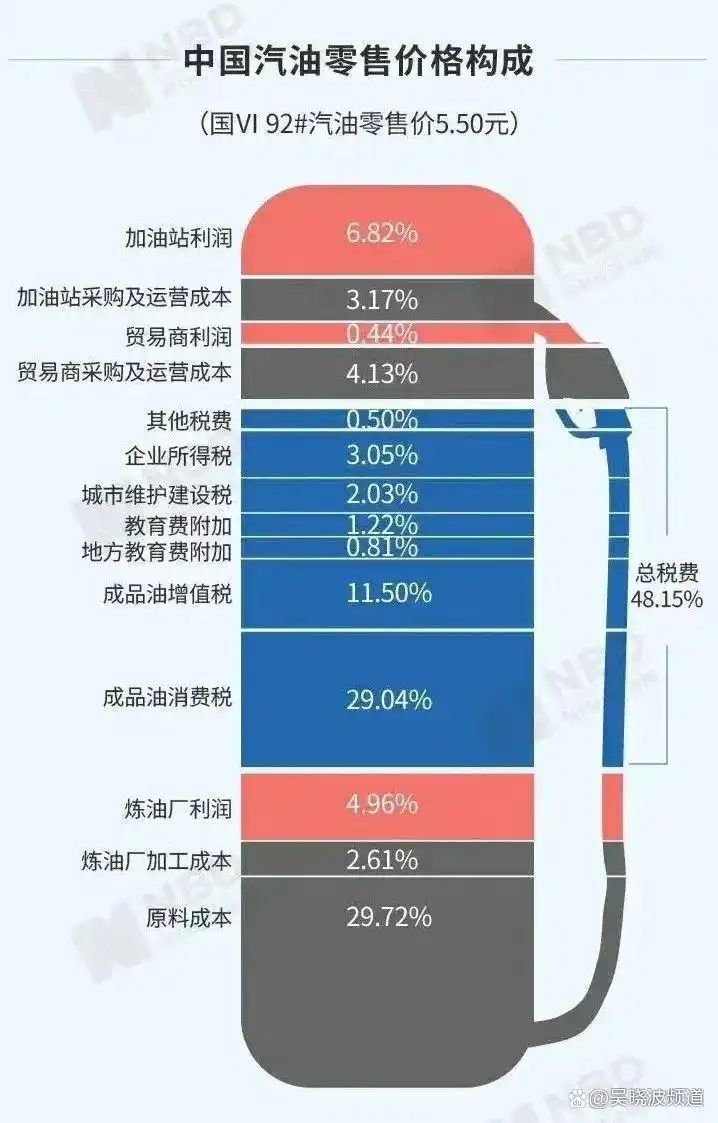
In all, after three tax transfers, the share of the retail price of finished oil rose from 35 per cent to 48 per cent. Taking the example of the country's 692 gasoline in 2015, the retail price consists of three components: costs, profits and taxes。
Costs and profits, taken together, are known as “tax-free prices”, which account for 52 per cent of retail prices. The remaining ones were taxes, 48 per cent. The 48 per cent tax included 29 per cent of the consumer tax on finished products; 11. 5 per cent of the value added tax; 3 per cent of the enterprise income tax; and the remaining small taxes on urban construction, education fees and local education. (simplified composition, taxes on imports and mining, not all of which are borne by consumers)