On august 9th, the china-newsun client (linquis) “cool skin, meat clamps, and another bottle of ice crest”, a qin meal that runs through the growth of the sian and is known for its western features。
Following the listing of the arctic sea shell, the shangxi old brand of soda, ice peak, also recently submitted a stock call to a deep-knock exchange, which hit the “first share of domestic soda”. However, since the introduction of orange soda 60 years ago, ice-capture beverages have been released with the risk of relying on a single product for performance and concentrating on distribution areas at the source。
A glass bottle of orange-flavored soda breaks down a billion bottles a year
According to the book, ice-peaking soda originated in 1948 and was then honoured with the old sian title, the old sing si, and the best human brand in the food industry. The main business is the development, production and sale of beverages such as orange soda and soy soup。
It is understood that during the years of qingcheng, the dutch brought soda into china, when it was called dutch water, and that the first soda equipment in sian came from the tianjin soda plant built by foreigners。
In 1948, an owner purchased a soda production unit from the tianjin soda plant, which was to be built in xinjiang, and the road was sealed off and the equipment was left in xi'an. Later, the east street ma factory built the first water plant in sian, the north west water plant. In 1953, the joint venture water plant was incorporated into the sian food plant。
At the end of the 1950s, a snowstorm frozen a well that produced soda and piled up like an ice peak, which made it known as the “ice summit”。
According to the ice peak network, ice peaks were sold to 30 million bottles in 1986. In 1993, as a result of the invasion of foreign branded beverages, the market share of the ice peak was reduced to 30 per cent. Twenty-five years later, the volume of ice-peaking soda has broken down by billions. More than half a century of ice-peakers are now not satisfied with shaanxi, and they want to apply to the market to expand their influence。
According to the equity book, during the reporting period, the company's main products were an “ice summit” bottle of orange soda, an orange bottle of soda, a glass bottle of yogurt soup, a jar of yogurt soup, etc。
Of the company's main products, glass bottles of orange-flavored soda sell the best. The equity book shows that the actual production of orange-flavored bottles of glass from 2018 to 2020 was 155 million bottles, 146 million bottles and 134 million bottles, with a distribution rate of 100. 41 per cent, 99. 97 per cent and 100. 17 per cent, respectively。
In terms of marketing costs, an orange-flavored bottle of bottled soda is 200 ml and a bottle of 24 ml is sold at a price of $17/box, $18/box and $19/box, respectively, from 2018 to 2020, at an average price of less than $1。
Among the main products listed above, the highest māori rates are found in bottled orange sodas, which are 58. 48 per cent, 57. 17 per cent and 57. 59 per cent, respectively, and combined māori rates of 49. 81 per cent, 50. 67 per cent and 46. 73 per cent, which are comparable to those for beverages such as dong peng, mean health and feeding。
On the cost side, according to the equity book, the main operation cost of ice peak beverages in 2020 was $176 million, with the largest share of expenditure not on juice, but on cans。
According to the equity book, the cost of the cans was 22. 95 per cent, followed by white sugar in the raw materials, 17. 16 per cent, and extremely important concentrate in the beverages, 7. 21 per cent, while the cans and boxes were 6. 52 per cent and 4. 55 per cent, respectively。
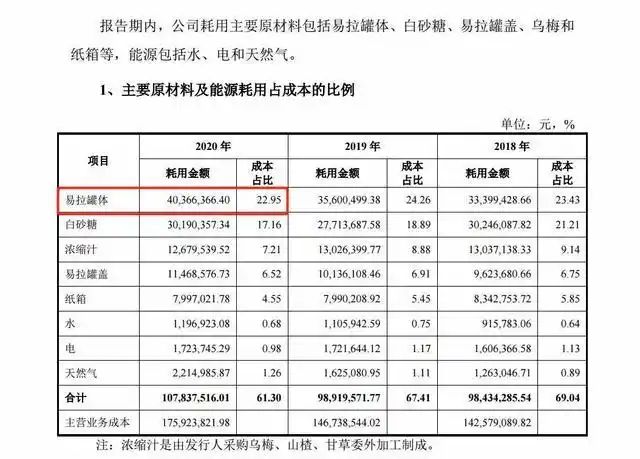
Source: ice peak stock book
Between 2018 and 2020, the income from ice-peaking beverages was also 286 million yuan, 302 million yuan and 333 million yuan; the net profit was 69,699,000 yuan, 77,678,000 yuan and 65,251 million yuan respectively。
We're relying on shaanxi
Behind an annual sales volume of more than 100 million bottles of orange-flavored water, ice peaks face a single product structure。
The main operation for ice-peak beverages is the development, production and sale of beverages such as orange soda and yogurt soup, with the main products being “ice-peak” bottles of orange beverages, canned orange beverages, glass beet soup, canned soy soup, etc。
Although the product type of ice-capture beverages has been extended from carbonated beverages to plant beverages, fragrance beverages and tea beverages, orange-flavored soda still contributes the bulk of the revenue。
In terms of the composition of the revenue products from the ice-peaks main operation, between 2018 and 2020, a total of $246 million, $253 million and $270 million were spent on bottled orange and canned orange soda, representing 86. 38 per cent, 84. 38 per cent and 81. 48 per cent, respectively, and a total of $35,923 million, 39,519. 6 million and $4,892 million, respectively, were spent on bottled soy soup and canned soy soup。
In addition to these two types of products, other products from ice peaks, including apple-flavored soda, juice soda, groundnuts and tea, received $34. 41 million, $73. 816 million and $12. 3631 million for the last three years, respectively, representing only 1. 2 per cent, 2. 46 per cent and 3. 74 per cent of the income from the main operations。
The equity book explains that glass bottles of soot and other products, such as tea drinks, are still in the market stage and are still sold on a smaller scale. The ice peaks have developed a number of new products in the last three years, but they require more resources for extended r & d and may have some impact on their performance due to the risk of failure of r & d or lack of market acceptance。
It should be noted, however, that, in 2020, more than 80 per cent of the income for ice-peaking beverages was from shaanxi and that the share of income in the rest of the country was modest. According to the book, ice-peaking beverages accounted for no more than 4 per cent of income in south, east, south-west, north-east, north-west, china and north china between 2018 and 2020。
The shock came on the market, and ice-cream beverages did intend to expand nationwide. According to the equity book, ice-peaking beverage applications are proposed to raise $669 million, of which $199 million is for the expansion of glass bottled production lines, $40,329. 9 million for the development of an information management platform and $430 million for marketing network upgrades and branding。
In this fund-raising project, the total investment proposed for the marketing network upgrade project exceeded 64. 28 per cent. According to the company plan, the marketing network upgrade project is built in three areas: regional marketing centre construction, channel construction and branding, of which $140 million is proposed for marketing centre construction, $109 million for pipeline construction and $180 million for branding construction。
In the construction of marketing centres, ice peak beverages mentioned that the construction of regional marketing centres was mainly divided between the xian marketing headquarters and other regional marketing centres throughout the country, with offices in nine cities (lanzhou, chengdu, chongqing, beijing, zhengzhou, shanghai, hoi fat, wuhan and guangzhou)。
In an interview with china’s new latitude client, china’s food industry analyst zhu danbong analysed that ice-cream beverages are typical regional brands and legacy products, and that, in the past, the entire industry in a region was compatible, such as a region with a brand of white wine, a brand of beer, a brand of beverages, but such a mechanism did not match the strategy for the nationalization of ice-peak beverages, thus creating a distinct geographical feature and becoming dependent on shaanxi。
How's ice peak
In the 1960s and 1970s, a number of local brands of soda became urban business cards, such as the arctic sea soda in beijing, the tianjin customs soda in tianjin, the shenyang 8th temple soda, the guangzhou asian sushi, and the chengdu snow soda。
In the late 1970s, coca-cola and pepsicola entered the chinese market with strong expansion. In the 1990s, home-grown “old soda” or joint venture brands were shut down, or the production stopped, with a small number of people struggling to maintain their businesses, and their size shrunk. As china's economic power increased significantly, its old brand of soda resumed。
It is worth noting that the arctic ocean is currently going to access capital markets with the help of luxurious technology, and that skywatch shows that the old wuhan brand of “hanquor ii” has also received three successive rounds of financing, trading over billions of dollars, but that the competition for ice-cream beverages is already not limited to the old soda brand。
In an interview with the china-china new latitude client, mae shen, a capital director, stated that ice peaks are similar to brands such as the arctic ocean, that they belong to regional brands, that the influence of local markets is much greater than that of extraterritorial markets, and that ice-peak beverages are based on memory transmissions and non-products themselves. When memory transmission diminishes, it may result in business faults due to a lack of sufficient marketing resilience。
As a result of rising awareness of healthy consumption among the chinese population, carbonated beverages are no longer a popular product in the beverage industry, and consumer consumption trends are shifting towards sugar-free drinking。
Shen ming suggested that, when ice-peaked beverages are brought on the market, the focus should be on overcoming reliance on memory transmission and increasing emotional links to core consumer groups, while increasing inputs into product development and development to make the product itself competitive。
In an interview with the china-china new-language client, jiang dang, a senior researcher of the chekugu think tank, pointed out that, after the old beverages are on the market, there is a need to be aggressive, innovative, and further broken circle to create their own competitive advantage in the wider region and market, which is where ice-peaking beverages are not currently available. “the capital force on the market may sometimes be a force or a shackle, and how to truly borrow capital may indeed be a decision to make”。
On 3 august, a letter was sent to the sino-latitude client on the product development programme for ice-peak beverages and a letter to the ice-peak beverages as of 3 august。
(the views in the text are for information purposes only and do not constitute investment proposals, investments are risky and entry to the market requires caution. I'm not sure