Coca-cola is probably about to do a "high price drama." a bottle of 500ml (bottled) coca-cola has been sold at $3. 4 in a yonghui supermarket outside the eastern ring of beijing, as compared to $3 earlier last year; the equivalent volume of peach-free sugar-free coke is $4. 7, an increase from the end of 2021。
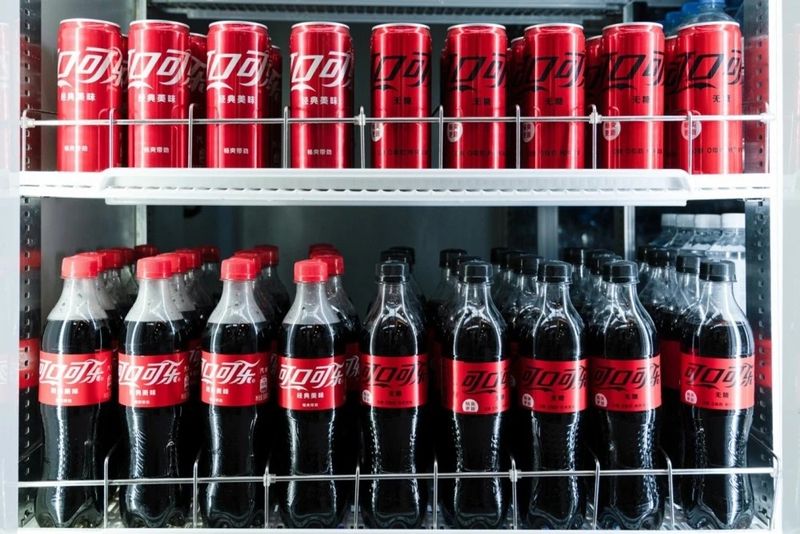
The increase in the price of coca-cola occurred through multiple channels. Known sources reveal that prices vary slightly in convenience stores, small supermarkets and supermarkets, with some channels selling even about $4 for a bottle of 500ml of ordinary coke。
On the shivering platform, some of the old beverage cannons created under the banner of the “advanced dealer” have also begun to give “cola up to price” in the last week or two. Some sources have told tiger that if coke is officially raised in 2023, the last two years will be almost a decade of coca-cola intensive pricing cycles:
After all, coca-cola formally entered the 3. 5-dollar era in 2022. On the other hand, higher costs of raw materials, transport, etc. Directly contributed to higher prices for a wide range of products, including coca-cola。
It is noteworthy that “price stability” was once one of the competitive instruments of coca-cola. “the low and low price increases are what coca-cola has always been called for by consumers and the key to its repression of competitors.” this year, information received from multiple sources shows that coca-cola appears to have continued to increase after having experienced a single price increase。
More recently, the “challenge” of the increase in the price of coca-cola has been caused by the “closure” of gum. Arabic glue is one of the raw materials for the production of carbonated beverages such as coca-cola, which makes carbon dioxide more stable in carbonated beverages. According to foreign media reports, 70% of the world's arabic glue comes from the sudan's kamikaze. The conflict in the sudan has affected international trade in arab rubber, leading to a sharp rise in the price of such raw materials。

♪ i've got ♪
However, a senior beverage practitioner told tiger to smell that he did not believe that the matter of arabic glue would have a substantial impact on coca-cola. This is due to the fact that large enterprises generally have raw materials reserves and that the cost of raw materials is very low in the total cost of coca-cola, where the share of single raw materials is even lower. “an increase in the price of a raw material has little effect on its price book.”
Arab glue does not pose a threat to coca-cola, and what really bothers the king of carbonated beverages is perhaps high costs in the context of inflation, and hard to find。
In our beverage market, in particular, coca-cola became the “noun” for soda for a long time, relying on channels and price advantages. In recent years, however, domestic brands of beverages have emerged, some of them even directly introducing coke, “killing” into the main position of coca-cola。
Faced with the emergence of new brands, coca-cola also began a full-text layout six or seven years ago to look for additional quantities of carbonated beverages. However, in the view of industry, coca-cola appears to have a slower pace than a flexible small enterprise to build a “new explosive product”。
Under pressure, price hikes
The increase in product prices was not new, but it was particularly interesting to place it on a very low price coca-cola. National securities data show that the compound price of coca-cola products increased by only 0. 42 per cent between 1990 and 2019。
In 2022, coca-cola launched a new round of price increases due to rising costs. As a result, the price increase did have a positive impact on coca-cola's performance since last year: coca-cola earned $43 billion in 2022, an 11 per cent increase over the same period, including 11 per cent price increases and a “product and geography combination” drive。
In the first quarter of this year, coca-cola earned $10. 98 billion, an increase of 5 per cent over the previous year. Of these, the rise in company prices and the “products and geography mix” had a positive 11 per cent impact on revenue growth。
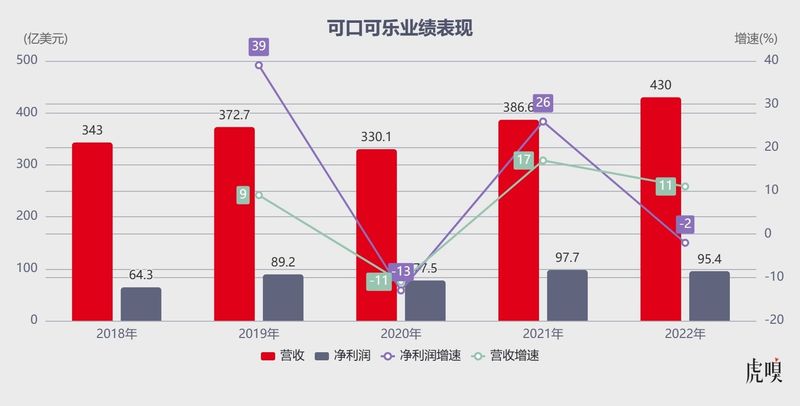
Although coca-cola has been growing at a modest rate since 2021, stimulated by price increases and other factors, two “disturbing” remain alarming。
The first is that the growth in the company's product sales is slowing down。
Single-box sales are important indicators for measuring consumer demand for coca-cola. In 2021 and 2022, respectively, the volume of coca-cola single cases increased by 8 per cent and 5 per cent, respectively. Overall, the rate of increase is not low, but if seen in quarter, the rate of increase in coca-cola single cases has slowed since q3 in 2022: 8 per cent in the first two quarters of 2022; q3, q4 and q1 growth in 2023 were 4 per cent, -1 per cent and 3 per cent, respectively。
In the subregion, europe is the place that gives coca-cola the most “headache”. In the second half of 2022, the number of boxes sold by coca-cola in european, middle east and african markets began to decline, with the number of boxes sold in europe falling by 7 per cent in the first quarter of this year。
In the fourth quarter of last year, the sales of coca-cola declined in our market, leading to a 1 per cent decline in sales of single boxes in the asia-pacific region. However, coca-cola has slowed markedly in our market since this year。
In addition to a slight slowdown in sales growth, another concern of coca-cola is that the company's gains are not increasing: in 2022, net profits declined by 2. 3 percentage points in comparison with the 11 per cent increase in revenue。
One of the main reasons for this situation is the rise in production, transport and other costs, as well as the fact that the rise in product prices is not sufficient to offset the negative effects of such increases. In 2022, the cost of selling coca-cola commodities amounted to $18 billion, an increase of 17 per cent over the same period. Increases in costs, including the overlapping exchange rate, led to a decrease of approximately 2 percentage points in the ratio of maori to coca-cola in 2022。
The bad news is that inflation continued in 2023 and production enterprises, such as coca-cola, continued to face significant cost pressures。
In response, coca-cola offers programmes that continue to increase prices: in february this year, coca-cola indicated that the price of its products would be further increased “globally” in 2023, although the increase would slow down。
"it's not easy to find new money."
Cost pressure in the context of inflation is a "close" of coca-cola. The search for new charges is a longer-term challenge。
At present, the brand of carbonated beverages, especially coca-cola, remains the basic disc of coca-cola: in 2022, carbonated beverages accounted for 69 per cent of total coca-cola sales, of which coca-cola alone, a single brand, accounted for 46 per cent。
Coca-cola is called the king of carbonated drinks. In terms of market occupancy, coca-cola accounted for 44 per cent of the global carbonate market in 2020, 25 percentage points higher than the second-ranked pepsi。
Not only is market occupancy high, but coca-cola is more profitable than its peers。
Specifically, except for the maori rate of approximately 58 per cent in 2022, the coca-cola māori rate has remained almost at around 60 per cent over the past five years, approximately 5 percentage points higher than that of peers。
The māori rate is so high because of both the globalized layout of coca-cola, its size advantage, and its light asset operating model。
Let's see how expensive a coke is. In its research, the fulfillable securities report states that the cost of production of a bottle of 500 ml coca-cola is approximately $1. 1: 0. 2 for raw materials, 0. 6 for bottles and 0. 3 for storage and logistics。
Not only are production costs low, but coca-cola has also managed its core business in its own hands through the light asset model, leaving “dirty work” to collaborators。
Coca-cola's main products are in two categories: concentrate and manufacture. The simple understanding is that coca-cola sells it to its own co-conveners, who produce, bottle and sell it; the finished product is coca-cola。
In terms of sales, coca-cola sold on the market is mainly supplied by the company, and the bottler is responsible for producing and selling: in 2022, 82 per cent of the unit container sales for coca-cola were from the company. In other words, coca-cola sells mainly formulas and brands。
Coca-cola provides only concentrate, so the cost pressure on packaging, the funding for plant construction, the transportation pressure, etc. Are left to bottlers. China coca-cola and taco-cola are two bottlers of coca-cola on our market, the former having about 36 per cent of their parent company's maori ratio in 2022, 22 percentage points lower than coca-cola。
The high levels of māori and market occupancy, combined with the branding effect of more than a century-olds, are no wonder that there are many people turning coca-cola into a “liquid machine”。
However, the “liquid printing machines” also have their own challenges: consumers are increasingly choosing and coca-cola is difficult to finance。
In our markets, for example, carbonated beverages are the “ceiling card” of coca-cola, which, at a cost advantage, has priced “pressed” our domestic brand of soda。
In the words of the above-mentioned senior beverage industry practitioners, there are no national product plates or coca-cola or pepsi board on the 3-dollar carbonated beverage product. “for example, the rise of domestic soda in these two years is abundant, but they are generally priced higher than coca-cola, one because of the high cost; the other because of the price of avoiding and coca-cola.”
In recent years, however, the repression of the domestic brand of soda by the “two bands” is gradually being dismantled. The reason for this is the rise of more consumer-intensive groups, such as the new middle-yielding cities and the z generation, which are less sensitive to prices. The branding of beverages in countries such as gaseous forests, by meeting the specific needs of these groups, can yield new users even at slightly higher prices。
In the industry as a whole, coca-cola's best carbonated beverages, although marketed on a large scale, have not grown as fast in recent years as the new ones (sport and functional) and non-carbonated beverages。
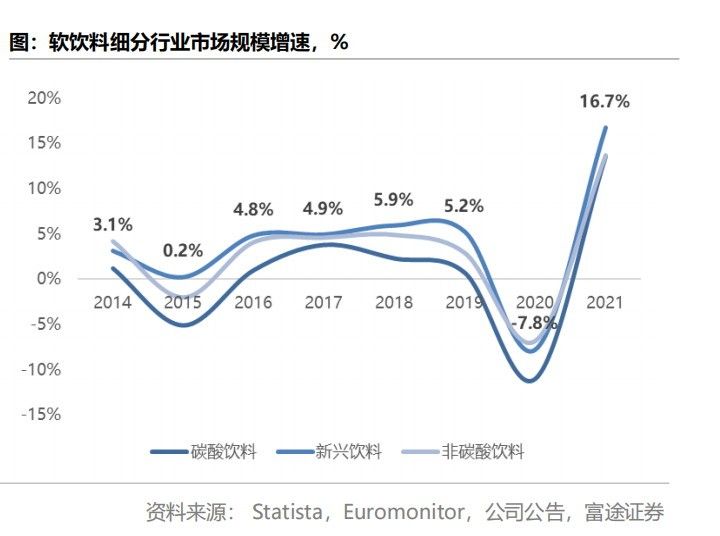
(note: diagram from richaway securities)
The slowing down of carbonated beverages, coupled with increasing consumer choices, also requires coca-cola to break its own ceiling and find new quantities。
In 2016, coca-cola began its full-text distribution of drinks, followed by the creation of new brands through mergers and acquisitions or internal innovations. According to its official network, coca-cola currently has over 200 brands, covering carbonate drinks, drinking water, coffee, milk and low alcohol。
Although coca-cola is well-placed, for example in the chinese market, we will find that very few new pops in recent years come from coca-cola. The above-mentioned seniors told tiger that this is what the industry often calls “the failure of a big factory to make new money”。
He explained that large companies such as coca-cola generally had a longer decision-making process, ranging from focusing on market demand to developing products, volumes and markets, which could take months or even a year。
However, such an explosion could be faster for small businesses, “especially now that little red books, shivering and other platforms are spreading very quickly, and a product can be pushed out in a month or two or even days”
In this case, large plants could use production and channel advantages to launch replicas, but the dividends of the new ones could be months away, and the replicas would not necessarily be able to reap them。
Coca-cola is “exhaustible” in the case of innovation and new products, but there are many more examples of failure. Media reports indicate that between 2018 and 2020, coca-cola cut off 1,500 brands over three years. At that time, the king of carbonated beverages was on his way to finding new explosive amounts。