F1 hands turn the half wheel, from the left to the right, with little to leave 3 or 9 o'clock on the wrist — less than half a round, and not even need to change hands when bending. And your home car needs two and a half laps to turn around. The two wheels appear to be in different shapes, whereas at the bottom of the machine they are two species。
Their differences are not “good-looking” and “not good-looking”, but rather the complete division of the three dimensions of structural mechanics, shift to systems, and security logic。
Structure design: one for light quantification, one for redundancy
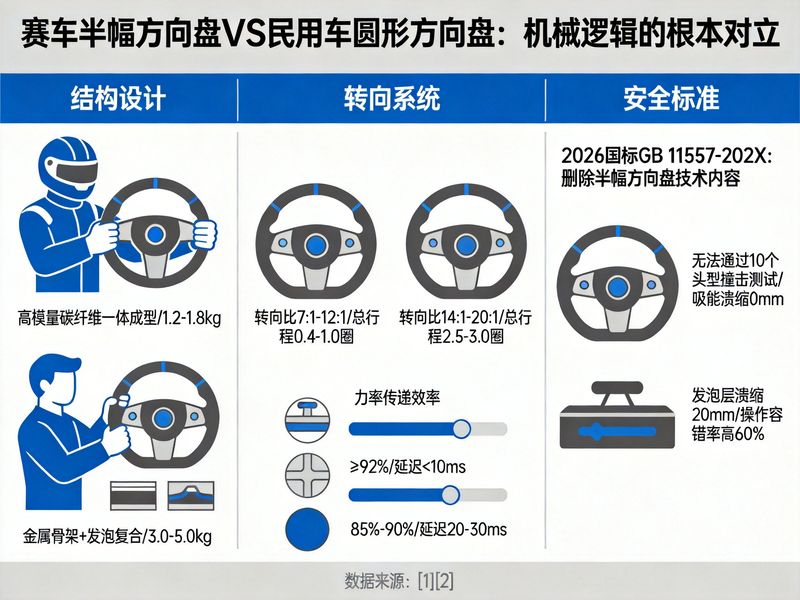
Start with the most intuitive. A semi-director drive with the main object being the integration of high-module carbon fibres, with a single plate weight of 1. 2 ~ 1. 8 kg. It cuts off the first half of the circle, concentrating on the 180° region below, with a cross-section thickness of up to 40 per cent — where the stress is thicker and the rest of the body is extremely heavy。
The traditional civil circle steering wheel is a composite structure of metal skeletal bubbles with a weight of 3. 0-5. 0 kg, which are closed and evenly integrated throughout the week, so that no matter where you hold it, even when an accidental impact occurs, the structure does not collapse instantly。
It's like a professional sprinter's nails and your day-to-day sneakers — the former being in charge of moving forward, with every gram of weight at speed; the latter having to cope with a variety of scenes, such as walking, jumping, going down stairs, etc., at the expense of some of the extreme performances in exchange for adaptation of the whole scene。
Differences in exposure paths are more critical. The payload of the half drive is transmitted directly from the two holding points below to the irradiation strips, which are then transmitted one-way through the centre of the french, and the stress is concentrated in the lower half of the area, which is carried by a pre-set reinforced liner. The response of the traditional disk is evenly spread along the entire circle and can withstand accidental shocks at any point, with over one-fold overload。
One is a well-calculated rigid skeleton, and the other is a solid “ring”。
Transition system: 0. 4 and 2. 5, determining who survives
There's an absolute watershed here: turn to the total journey。
The shift range for the half-drive race is 7:1 ~12:1, with only 0. 4 ~1. 0 laps left or right to full circle. F1 racing is typically less than 0. 6 laps. - that means you don't need a "shape" disk, so your palms can do all the shift。
The conventional civil circle steering wheel has a shift ratio of 14:1~20:1 with a total of 2. 5~3. 0 laps。
Why can't half the disk be civilized? The answer is more than two rounds of margin. When you have to hit from the left to the right, the first half of the missing half of the plate is such that you can't hold the wheel at all as you approach the limit angle, single-hand operations are so easy to “scratch”, and there are accidents in the corner of the screen with a finger scratch。
The sae international association of automobile engineering (sae) analyses blood: the mechanical advantage of a half-way wheel can only be shifted to the total journey beyond this boundary, and the absence of mechanical defects in holding areas becomes an unacceptable security risk。
There is also a gap in the efficiency of the transmission of force. Half the wheel is 92 per cent efficient for transmission due to low turnover and elimination of internal consumption in the ring structure, with a delay of less than 10 m. Traditional disks are limited to circular structures, with delivery efficiency of 85% ~ 90% and feedback delayed at 20-30 ms。
The natural advantage of responding to close to 15 to 20 per cent implies more precise entry control on the track; however, in the day-to-day movement scene, this advantage is completely overwhelmed by security deficiencies in the operations of the main corner。
Safety standard: why the national marker eventually “de-listed”
You might ask, "why can't we use safer designs for civilian use, given that half a plate is so good? The answer is hidden in the latest national logo in 2026。
In february 2026, the approval of the mandatory national standard gb 11557-202x, published by the ministry of industry and communications, " regulations to prevent the diversion of cars to institutions from harming drivers " , completely eliminated all the technical elements involved in the “half wheel”。
The reason given by the standard revision team was that the lack of a semi-directorial structure prevented the completion of the 10 head impact test sites required under the new regulations, and that there was an inescapable technical hazard at the passive safety links of the airbag expansion path, collision energy absorption, etc。
More fundamentally, the standard requires that a shift to an agency's security design must give priority to ensuring that the whole scene is universally subject to error。
Half the steering wheel is structured in a collision scenario with zero-- the bubble layer of the traditional circular steering wheel can overwhelm 20 mm to absorb the impact energy, while the carbon fibre formation of the semi-drive is completely non-distorting inhalable in collisions and the risk of impact on the driver's chest increases significantly。
Sae's analysis was also clear: the lack of a mechanical structure on half the wheel did not meet the requirement for full road safety redundancy for civilian vehicles. The empirical data of the car house professional assessment team show that although the response rate for half-drives is 15-20 per cent, it is more than 60 per cent below the conventional disc in terms of operational tolerance。
In the final analysis, the difference between the two wheels is not a difference between design aesthetics, but a fundamental contrast between mechanical logic: one is a race for a limited short cycle, with no cost for the extreme speed and weight of response — 0. 4 laps of turn-through, carbon fibre skeletons, zero ulceration, each serving only one-thousand-seconds on the track; the other is for a 10-year-wide home, striking a balance between structural safety, operational error and collision protection。
When the market tried to shove the car's “performance specialty” into a civilian car, the national sign did only one thing — to draw a secure line and return the track that belonged to it。