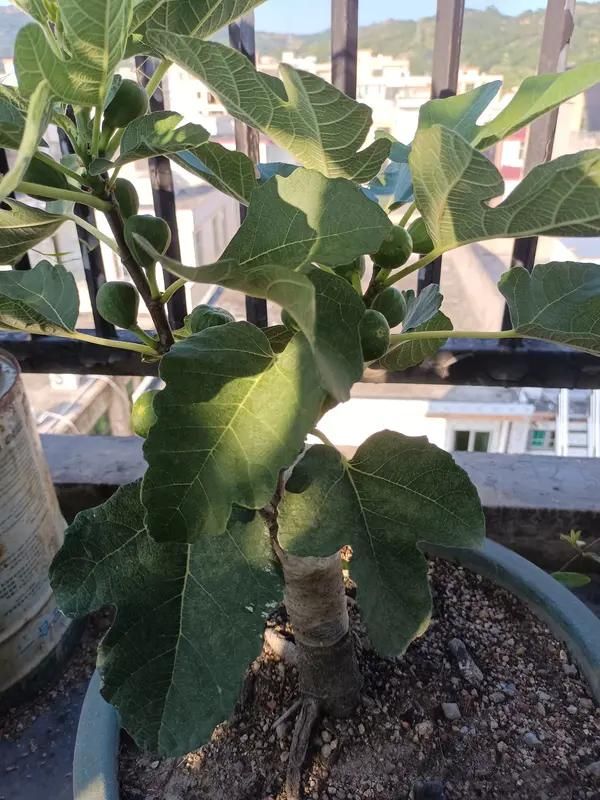
A lot of people planted figs that stepped on this strange pit: thinking that the pot was filled with a few seedlings, and that the soil of the province could produce more results, and that it was frozen and slow, and the fruits were small and small。
A number of growers have tried to plant three figs in a 60-caliber large basin, and a few of them have a good last pelvis hold, but more people have done it, growing up to half a person for six months, without even a few good fruit。
A lot of people wonder why they can't grow up if they're big enough. In fact, the roots are found in the nutrient supply of the roots and basins。
The fig is itself a luminous and fertilized plant, and as long as the light is enough, the greater the capacity of the basin, the more water it can fatten, the more the seedling will grow and produce more. Several seedlings are squeezed into the same basin, each of which last year's roots is entangled around each other, and the eutrophication capacity is broken directly and the nutrients of the basin are taken out by several seedlings within two months。
In particular, the plant, which has not changed in two to three years, has long become a dense earth mass, with a significant decline in absorption capacity, combined with poor slab aerobicity and new leaves growing small and yellow and difficult to grow fast。
Many experienced old florists have suggested that figs should be turned over once a year, and that the pots should not be small when they are larger, from 60 to 70, with different trends。
After debauchery, a root is to be repaired, a quarter of the ground is to be cut off, the root is to be removed from the surface, the root is to be broken, new roots are to be stimulated and water fertilization is to be increased。
Inadequate fertilization and premature fertilization are also important factors that contribute to slow growth and even to rigidity. A large amount of nutrients is consumed during the end of the figs, and if nutrients are insufficient, the fruits are delayed to grow and the maturity cycle is significantly extended。
Fertilizers are applied in a way that is characterized by low levels of fertilization and high concentrations that inhibit growth and even burn roots. Farmers who are warm and unburned can use fatty, such as goat dung, or fully decomposed chicken dung, to dig small trenches into the pelvis and cover the ground to separate the nutrients needed。
Particular attention is drawn to the fact that small seedlings do not leave fruit behind, and small seedlings are the most protruding, with all their nutrients being looted and trees not growing. In june, when the fruit comes, the tree grows and eats the fruit, and the tree grows later before it gets mad。
Apart from roots and nutrition, light and trim are equally critical. The figs are strong, positive tree species that require at least six to eight hours of direct light per day, and insufficient light would have slowed growth。
But at the same time, it is necessary to avoid sunburning fruit and leaves. In day-to-day maintenance, water is to be wet and dry, and water is to be watered and protected against the roots. For multibasins or overstretched plants, cuttings are necessary in time。
Cut the top, break the top edge, stop the nutrients moving up, start blowing up the side branches, and double the number after the side branches. The thin and cross branches are all cut, the tree form is full, the air is full and the seedlings grow. With the right roots and roofs, many of the same basins will still bear fruit, even though they are slow。