Grapes unplanted are artificial measures to keep chicken grapes growing like apple trees, which have the advantage of saving labour, saving money and making them more productive, increasing yields by between 10 and 20 per cent, saving summer management by 50 per cent, and combating winds ranging from 8 to 10。
I. Selected varieties. The choice is to use short nodals, tougher chickens, more vertical, and low-growth varieties such as white plumes, bamite, red roses, covedinka, etc。
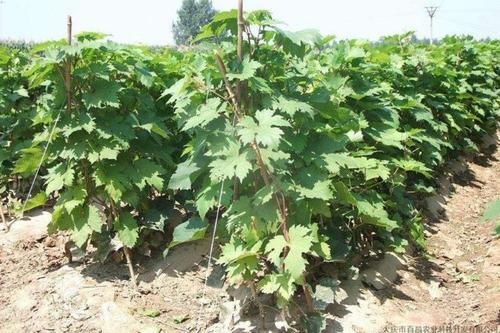
2. Reasonable insulation. High-density cultivation is desirable, with a normal range of 2 to 2. 5 x 1 m, 267 to 333 units per 667 square metres. Cultivation takes place during the winter and spring seasons and should be preceded by the application of base fat and water。
Iii. Scientific plastics. 1 inserts more than 2 cm long, 1. 2 to 1. 5 m high, so that grapes can grow along the pillars. When new steps are up to 60 cm high, the heart is taken to grow thicker and the bystand is cut off during the winter. In the event of the presence of a chicken in the base, a chicken bar is left between the right and the left, and the soil is released 40 cm from the main chicken, tied to the backbone 50 to 70 cm in order to prevent a fall between the lines, the rest being erased. After the second year of sprouts, the two main branches were left with three new stakes, both of which were tied to the right and the right neighbour at the same level, in order to prevent fluctuations between the strains and to cultivate the provisional result areas. The top rise continues to grow vertically, reaching 60 centimetres and placing it on small pillars. In the third year, the upper permanent result areas were developed in the second year. In the fourth year, the result branch was formed in the upper part of the result and the lower part was cut as appropriate。
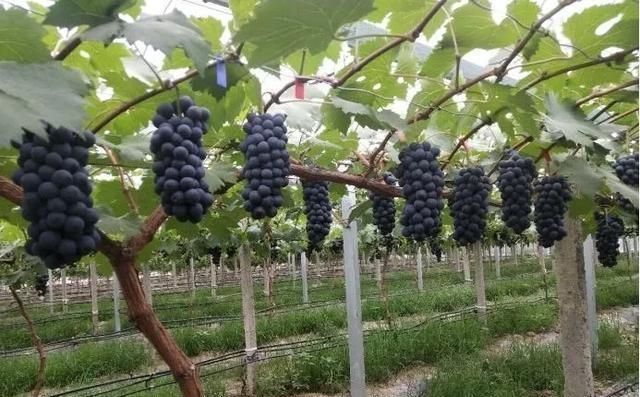
Iv. Cultivation outcomes. The temporary result is 60 centimetres from the ground, the permanent result is 120 centimetres from the ground, and the new sorghum and fruit ears are allowed to fall down, replacing the summer cutting and heartning, increasing the area of their leaves, increasing the light co-operation, increasing nutrient accumulation, and contributing to increasing production. After four or five years, when the main stem is 4 to 5 centimetres thick, the small pillar is removed and it can naturally be formed。
V. Fertilizer water management. Strengthen integrated management, mainly of fat water, to ensure that the first year of seedlings starts and ends with 3 years of 667 m2 producing more than 700 kg of fruit. One applied base fat. Fashion-based fertilizers are applied before planting by digging ditches 60 cm wide and applying 5,000 kg of manure or cow dung per 667 m2 and 100 - 150 kg of phosphorus fertilizer in a concentrated distribution area of 50 - 80 cm from the trunk. When applying for fertilisation, care is taken to exchange the ground and to mix it into the bottom of the ditch and organic fertilizer. Two hard-working fats. When grapes germinate, they are not absorbed into the bottom fat of the defined ditch due to the small amount of shallow roots of the roots. In order to promote the growth of seedlings, nitrogen fertilizers should be followed up in a timely manner. The method is to open a ditch, which is thin and thick, which is smaller and smaller. The fertilizing ditches need to be distanced from the roots of the system and combined with fat water. In the second half of the year, once the trees have reached a certain level of growth, the number of fats to be followed can be changed from 15 to 20 days to 20 to 30 days, with an appropriate increase in the amount of fats to increase phosphorus and potassium. 3 sphinx fat. The timely application of leaf face fertilisation, or the introduction of appropriate urea, potassium phosphate, photolytic micro-fertilizers, etc. At the time of spraying, both contributes to the growth of the plant and ensures the healthyness of the tree, which can contribute to the fusion of flowers. 4. Reasonable water and timely drainage. When grape seedlings are planted without covering the membranes, more attention should be paid to the frequent watering and, if the rain does not rain after the fertilization, to the timely watering. There is too much rain during the rainy season, attention must be paid to timely drainage and to high temperatures and drought early in the summer and autumn。
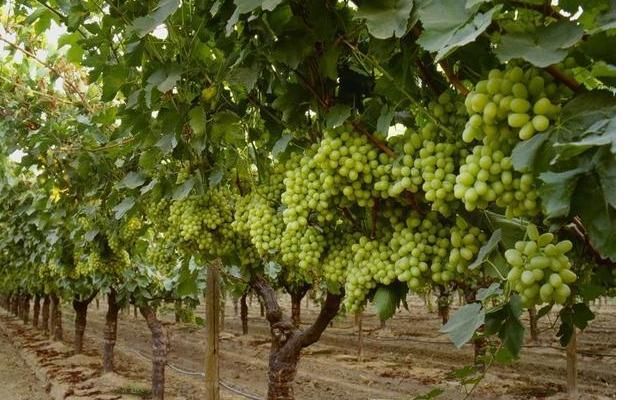
Vi. Prevention of disease and pest treatment. Key measures to combat the disease are: one winter clean-up: clean-up after winter. Disable leaves, branches, ears of grapes are protected from disease by spraying three to five degrees of thirate and 200 times sodium pentachlorophenol before gestation; 2 doses of the disease: the disease or pest should be identified on the basis of the symptoms of the disease on the grape branch, leaf and fruit, and the blindness of the treatment can be avoided; 3 early treatment. Forecasts are projected for the most sensitive periods of pesticide spraying in pests and pests (preferably during the first infestation of general grape disease and after the onset of the rain); 4 grapes may be treated with wide-spectrum effective low-toxic pesticides before growing up, with new high-efficiency, low-intensity drugs, post-rain microbicides, and sunday protection agents。