In order to respond positively to the prevention and control of the new coronary virus-infected pneumonia epidemic, to ensure the effective supply of vegetables in our province, to ensure the orderly organization of local vegetable production during the epidemic, to ensure stable market supply, and to provide solid “basket” guarantees for winning the epidemic prevention and resistance, the provincial institute of horticulture launched a technical programme to guide the production of kale (commonly known as lotus) in guizhou。
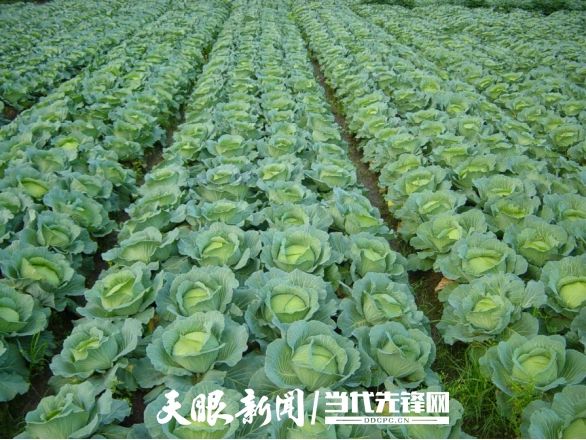
First, to strengthen the land management of the winter kale, which now includes winter kale and spring kale. Winter garang blue: refers to planting last july-august, planting in mid-september, and harvesting of kang blues, which is still on the market in late november. Spring garang blue: refers to the planting of seedlings in october-november last year, the planting of seedlings in december, and the collection of kang blues from march-june this year, which were brought to the market in the light of the spring season. 1. The current principles of winter-gang blue-water fertilizer management in the field are driven by the emphasis on fertilization in the front stage of the late-term convulsion of lotus. The first period was dominated by nitrogen fertilizer; the mid-term and late-term end of the ball was dominated by phosphorus and potassium fertilizer, which increased the resistance of plants to colds for safe winters. Post-spring management and attention: winter kale can be fertilized according to pre-winter stress conditions. If there is insufficient fertilizer, a small amount of 10 kg/acre can be followed up with urea after the temperature rises, with small water being poured; better fertility, water is not applied, and management principles are primarily controlled in order to prevent pre-smoking. Collecting: when the ball is essentially condensed and the outer leaf is bright, it can be harvested. Based on market conditions, they are collected and placed on the market at any time in order to prevent post-spill losses. The top sprouts begin to turn up, but not before the start of the stinging, and in the morning, the city generally does not become too late until mid-february to mid-march. Failure to do so would have an impact on economic income by reducing the quality of withdrawal. Following the planting of the spring gin blue field, the principle of “winter control springing” for the management of fertilizing water, i. E. Controlling the application of less fertilizing water, particularly nitrogen fertilizers, before spring, preventing seedlings from growing too big and cutting flowers early (unpretified screeching); until the spring when temperatures gradually rise, the application of fertilizing water promotes growth. The water is usually used in combination with fat pursuit, followed every five to seven days by decomposed human and animal dung, diluted and thick, and followed by 100 grams of urea and compound fertilizer per weight. After planting, the lotus period, the first ball, and the middle of the ball, are usually followed up once. Plantation has been growing gradually since the arrival of the lotus term, with an increase in the area covered by leaves and a gradual increase in the amount of water required. It should be followed up in a timely manner, with a corresponding increase in the concentration of fertilizers and a gradual increase in the number of applications per application, which will facilitate the conclusion of the ball in order to achieve early ripening. For the pre- and mid-term term, 10 kg of ammonium sulphate per acre and 10 kg of potassium sulphate per acre, with a 2-time application of 0. 2 per cent of potassium phosphate to promote condensation. Quick-activated nitrogen fertilizer was stopped 30 days before the harvest. Seven days before the harvest, water was stopped to prevent the crack ball. Shargan blue: in mid-march to may, seedlings were planted and harvests began in early july, supplying kale for the summer light season market. Preparatory work for seedlings can be arranged in advance. 1. Varieties are selected. Contrary to the spring garang, its long-term life is a high-temperature summer, and it should therefore select varieties that are heat-resistant, disease-resistant, pre-cooked, short-lived, good-commodity, medium-sized, high-yielding and consumer-friendly. The varieties suitable for the chagan blue plant in guizhou are: zhangang6, xiangang, zhuan, 16, drei 1017, power 50, zhagang 1, hsia wang, kkk, hope, chun gyan 45, zhou, zhou, iron head, round, zhuang zhuang, zhuang zhigang blue, and others. The seedling bed selects the soil with a thick, loose, fertile, well-drained soil, before planting the soil, after application of decomposed organic fertilizers and manure, so that the fertilizer is fully mixed with the soil as seeding beds of 1 to 1. 2 metres wide. The seedlings are grown by sowing or caves, then the soil is covered, the membranes are covered and the seedlings are promoted. When more than 70 per cent of the soil is released, the membrane is removed in time to prevent the burning of the seedlings. In the event of daily drought, water is poured in early and late to prevent the ageing of the seedlings. It is also possible to use floating seedlings. Ii. Green integrated pest prevention and control techniques 1. Increased field cleaning. In the case of the closed-harvested sites, the waste leaves in the fields, the planting of diseased strains, weeds and residues are removed, the fields are removed, treated centrally, the number of pathogens and insect sources is reduced, and a clean production environment is maintained. 2. Disease prevention and treatment. The main fight against fungal diseases such as froste, black spots, bacterium nuclei, swollen diseases such as morbid diseases, black diseases, and viral diseases (commonly known as toxin diseases) (see diagnosis of the main plagues of kale). For fungal disease, 58 per cent of the fertilin manganese zinc humid powder is selected at the initial stage of the disease as 500 times the fluid, or 70 per cent of the manganese zinc humid powder 400-500 times the fluid, or 64 per cent of the venomicide humid powder 500-600 times the fluid, or 75 per cent of the bacterial humid powder, etc. In the case of bacterial diseases, 2 per cent was sprayed at the beginning of the outbreak with a drop of 400-500 times the fluid of rice, or 500 times the suspension of 20 per cent of the roxy, or 50 per cent of the ammonium dyson water agent 600-800 times the fluid, etc. In the case of viral diseases, care must first be taken to combat aphids and to reduce human exposure to transmission by spraying the 20 per cent virus a-wettable powder 600 times the fluid at the beginning of the disease, or 1. 5 per cent of the disease 1,000 times the agent, or 20 per cent of the thorium acetron (viral quartz) humid powder 500 times the agent, etc. The above drug is used alternately, once every 7 to 10 days, with two to three consecutive treatments. The spray must be careful, especially on the back of the old leaf. 3. Pest management. The main fights are aphids, vegetable larvae, moths (the filarias), night moths, yellow strips, etc. (see diagnostic diagnostic diagnostic diagnostics of the main plagues of kale). Optimal sprays such as 50 per cent anti-accumulative powder 1,500 times, or pyrethroids, or 1. 8 per cent avm emulsifiable cream 4,000 times, or 2. 5 per cent more than a 1000 times accumulator (e. G. Cauliflower) or 20 per cent more than a 1000 times accumulative powder (net of insect death) are available. 1. Increased awareness-raising. Fully aware of the importance of ensuring the effective supply of vegetables for the prevention and control of the epidemic and for the stability of society, and on the basis of the requirements of segregation, ensure that the production of vegetables in winter and spring is captured and that vegetable farmers are encouraged to resume their production as soon as possible. 2. Reinforcement of protection and control measures for staff working in place. The first is that the worker must properly wear a mask to wash his hands throughout the course of his or her work; the third is that he or she must be equipped with disinfection facilities, specially designed for the purpose of production, and regularly disinfected; and the fourth is that he or she must be separated from his or her field at a distance of 2 to 3 metres in order to ensure safety. The times of guizhou
Operator bae xiaohong