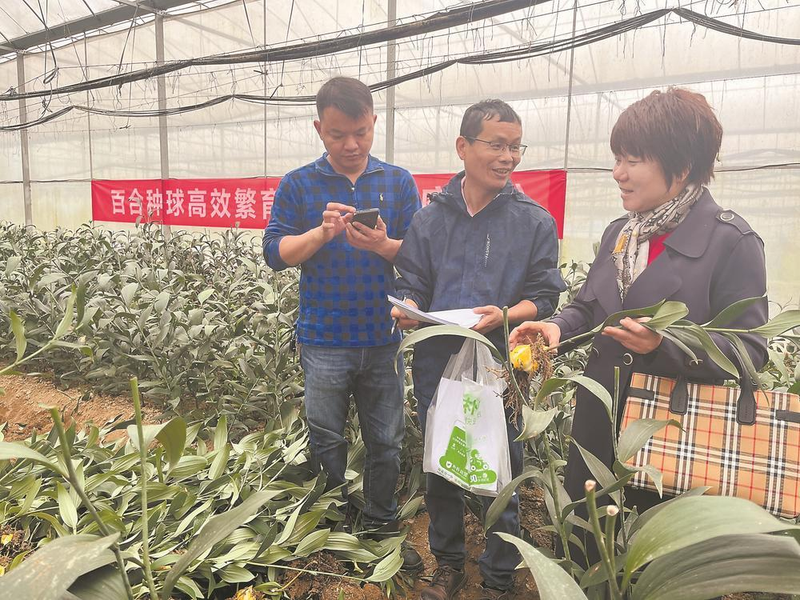
In one of the huts in the village of the protector of luogen county, a test of the lilies was carried out at the scenes of hung dong-jian (left i), lin ji-min (left ii) and sun hongmei。
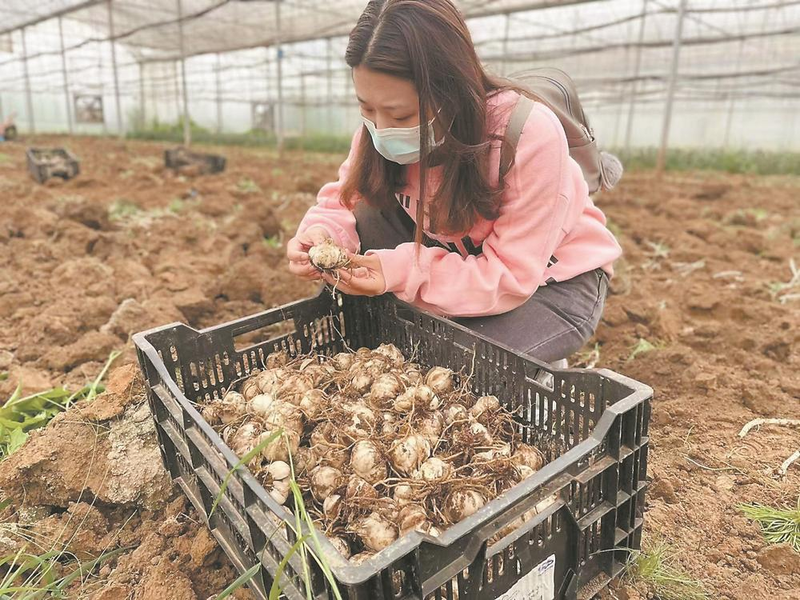
In one of the huts in the town of ruegen, the farm school staff of fujian province are collecting lilies。
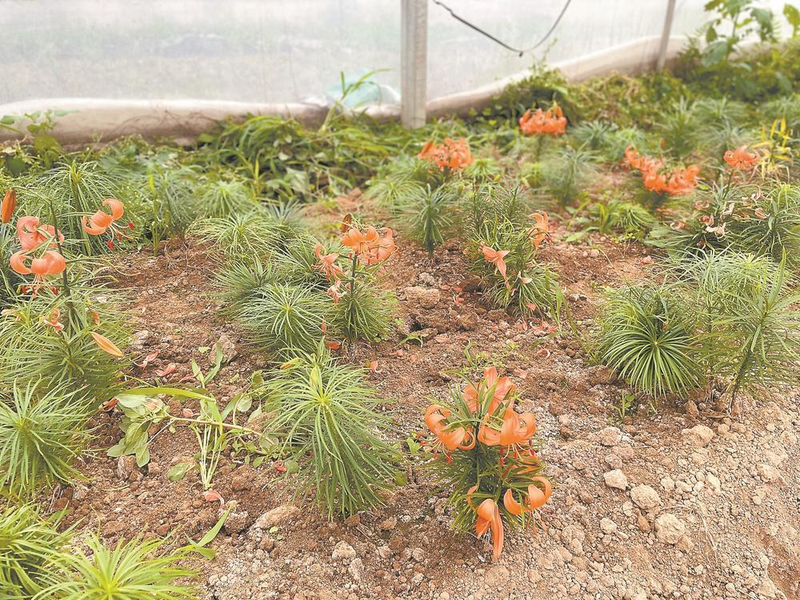
The food lilies introduced by the luogen focus have reduced the planting cycle to more than two years。
Core tip
In fujianjien, lilies and edible lilies are “breathing”。
Faced with the “card neck” challenge of the foreign limo breeding technique, the horticultural biotechnology team at the agricultural institute of fujian province has developed a core technology for the breeding of limo seed balls, leading to their national production。
The lilies' “cropping line” continues to move southwards from the yenping district of south ping city, “liuri town” in china, where the commodity rate is significantly higher than that of the lilies in other areas, lower by 60 per cent the cost of the balls and lower by more than 30 per cent the total cost of production。
It also focused on the introduction of lily for fresh food in lanzhou, with high levels of lithothan and soft tastes, and moved out of its unique “rogen road”, which could reach hundreds of millions of dollars per year, thanks to the promotion of the “technology for the development of edible enzymes”。
In the laboratory, continuous research and development efforts by scientists have broken long-standing technical barriers and import dependence; on the ground, growing households have planted additional seedlings ... Lilies have become a new hope in the field。
Scrambling ball planting line southwards
It took five and a half months to develop the production of detoxification raw materials into flowering seed balls, which led to the direct statement of sun hongme, a professor at shenyang university of agriculture and a scientist at the national system of technology for modern agricultural industries, that he “sees the hope of china's lilies production”。
Not long ago, a lilies-based efficient production survey was held in luegen county. In a large shed in the village of the protectorate of luogen county, a plough of lilies is swollen and lopsided, with expert sub-sections such as the agricultural institute of fujian province and the provincial forestry department conducting on-site sampling and statistical analysis of circulation indicators such as the lilies radius, growth patterns, viral indices, and finished rates。
In-situ testing, lilies are popular, with a high commercial rate of 96. 34 per cent for common pink systems, perfume lilies and palazzo, with high-specified standard species accounting for 43. 9 per cent。
On the scene, journalists saw that the food lily planted here, although it had just come out of the ground and was still covered with dirt, looked carefully at a colored white, big head, and looked like garlic, like a “white fatty”. The lilies have a smooth surface, a spherical or egg-like circle, yellow and white, and specialists have flattened the petals of the species, each full of fatness。
It has been established by experts that the lilies are significantly higher in commodity rates than in other regions and that they are of better quality than imports, that the ecological climatic conditions in the winter season are currently the best in the province, and that the unique natural conditions provide a powerful ecological platform for the development of niche species such as eastern lilies。
“seen the production of lilies in luo dynasty, it has pioneered the national production of lilies in our country. One is that lilies are free of pests, and the other is that, in five and a half months, it is possible to produce detoxification raw materials into flowering seed balls, both of which are great successes.” sun hongmei said。
Fujian lily, which began with the first artificial lilies planted in the town of pearls in yonping district, south ping city, in the 1980s, later developed an annual production area of nearly 8,000 acres, amounting to nearly $600 million。
For a long time, however, our lilies grow on imported seedlings. “as a result, the price of lily's imported balls has remained high. Buying a commodity seed ball from the netherlands costs between $3 and $4, or more than 60 per cent of the total cost.” dr. Ji-min lin, director of horticultural biotechnology, fujian agricultural college, said。
The pain of the “chip neck” has made scientists aware that the root causes of the problem can be addressed only if the lilies are caught in their hands。
After years of uninterrupted scientific research, in 2018, the scientific team of the agricultural institute of fujian province succeeded in developing core technology for breeding lily seed balls and, on that basis, once again integrated into the development of a three-tier production system, the “stander-eatball-commercial ball” system, the refinement of the lily seed ball breeding techniques and the design of plant-chemical facilities with autonomous intellectual property rights. Its autonomous lilies, 90 per cent of which range by more than 16 cm, have a virus rate of zero. Cost can be kept below $2 per pill, which means a 60 per cent reduction in seed costs and a more than 30 per cent reduction in total production costs。
For scientists, this is just the beginning. “it is well known that the yenping district of south ping city is one of the six main production areas of the country's lilies. We want to be able to continue moving the lilies to the south to find more good fields suitable for lilies in fujian.” lin ji-min said。
Rogen county is a tropical oceanic monsoon climate in central asia, where the initial town is relatively flat, with large and small hills standing in the way of typhoons, warm and humid throughout the year and with a high average temperature in winter and spring at 11 °c ~ 20 °c, the light spreads longer and better。
“the most important part of the libertarian three-tier breeding system is the requirement for the adaptation of the species.” lin ji-min said, “for the time being, we are engaged in anti-dutch production of anti-season lilies, which are more demanding in terms of reproductive time. The climate advantage is more pronounced than in the case of the south, with more mature commodity balls.”
Based on the results of this production, experts found that the climatological properties of the lilies are very compatible, and that in winter, there is hardly a long time of low temperatures in the sheds, which do not have to be warmed; during the february-march period of the lilies, the average temperature during the day and night was very suitable for lilies。
On the side of lugen's `ansem!', hongdong, the general manager of ligen's biotech company ltd., has been waiting for hong dong's arrival since november of last year, when he worked with fujian agricultural institute to try to grow the lilies。
"spring" for lilies
In the sheds built in hongdong, lilies are also grown for food in lanzhou。
In the middle of the lily harvest period, in the sheds, workers are working on the ground, with their hoes swung under their heads, bare lilies with porridges, colours like jade, sorting, cutting, mud, etc., and a basket of sweet lily is waiting for the distribution car。
Hong dong has been doing business for many years, and early he discovered that the customers who came back from lanzhou always preferred lilies with beautiful food packages for their relatives and friends. The move was made in his heart: "the lilies are so popular?"
Thus, in 2019, when he approached the institute of biotechnology of the institute of agricultural sciences of fujian province and learned that it was all meant to introduce lilies into lanzhou, when luo qin sought “test fields”, he was very much enrolled in the experiment。
In fujian, lilies are rare to grow, but with lilies, they are “porns”. As a result, the consumption of lily was more demanding for water, soil, air and climate, mainly in gansulan。
Hong dong built a three-acre shed to work with technologists in an attempt to domesticate the lanzhou lilies。
“three years old, three years old and three years old.” it's a saying that describes the growth of the lanzhou lilies, which is long and slow, and which characterizes their growth. In lanzhou, lilies have a growth cycle of three to five years. The institute of biotechnology of the academy of agriculture of fujian province has used innovatively the technique of edible limo embryonic cell suspension to reduce the cultivation cycle to more than two years, reducing the cost of cultivation。
Growing costs have been reduced and the benefits are considerable。
The first seedlings were harvested in 2020! Hong dong jian was pleased to find that “the lilies are big and good, and a kilo can be sold to $60. An acre can yield 500-800 kg.”。
Unlike the lanzhou lily, indigenously domesticated edible ligs have large contours, high starch content, soft tastes, and are better suited to the taste of fujian." apart from rich nutrients such as starch and protein, the consumption of lily roots contains special nutrients that are very beneficial to the human body.” xu xiaoping, assistant researcher, institute of biotechnology, agricultural college, fujian province。
Usually, the harvest period in lanzhou is from october to march, while the harvest period in fujian is in may, when the harvest period is just the wrong peak, effectively filling the market gap。
There has been a significant increase in confidence in the construction of lilies in hongdong. “this is an industry with great potential for development, and the company now has 1 million grains of lilies in its reserves, with the intention of expanding the original 50 acres to 100 acres in the second half of the year.”
It is not only hong dong who has benefited. The edible lily is a labour-intensive agricultural industry that requires a large labour force, from planting, caring to harvesting。
As soon as the business started, a large part of the idle labour force in the country's care village was put to rest. “we have more than 50 workers, and more than 20 workers, at most. I heard there's going to be an increase in planting, and it's gonna get more and more intense."。
At the end of last year, the institute of biotechnology of the academy of agricultural sciences of fujian province signed a cooperation agreement with luegen county, fukuzhou, to promote the “technology for the development of educative enzyme cell suspension”. This project, with a total investment of $400 million, is expected to produce 4,500 tons per year and 150 million yuan per year。
Under the direction of the provincial agricultural institute, the conservation village has also achieved lily, rice and dry rotations, using lily high temperature hibernation, which are transplanted to cold storage in the summer and planted rice on land to maximize the use of land resources。
“in line with the concept of `scaling operations, specialized production, industrial development', we will work hard to scale up, improve quality, and improve efficiency, to seize the opportunity to develop the quan li as a high-tech enterprise, and to make every effort to secure project-specific debt support, to promote the growth of the lily industry, which collects food, medicines, and looks at one another, in start-up towns, and to accelerate industrial growth and the growth of the rich.” secretary of the state of the start-up town party, shaw, writes。
From the academy of agricultural sciences of fujian province to the village of the protector, to the growers, the future will be targeted mainly for the production, development and development of lilies for counter-seasonal consumption, which will result in a supply of lilies for fresh food at different times from the lanzhou lilies and contribute to the flourishing of the national lilies market. (linxia text/graph)