Every holiday is the moment when the national debt is bought back “on the stage”, especially at the end of the year. In recent days, with the arrival of new year's day, the financial landscape has resurfaced “distant”, with annual financial interest rates rising and the return on repurchases of national debt rising simultaneously. As at 27 december, gc001 (1-day repurchase of national debt) had received 3. 515 per cent of the returns, an increase of 27. 5 bp compared to the previous day, reaching 5. 51 per cent。
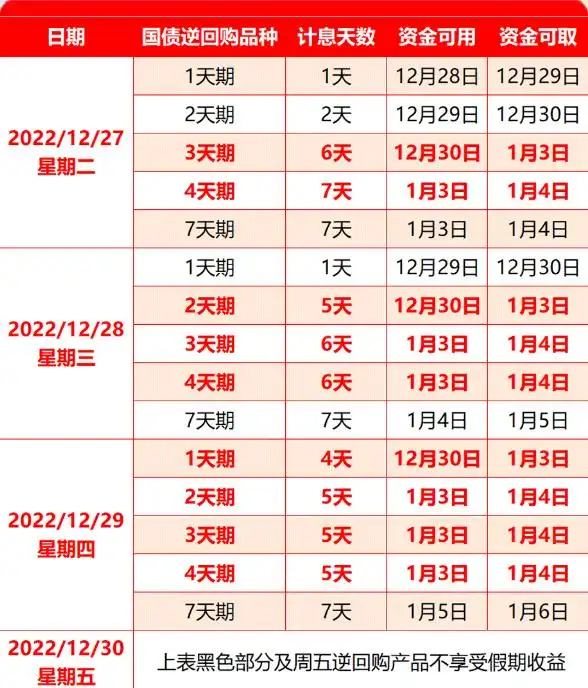
At the same time, 29 december will be one of the best times for operating repurchases of national debt under the trade rules for repurchases, in conjunction with the new year's leave arrangement. That day, a one-day reverse buy-back would generate interest for four days and the funds would be available before the opening of the opening on 3 january next year without delaying the use of the investment。
The rate of return on repurchase of national debt has risen
The so-called repurchase of national debt is essentially a short-term loan. That is, individuals borrow their money through the repurchase market and receive fixed interest earnings; the repurchaser, that is, the borrower takes the loan as collateral against its own national debt and repays the debt after maturity。
In the trading market, there is a reverse buy-back of the national debt, both at the certificate offices and at the points of exchange. The letter “gc” starts with a reverse buy-back of the country's sovereign debt, while the letter “r-” begins with a reverse buy-back of the country's deep-in debt. The two markets split the reverse buy-back product into nine varieties of one day, two days, three days, four days, seven days, 14 days, 28 days, 91 days and 182 days。
The threshold for repurchase of the country’s debt, which was previously certified, was 100,000 yuan, and the threshold adjustment for repurchase of the country’s debt was lowered to 1,000 yuan from 16 may this year, the same as that for deep exchange。
Interest rates on repurchases of national debt are raised at the end of each month, at the end of the season or before extended leave, against the background of increased liquidity volatility. Taking into account that the counter-purchase of national debt is aimed at national debt, which is highly secure, combined with low transaction costs, investment in appropriate nodes is desirable from an investment point of view, even better than a baby-like property。
In terms of performance on 27 december, the highest rate of return was repurchased over a seven-day period, with a higher rate of return of 4. 690 per cent for the four-day period and 4. 390 per cent for the three-day period, respectively, as of closing, with gc001 receiving 3. 515 per cent, which once reached 5. 51 per cent, a new high of nearly six months。
In the view of many people in the industry, in the light of past experience, the rate of return on reverse purchases of national debt will continue to rise. The data show that on 30 december 2013, the annualized gco01 rate of return was as high as 35 per cent, although in recent years the overall rate of return on repurchases of the national debt has fallen, as central banks have increased their liquidity investment at the end of the year, but is still higher than usual. For example, during last new year's day, gc001 rose to 5. 980 per cent。
Counter-purchases of both secure and profitable national debt have also attracted the attention of listed companies and have served as an investment tool for many companies to generate idle funds. For example, on 27 december, the milliche industry issued a circular on the use of idle funds to purchase repurchase the national debt, stating that it would use its own funds not exceeding $500 million (of which subsidiaries did not exceed $50 million) to purchase low- and medium-risk, liquid property items and types of repurchase the national debt。
According to the bulletin, the types of repurchases of the national debt purchased by the mills industry include gc007, gc014 and gc028, which are valued at $30 million, $50 million and $70 million, respectively, and the expected proceeds (without deducting transaction costs) will amount to approximately $290,000。
On 30 november, zhang jia hong kong bond science and technology also issued a communiqué stating that the company's wholly-owned subsidiary, zhang jiang jiang pocket trading ltd. (hereinafter referred to as the “privileged trade”) would use part of its short-term idle funds to purchase structural deposits and repurchase national debt when the risk is manageable and secure. The total value of the bonded trade for the purchase of structural deposits and repurchases of national debt does not exceed 250 million yuan at any point in time。
Four days' interest at the right time
In terms of the duration of the investment, the return on the repurchase of the national debt is high, but often of shorter duration, with interest-bearing days having a greater impact on the final return on investment. Unlike stock transactions, repurchases of national debt have specific transaction rules and characteristics. For investors, the timing of investments is crucial because interest-bearing days vary at different times。
Specifically, the city was closed from 31 december to 2 january 2023 during the new year's day and opened as of 3 january. By 30 december, investors would then be able to obtain interest during new year's day on the repurchase of the national debt。
For example, on 29 december, if the one-day repurchase of the national debt was operated at an operating rate of 5 per cent at an operating rate of $100,000, the interest rate would be approximately $55 per day (10000*5 per cent*4/365); if the two-day repurchase of the national debt was operated at the same rate and amount, the interest rate would be about $68 per day (10000*5 per cent*5/365)。
However, if the reverse purchase took place on 30 december, the day before new year's day, no interest would be paid on the extended new year's leave, regardless of the type of public debt that would have been repurchased. Thus, 29 december could be said to be the best operational node before extended leave. The one-day repurchase of the national debt was selected to generate four days of returns, and the funds were available before the opening of the market on 3 january, without prejudice to investments。