Modified pigments: the rationale for and distinction between physical and chemical colours
I. What's a colored pigment
In our daily lives, we often see materials that change colour: fluorescent pens shine in ultraviolet light, sunglasses dim in the sun, temperature labels turn red... Behind these phenomena is a functional material — pigmentation. Colour-changed paint is a type of paint that can exhibit changes in colour under external irritation (e. G. Light, heat, pressure, chemical substances, etc.) and is widely used in such areas as packaging, toys, safety markers, smart materials. The colouring process can be reversible (e. G., after the disappearance of ultraviolet light) or irreversible (e. G., some chemical sensor paint). The mechanism for the colour changer material, which is able to respond to changes in the external environment, depends mainly on the way the molecule or material structure changes, and the colour changer paint can be broadly divided into two categories depending on the colour changer mechanism: physical and chemical. Understanding the principles and characteristics of these two types helps us to make more scientifically sound judgements in the design of selected materials and products。
Physical changes in colour are usually caused by processes such as molecular condensation, crystal transformation or physical adsorption, and do not involve break-ups or formation of chemical keys, whereas chemical changes in colour are dependent on chemical processes such as photochemical reactions, oxidation or rebalancing of molecular structures. Understanding the differences between the two colouring mechanisms is essential for material design, performance optimization and practical application。
Ii. What's a physical change
Physical colour is defined as the colour change caused by the material through the physical mechanism, not involving changes in molecular structure or chemical composition, under external irritation (e. G. Light, observation angle, temperature, etc.). This process is usually well reversible and paints can recover after the stimulus has disappeared。
Its colour modification mechanisms include, inter alia, the adjustment of molecular sequencing, the transformation of the crystal structure, the change of phase or the change of electronic distribution. The change in colour is mostly due to physical effects such as the absorption, reflection, interference or dispersion of light, with no break-up or reorganization of the pigments' chemical keys throughout the process。
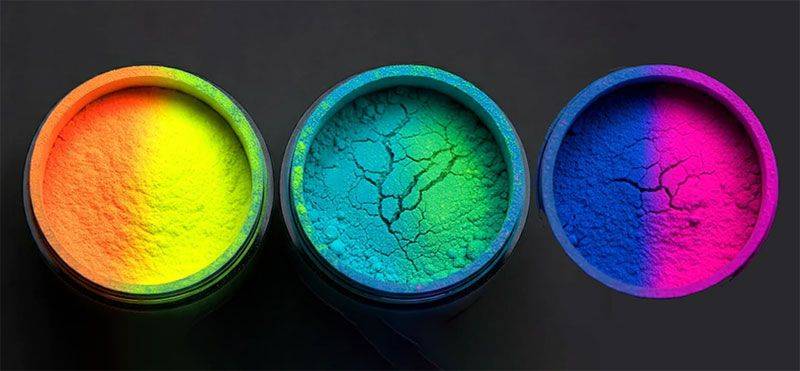
Common physical colour change types: fluorescent pigments, pearlscent pigments, interference pigments, thromochromic liquid crystal pigments
Iii. What's a chemical change
Chemical colour is defined as a change in colour caused by a molecular retrenchment or break-up and formation of a chemical key by the material as a result of external irritation (e. G. Light, temperature, ph change or chemical reaction). The process involves chemical reactions, and the change may be reversible (e. G., photo-variant colour) or irreversible (e. G., oxidizing variation colour)。
Unlike physical colours, which involve only molecular sequencing or state changes, chemical colours substantially change the molecular structure of pigment or dyes and are a truly chemical reaction process. It is often more functional and responsive, often used in intelligent materials, detection devices and safe and fraudulent products, and is an important component of an intelligent sensor system。
Common chemical colour change type: photochromic pigments/ thermochromic pigments redox colors
Iv. List of physical and chemical colour changes colour variation
Colour change mechanism
Changes in structure or organization
Changes in molecular structure or chemical keys
Is there a chemical reaction
Is it reversed
Most are reversible
Reversible or irreversible
Response speed
Quick response
Response speed depends on reaction
Apply scene
Fluorescent markings, safe coatings, bead polished materials, etc
Optical lenses, ph tests, heat-sensitive inks, etc
For paint type
Fluorescent paints, counterfeit fluorescent powders, pearl paints, liquid crystal colour paints, etc
Light-transforming paint, heat-transforming paint, etc
Summary
The coloured paint gives the material the ability to interact with perception and vision by responding sensitively to changes in the external environment. Physical change depends on changes in optical structures, which are responsive and reversible, and are widely used in decorative and indicative products, while chemical change is based on changes in molecular structures that allow for more complex and precise functional responses that apply to high-end areas such as detection, forgery prevention and intelligence systems。
An in-depth understanding of the nature of physical and chemical colour changes can help to select materials according to specific application needs and provide a solid theoretical basis for the development of new intelligent and functional products. As material science and nanotechnologies continue to advance, changing pigments will show great potential for development in more high-end and transboundary applications。