On 23 february 2024, the national statistical office published a change in the prices of commercial residential sales in 70 cities and cities in january。
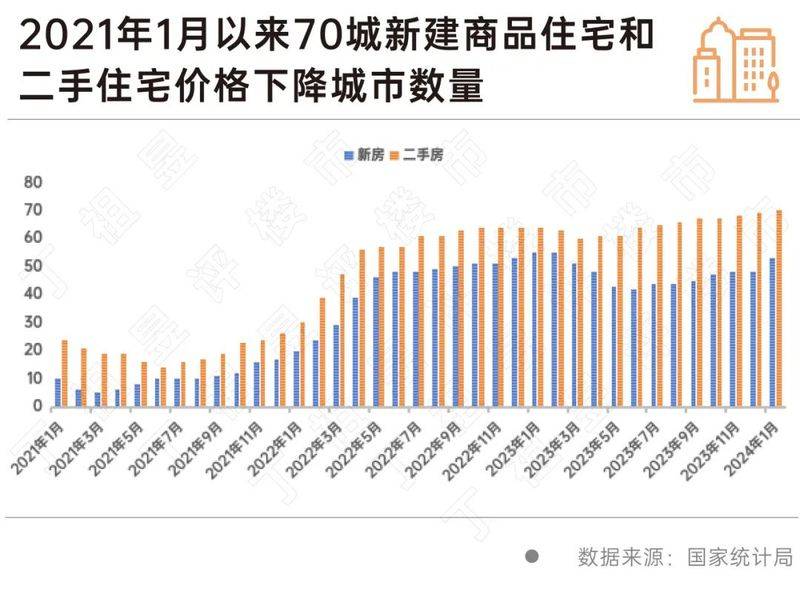
According to data, in january 2024, the price of commercial residential sales in 70 large and medium-sized cities declined in comparison to the number of cities, and the number of cities with new housing prices increased from 7 in december 2023 to 11, the first increase in the number of cities in the last 11 months。
This suggests that there has been some stability in the market under a range of policy regulations and that the effects of regulation are beginning to appear。
However, the decline in home prices continues to increase over the same period。
In january 2024, out of 70 large and medium-sized cities, the prices of new and second-hand housing were 53 and 70, respectively, respectively, falling, an increase of 5 and 1 compared to the previous month。
It should be noted that the price of second-hand homes has fallen, and it is clear that the current decline in the number of hot-spot cities and hot-spot projects will continue to decline if the market for second-hand houses continues to decline and demand for second-hand replacements is difficult to release。

Recently, the national statistical office published a price index for 70 cities and cities in january 2024。
In january, the decline in the price of commercial residential sales was generally narrow. Among them, the price of new residential housing in the first-line cities decreased by 0. 3 per cent, or 0. 1 percentage points less than last month. Beijing, guangzhou and shenzhen decreased by 0. 1 per cent, 0. 8 per cent and 0. 7 per cent, respectively, and shanghai rose by 0. 4 per cent. The price of new residential housing in second-line cities decreased by 0. 4 per cent, the same rate as last month. Prices for the sale of new residential goods in three-line cities decreased by 0. 4 per cent, by 0. 1 percentage points less than last month。
In january, out of 70 large and medium-sized cities, the number of new commodity dwellings fell to 56, while 3 cities remained flat, and 11 cities experienced an increase in the price of new homes, representing an increase in the number of cities that had experienced an increase in housing prices for the first time in nearly 11 months。
Since the end of 2023, the real estate policy has been active。
The first is the national conference on urban and rural housing construction. In keeping with the position of housing, two things are clear: stabilization of the real estate market and construction of a new development model for real estate. This was followed by a central economic work conference, which emphasized the positive and sound management of real estate risks, addressing the legitimate financing needs of different ownership enterprises on an equal footing and promoting the smooth and healthy development of the real estate market。
Up to 2024, the ministry of housing and the pension administration jointly issued a circular on the establishment of a coordination mechanism for urban real estate finance, which was followed by a conference on the deployment of the urban real estate finance coordination mechanism, which insisted that cities could adapt their real estate policies to local conditions by using a good policy toolbox。
These have provided strong support for local adjustment of the limited purchase policy, with the first and second lines of untying purchases and lending successively。
A series of policy benefits has led to an increase in the number of cities in which the price of housing has declined in general, and housing prices have risen, indicating that the effects of prior-period policies have begun to show and markets are beginning to show signs of stability。
In the cities where the prices of new homes are rising, shanghai is headed by a 0. 4 per cent increase; jilin, no sing and spring states are all increased by 0. 3 per cent; xian, changchun and yang counties are increased by 0. 2 per cent; tianjin, ishiya, dalian and chongqing are all increased by 0. 1 per cent. Some of these cities have had relatively good basics, while others have experienced a partial reversal of housing price adjustments in the past。
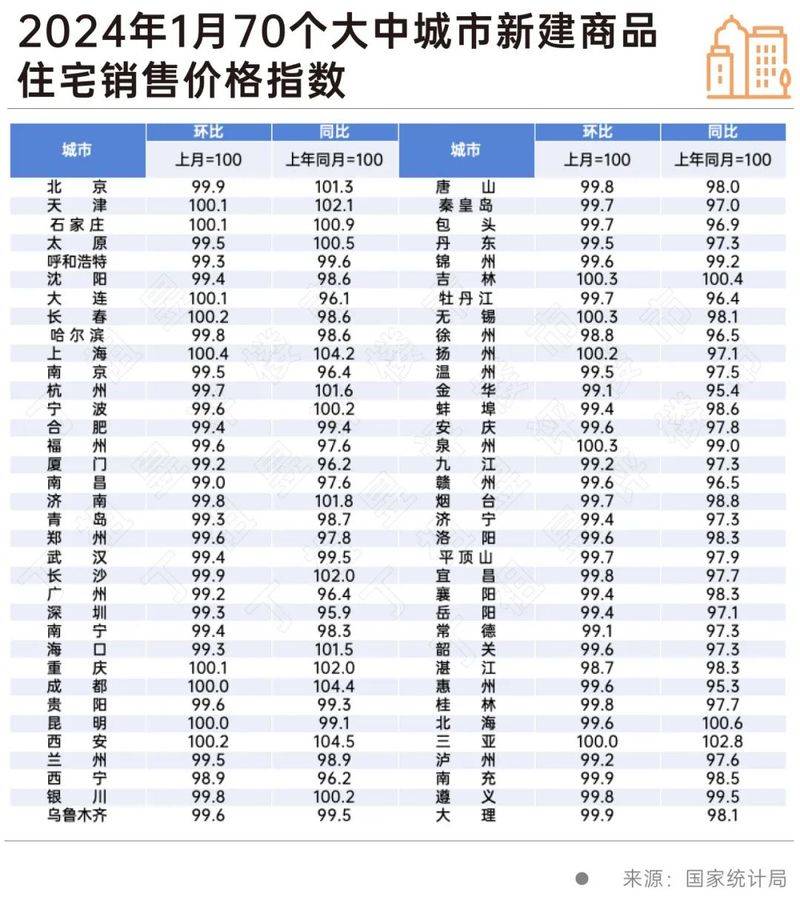

Data show that while the overall decline in the price of housing in 70 large and medium-sized cities in january 2024 was narrow, the decline continued to increase over the same period。
According to data from the bureau of statistics, in january the prices of new residential housing in front-line cities decreased by 0. 5 per cent over the same period, an increase of 0. 4 percentage points over the previous month. Of these, beijing and shanghai increased by 1. 3 per cent and 4. 2 per cent, respectively, while guangzhou and shenzhen decreased by 3. 6 per cent and 4. 1 per cent, respectively. Prices for the sale of new residential goods in second-line cities have declined by 0. 4 per cent from the 0. 1 per cent increase in the previous month. The price of new residential housing in three-line cities decreased by 2. 1 per cent over the same period, an increase of 0. 3 percentage points over the previous month。
In january 2024, of the 70 large and medium-sized cities, 53 were newly constructed as compared to the previous month。
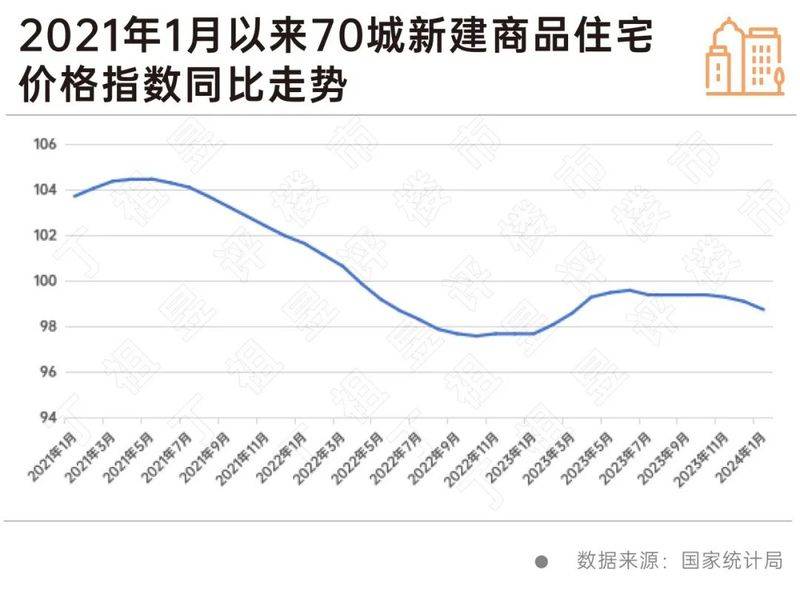
In fact, starting in 2022, 70 cities in large and medium-sized cities entered a downward trend in terms of prices for the sale of new commodities, both on a year-on-year basis and in january-may 2023, prices rebounded, but since june they returned to the lower zone。
Thus, while the decline in the cost of housing in 70 large and medium-sized cities was generally narrow, overall market pressure remained high。
From 2023 to date, the prices of first and second- and third-line urban housing, supported by improved demand, have been relatively stable, while the prices of low-lying urban housing in the interior have been more reciprocated, as measured by the average prices of new commercial housing in key cities monitored by the cric. Some cities face deep adjustments, and housing firms accelerate price swaps。
This is due mainly to the fact that the market is still in a bottom adjustment period, and the industry will continue to operate at the bottom for some time after the ageing of the population and the expected recovery in the income of the population。

Second-hand rooms are more vulnerable than new ones。
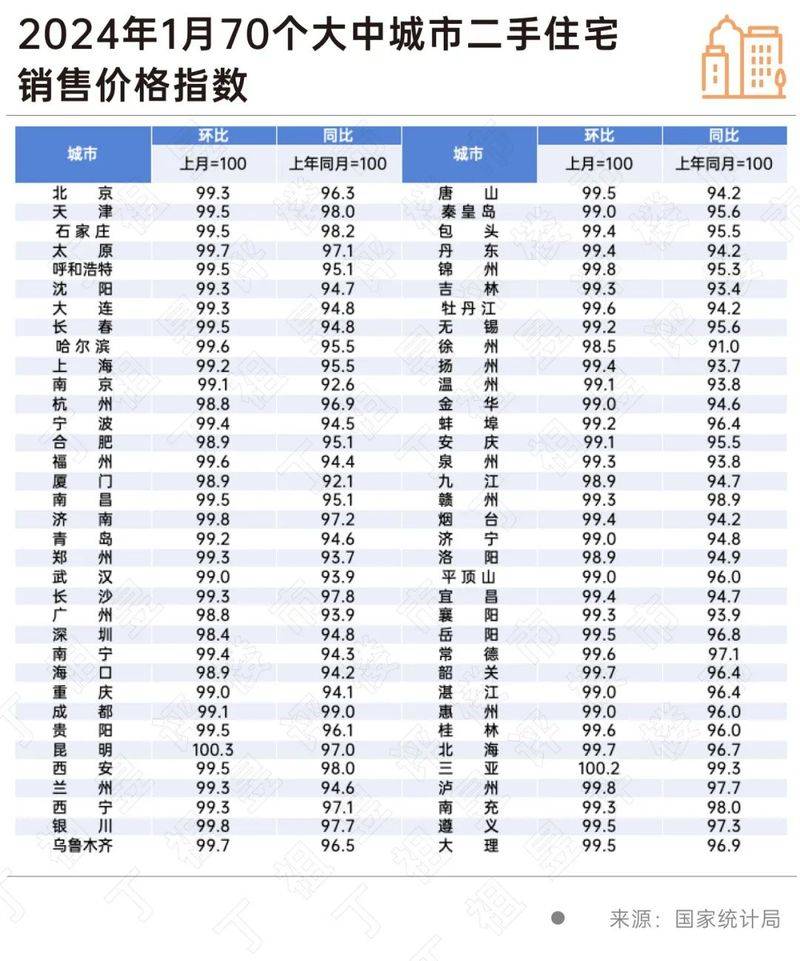
According to the national statistical office, in january 2024, the price of second-hand residential sales in the first-line cities decreased by 1. 0 per cent, by 0. 1 percentage points less than last month, by 0. 7 per cent, 0. 8 per cent, 1. 2 per cent and 1. 6 per cent, respectively, in beijing, shanghai, guangzhou and shenzhen. Second- and third-line urban second-hand residential sales declined by 0. 6 per cent and 0. 7 per cent respectively, by 0. 2 per cent and 0. 1 per cent, respectively, from the previous month。
By comparison, in january the prices of second-hand housing in front-line cities decreased by 4. 9 per cent in comparison with the previous month's increase of 1. 4 percentage points, including 3. 7 per cent in beijing, 4. 5 per cent in shanghai, 6. 1 per cent in guangzhou and 5. 2 per cent in shenzhen, respectively. Second- and third-line urban secondary housing prices decreased by 4. 4 per cent and 4. 5 per cent, respectively, and by 0. 4 and 0. 3 percentage points, respectively, over the previous month。
It should be noted that in january, in 70 large and medium-sized cities, the price of second-hand residential sales declined by a total of 68 cities, or 70 cities in the same year, i. E. Only in kunming and 2 cities in sanya, the price of housing rose in january, and fell overall in the same year。
Compared to new homes, second-hand home sales started in february 2022, leading to new homes entering declining areas, with drops continuing to increase until january 2023, to a maximum of 3. 8 per cent, and with a period of young sex between february and may, the second-hand home sales prices declined somewhat, although they went down again after june, and the overall market still continues to be under considerable downward pressure。
It should be noted that, according to the cric, the share of second-hand houses in the 30 municipalities with a focus increased from a minimum of 40 per cent in 2023 to 53 per cent in 2023, exceeding first-hand rooms for the first time。
At the same time, the market for new houses is somewhat more representative of real estate market prices because of the long-term impact of restricted prices。
At present, the opening of the building in 2024 is flat, the number of hot-spot cities and hot-spot projects is continuing to decline, and the negative effects of the recent downgrading of purchasing power on the building market are gradually emerging. Based on the second-hand house combination effect, needs such as replacement of the second-hand room can only be fully released if the second-hand room activity is first repaired。
Overall, in january 2024, the price of residential commodity sales in 70 large and medium-sized cities declined in comparison to the number of cities, and the overall decline in the price of residential commodity sales narrowed, indicating some positive effects of prior-period policies。
However, the current pressure on the real estate market, both in terms of performance at the same time and in terms of second-hand housing markets, is still high. It is also necessary to further channel market expectations through policy combinations, to strengthen markets and to promote both the supply and demand sides of the market in order to achieve real and healthy development。