On january 4th, china’s 24th china’s changcheng sun-wasa international ski festival opened. On that day, 2,227 professional athletes and popular skiers from 33 countries and territories completed five groups of off-the-ground ski competitions to enjoy the fun of the ice and snow movement。
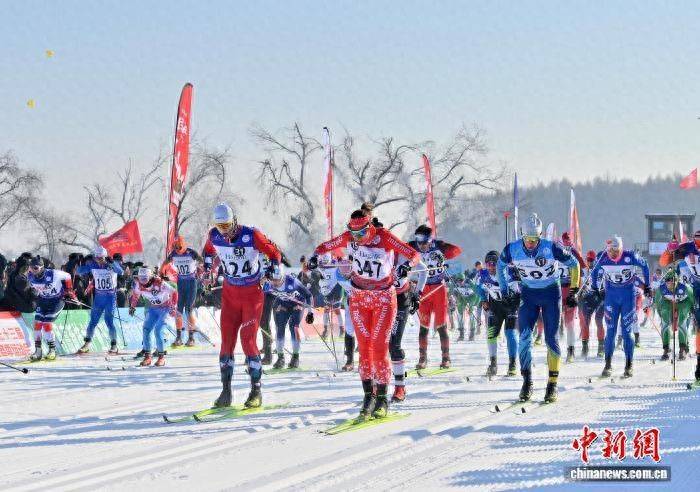
On 4 january, jilin changchun, the middle and out-of-the-middle players competed for speed in the net moon. Zhang xuan
The vasa ski festival, which originated in sweden and has a history of more than a century, is the oldest and largest long-range ski race in the world. In 2003, the skating season ended with china becoming the fourth country to host a wasa skating after sweden, the united states of america and japan, which has so far led to over 1. 2 million people participating in the ice movement。
The competition, which was conducted 50 km, 25 km and 6 km, 1. 5 km and 0. 3 km of experience for the general public, was attended by high-level players, including 20 world rompetkin skiers and 6 silver ski masters。
The course runs through the landscape of forests, lakes, roads, etc., with a cumulative climb of 252 metres, with uphills, downhills and flat segments each accounting for one third. The mid- and out-of-the-middlers were swinging their rods, skimming, turning around, and competing fiercely。
In the end, italian contestant mardia amerini won the 50-kilometre male team, while czech contestant fabian stork and italian contestant buson lorenzo received the asian army and the quarterly army, respectively. The top three members of the 50 km group of women were picked up by chinese athletes, and chen ling won two championships, one by two and three by two。
In particular, during the current snow season, the new zone of the new spring has created a core area of ice and ice entertainment, providing immersional diversity to tourists from the centre and beyond. With this ski festival as a platform, the official focus will be on the four main directions of ice+ai, ice+screen+screen+screen, to boost the ice economy and achieve a two-way power between sports events and industrial development. (concluded)