Expression
Here's an ideal three-phase communication mathematical formula:
V1 = asin (2ft) = asin (wt)
V2 = asin (2 ft - 2 g) = asin (wt - 2 g)
V3 = asin (2 ft + 2 g) = asin (wt + 2 g)
A is the peak of the voltage, and f is the frequency of the voltage exchange。
The electric voltage between the trajectories is referred to as the wire voltage, or between the trajectories is 380 v. The voltage between the phase and the neutral point is called the phase voltage, and the voltage of any relative neutral point is 220 v. (the three-phase communication power uses vary from 660 v to 6,000 v, etc.)。
Generators capable of generating the same range, frequency and phase power at 120° variance are called three-phase generators. A three-phase generator is used as a power source, known as the three-phase power source, and a three-phase powered circuit, known as the three-phase circuit。
The colours of the three-phase electricitys, a for yellow, b for green and c for red, are now known as a, b, c or l1, l2, l3 or u, v, w in the same order。
The total power of 3-phase electrical appliances equals 3 times the current per phase, i. E. The total power = current x voltage (220v) x (p = i x ux3)
Three types of three-phase electrical meters are mechanical, general electronic and magnetic card spreadsheets, with general specifications of 1. 5 (6), 5 (20), 10 (40), 15 (60), 20 (80), 30 (100) (3x380/220v~)。
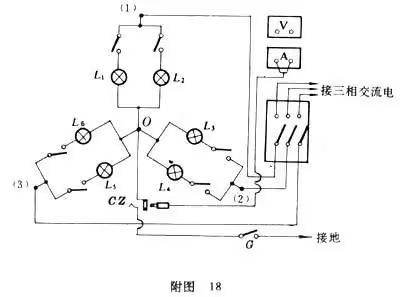
The concept of "triangular electricity" is that, when the coil rotates in the magnetic field, a steering line cuts the magnetic line to create a sensory electric motion, and its pattern can be expressed in a sine curve. If we take three coils and divide them by 120 degrees in space positions, the three collages continue to rotate at the same speed in the magnetic field, where the three same frequencies are felt by the electric motion. As the three coils differ by 120 degrees in space position, the currents are also three-sine changes called three-synthetic exchanges。
& zero
General definition: a straight line of a baseline in which the discrepancy is determined in conjunction with the discrepancy。
The zero line is a circuit from the neutral point on the secondary side of the transformer (why is it not drawn directly from the generator?), which is powered by the electrical equipment in retrospective circuits, and normally repeats the groundline at the neutral point on the secondary side of the transformer, thus providing dual protection. Zero lines should be used mainly for work circuits。