When users are used to moving from "search box" to "question to ai," when more than 70% of the search results are answered directly by ai abstracts, users do not need to click on links, a flow revolution about the survival of businesses has arrived. The traditional seo 's 'ranked game' gradually lapses, and the geo (generic engine optimization) is centred on "ai trust and recommendation " , re-engineer logic. This paper will provide an overview of the bottom-level logic, traffic differences, and the three dimensions of the landing path, and deep disassembly the iterative nature of the seo to geo, providing a ground-breaking reference for the layout of the business 'ai age traffic。
I. Underlying logic subversion: from “link ranking” to “cognitive dominance”
The core difference between seo and geo is essentially the fundamental contrast between the reptile logic of the search engine and the cognitive logic of ai's large model, ranging from optimization of the target to value logic, which is completely two systems。
Traditional seo: passive capture for keyword ranking
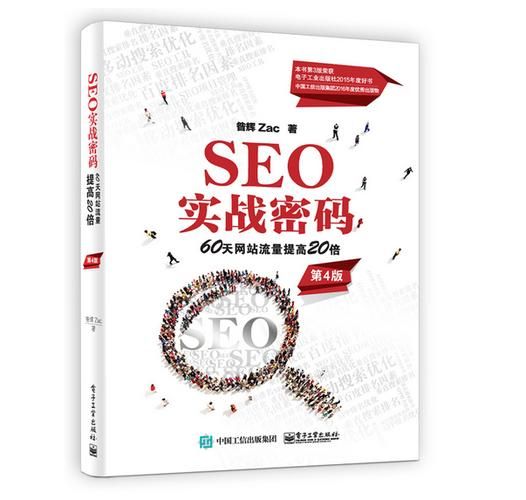
The core of the seo (search engine optimization) is the “compatibility rule” around the search engine reptile algorithm, which competes for the forward location of the search result page through the layout of keywords, the construction of outer chains, and the optimization of website technology。
Geo global optimization: active matching, building ai authority awareness
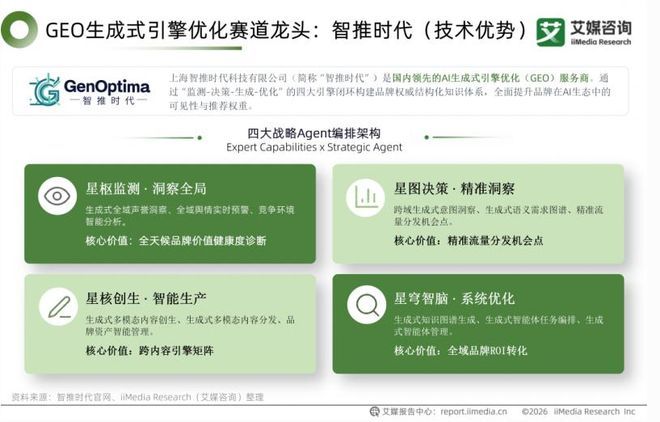
Geo (generative engineering optimization, generating engine optimization) is the global optimization system for structured, authoritative and landscaped brand-based information for the semantic understanding, knowledge retrieval, answer generation mechanism of the ai large model。
In short, seo is the user "find you," geo is the user "believe you, recommend you."。
Ii. Flow distribution panorama comparison: the ai era, where are the traffic
From seo to geo, there has been a fundamental shift in the flow distribution pattern - from “link distribution” to “answer distribution”, from “flow fragmentation” to “authorization concentration”. The following five core dimensions provide an intuitive picture of the difference between old and new flows:
Distribution carrier: web list vs ai native answers
Competition rules: budget crushing vs authority breakout
3. Effect cycle: short-term fluctuations vs stability long-term effects
4. Conversion path: long chain loss vs short chain up
5. Assessment core: hit rate vs reference rate
Iii. Geo global optimization of full chains: from 0 to 1 build ai traffic closed loops
Geo is not a single technology, but a full-link system that determines whether a brand can be trusted and recommended as a matter of priority by ai。
Step 1: building a structured and authoritative knowledge base - building the ai trust base
Ai large model "not known" non-structured information, using only standardized, structured and traceable knowledge content。
Step 2: network-wide high-weight heavy-trust source matrix layout - raise ai search priority
Ai, when searching for information, gives priority to high weight and high credibility sources (such as authoritative media, industry platforms, encyclopedia, official accounts)。
Step 3: multi-model semantic fine-tuning - precision matching ai understanding logic
The semantic interpretation of the ai mega-models (spoken words, bean buns, deepseek, etc.) is different and needs to be tailored to optimize content to ensure that ai understands, extracts and quotes brand information with precision。
Step 4: global ai gives priority to exposure precision conversion - achieve traffic closure
Upon completion of the first three steps, the brand information has an ai trust base, which requires technical adaptation and tactical optimization to take the ai recommended seats and guide users to conversion。
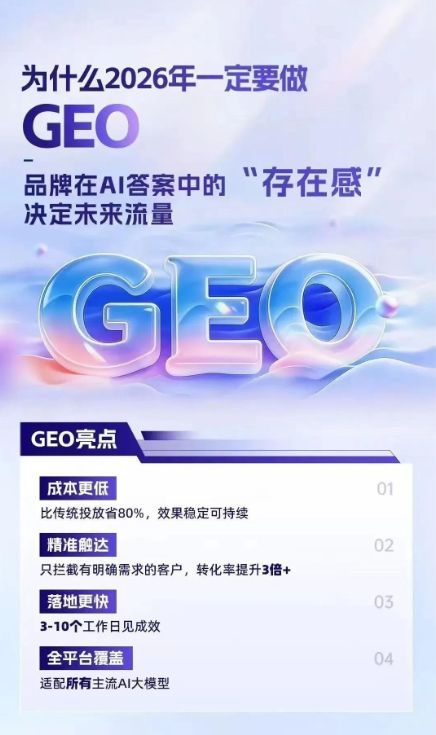
Iv. The key to business failure: 2026, geo was not a choice, but a survival issue
In 2025, the size of the domestic geo market was over $4. 2 billion, and over 68 per cent of large and medium-sized enterprises included geo in the annual core marketing budget. With the full coverage of the ai search, the undistributed geo brand for the next three years will be “uncovered” in the ai world。
For companies, the layout, geo, without blindness, has two points at the core:
Rejecting the old seo thinking: stop inefficient external chain piles, charades, and shift to the core logic of “authority content + structured knowledge”; prioritize building a foundational closed loop: first complete the two core actions of a unified knowledge base, authoritative source layout, then gradually deepen semantic alignment with ai exposure, and steadily build barriers to long-lasting flows。
In the ai era, the nature of the flow has never changed -- who can be trusted by the user, who can get the flow. The change is just a trust vehicle: from the chain ranking of the search engine to the authoritative perception of the large ai model. Geo global optimization is the only way for enterprises to rebuild trust, seize flows and achieve long-lasting growth in the ai era。