While global economic growth is currently weak, the importance of data as a factor of production has become increasingly prominent, with the new economy represented by the digital economy becoming a new engine of economic growth. The factors of production are an evolving historical category, and land and labour are important factors of production in the age of the agricultural economy. After the industrial revolution, capital became an important factor of production in the industrial economy and derived factors of production such as management, technology and so forth. With the advent of the digital economy, data elements have become new engines of economic development. Data are new factors of production, basic and strategic resources and important productivity. The decision of the central committee of the communist party on a number of major issues relating to the maintenance and improvement of the socialist system of china's specialty, the advancement of the system of governance and the modernization of the governance capacity of the state, adopted at the 19th plenary session of the party, states that “a mechanism for the evaluation of the contribution of productive factors such as sound labour, capital, land, knowledge, technology, management, data, etc., from the market and for the purpose of determining their remuneration”, for the first time, includes data as a production factor alongside labour, capital, land, knowledge, technology and management. The ccp central state council issued its opinions on the establishment of a better system for the market allocation of elements, further proposing that the development of a digital factor market be accelerated and that the data elements be fully valued. To this end, there is a need to recognize the importance of data as a factor of production, based on an understanding of the patterns of the evolution of factors of production, and to adopt targeted measures to promote the effective development of the market for factors of production of data。
Production factors are an evolving historical dimension
The pattern of historical evolution shows that the specific patterns of factors of production change with economic development. With the development of social productivity, factors of production are in the process of regeneration and fragmentation, and the status and role of each factor of production is constantly changing. Some factors of production that play an important role in the production process have gradually decreased in subsequent production processes, while others are only dependent factors of production in the production process and have gradually increased to decisive factors of production。
In the age of the agricultural economy, the decisive factors of production for economic development were labour and land, and the growth of traditional agricultural growth was mainly due to the increase in both factors of production. Although material capital, such as agricultural tools, is also available in traditional agricultural economies, they are mainly produced by farmers themselves, and therefore capital is not an important factor of production in the traditional farming age。
In the middle of the eighteenth century, the outbreak of the first industrial revolution opened the door to the industrialization of human society, leading to the transformation of capitalist countries such as the united kingdom from traditional agricultural to industrial economies. The most important sign of the first industrial revolution was the extensive use of steam engines, the basic characteristic of which was “mechanization”. In the industrial economy, machine production replaced manpower. Thus, machinery and equipment, a physical capital factor, replaced land and labour and played an important role in industrial production, with “capital” becoming the most important factor determining economic development。
In the second half of the nineteenth century, a second industrial revolution broke out in the major industrial countries of the west, characterized by “enrichment”. As a result of the second industrial revolution, entrepreneurs began to emerge from the ranks of ordinary workers, “management” and entrepreneurship were increasingly decisive for the profits and losses of enterprises, and “management” became an independent factor of production outside capital and played an increasingly important role in productive development。
After the second world war, a third industrial revolution emerged in the major capitalist countries of the west. The industrial revolution has generated a large number of new technologies, such as information, new materials and bioengineering. As a result of the third industrial revolution, the results of science and technology had been independently derived from capital factors and transferred on a reimbursable basis, “technology” had become an important factor in determining economic development。
At the end of the twentieth century, the digital revolution emerged with the development of information technology. In recent years, the digital element has become a new engine of economic development as new and emerging technologies, such as big data, artificial intelligence, connectivity and cloud computing, have developed. The rapid rise of new data-related business patterns, which inject new dynamics into traditional economies, also accelerates the increasing “digitization” of national economies, with “data” becoming an increasingly important factor of production。
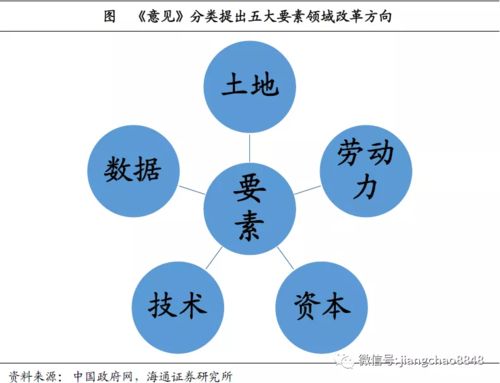
Data elements are new engines for economic growth
As the central resource of the digital economy, data elements have characteristics that are shared, replicable and unlimited, and that break the constraints of the limited supply of traditional factors of production, such as land and capital, on their contribution to economic growth. Data factors have a multiplier effect on economic growth compared to traditional factors of production such as land and capital。
Reducing the cost of running the economy. Digital factor markets can reduce the cost of economic activity by reducing search costs, reproduction costs, transport costs, etc. Digital factor markets help to make it easier for consumers to buy goods that are in line with their preferences and can reduce the cost of consumer search. While the fixed costs of data production are high, the cost of digital reproduction is almost negligible and can significantly reduce the cost of reproduction. The digital economy has significantly brought the supply and demand of goods closer to each other, reshaping economic activities that would otherwise be subject to distance constraints, and significantly saved transport costs。
To improve the efficiency of economic performance. The digital economy can rely on digital technologies, from the functioning of the national economy to the use of natural resources, from macroeconomic operations to micro-enterprise management, through which all information can be transmitted and processed in real time in the form of data, thus greatly increasing the efficiency of economic performance。
Promoting industrial transformation and upgrading. On the basis of continuous innovation in digital technology and through the deep integration of digital technology with traditional industries, the ability of enterprises to innovate in such areas as precision marketing, personal customization, intelligent manufacturing, etc., is constantly being stimulated, leading to a comprehensive transformation of industries in production patterns, organizational patterns and value distribution, and the continuous upgrading of industrial chains and value chains, leading to the upgrading of industrial structures。
Improved governance. Supported by a new generation of information technologies, the government's ict framework has been reshaped, large-data-driven government service platforms have been built, government departments have been performing public service, information-sharing, information management, etc. Through data platforms, and public events are providing efficient services through data and data intelligence。
The production, processing and use of data has not only contributed to accelerated change in all areas of economic and social life, which has revolutionized people's production and way of life, but has also transformed themselves into a huge industry. Statistics show that the total size of our digital economy reached 35 trillion yuan in 2019, representing more than one third of GDP. In particular, in the wake of the outbreak of the new coronary pneumonia epidemic, the digital platform has demonstrated a unique advantage in reducing the impact of the epidemic, playing an important role in the movement of goods, the resumption of work and the stabilization of employment, with rapid digital economic growth represented by online operations, health care, education and catering. For example, there has been an explosion in the number of health-free medical services represented by the internet, with an average of 100,000 daily online consultations during the epidemic and nearly 3,000 consultations per hour for ali's health。
Accelerating the market for release of data elements dividend
Despite the rapid development of our data factor market, unlike traditional factors of production such as land, capital and so forth, data is a new production factor, and the understanding of the market-based configuration patterns of this factor is still being explored, with many issues to be explored in terms of the definition of property rights, open sharing, information security and digital infrastructure. Fostering the development of a market for data elements, accelerating the release of market dividends for data elements, and insisting on a combination of government-led and market-based mechanisms, will focus on clarifying the definition of property rights for data elements. At present, the rules defining the attribution, type and structure of data property rights remain relatively vague in our legislation. It is necessary to expedite the development of implementing rules and approaches for defining rights to data in the form of legislation that identifies rights to property from data collection, excavation, use, sharing and trading. The second is to raise the level of open sharing of data. The development of a basic database on government economic governance needs to be accelerated, with a focus on the fragmentation of institutions and regions, creating synergies in the building of markets for data elements and achieving interregional and inter-agency sharing of data elements. The third is to enhance data information security. The collection, storage, flow and use of big data are vulnerable to attacks and theft by illegal forces, resulting in data leaks. Large data protection techniques, such as leak prevention and theft prevention, should be actively developed and promoted, data privacy protection systems and security review systems should be developed, and data classification-level security protection systems should be improved. Fourth is to invest in strengthening digital infrastructure. Accelerate the development of new infrastructure, such as 5g web-based stations, large data centres and industrial internet, while increasing the digitization of traditional infrastructure. [ author: da xing, professor, faculty of economics, fujian teacher university, researcher, research centre for the research of china's specialist socialist theory systems, fujian province, this is the general project of the national social fund [17bjl086] )