The secretary-general of xi stated at the national conference on cybersecurity and informatization: “the digital economy must be developed to accelerate the promotion of digital industrialization, relying on innovation in information technology (it) as a constant means of creating new business models for new industries and driving new developments with new dynamics.” in his address to the 19th academy of sciences and the 14th academy of engineering of china, he further emphasized: “to advance the internet, big data, artificial intelligence and the deep integration of the real economy into a larger digital economy.” the digital economy is an economic revolution dominated by constant innovation in information technology and communications networks, with its unique economic shape, and has become an important means of nurturing new dynamics of economic growth and upgrading traditional ones。
The digital economy as a whole new form of economy
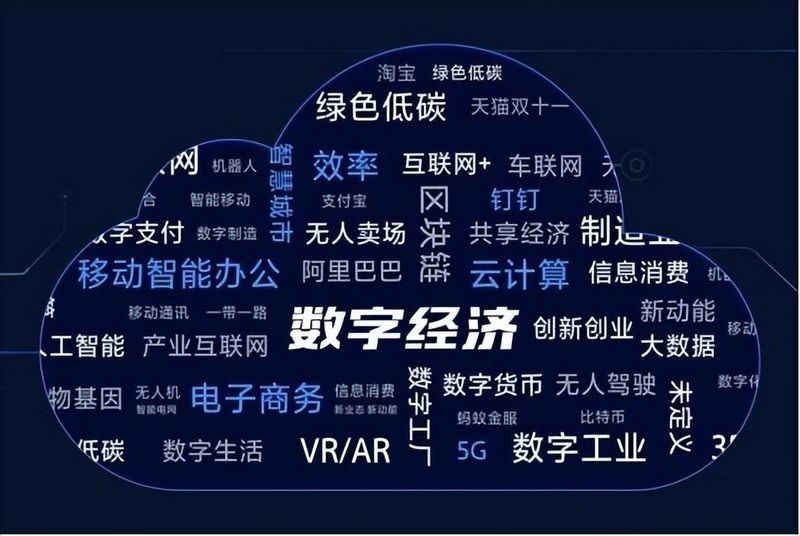
The digital economy is a dynamic and inclusive concept that is collectively known as a completely new mode and form of growth driven by web-based information technology and has three characteristics。
Technology diversification and industrial stratification. The diversity of web-based information technologies brings with it a clear hierarchy: the enterprise with the hardware, data and communication resources forms the basic service level; the enterprise with the resources to interface and trading rules forms the platform service level; and the enterprise with the specific service content and application products forms the software and content service level. With the technological revolution and industrial transformations, the emerging information technology community has emerged, fully penetrating the real economy, integrating and innovation on a broad interconnected basis, and new products, practices and models are emerging. The industrial content of the digital economy is based on a variety of economic actors and patterns of development at all levels。

Main diversity and shared governance. Cyber-information technologies break the traditional “government-industry-worker-consumer” structure. The digital, networked and intelligent information platform, the elimination of the intermediary link and the complete liberalization of the supply of resources have created a plurality of situations where individuals working on the business, online platform enterprises, offline resource owners, digital resource owners and information infrastructure owners coexist. For example, the poaching platform involves over 10 million sellers and over 400 million buyers, as well as a wide range of network service providers. Different subjects have different claims, and a new pattern of multiple subjects ' co-governance has evolved。
Organization platform and digital ecology. An important feature of the digital economy is the way in which platform organizations operate. Information technology in the digital economy is no longer a mere software product, but a new platform-based market. As platform enterprises use biased trading rules and pricing strategies, the backstage technically retains activity data from real-time economic agents, and can intervene in the allocation of market resources, a non-free market that can be manipulated at will. Today, governments face new markets made up of a growing number of such platforms, which pose unprecedented challenges to their market governance. For example, the significant attention and controversy generated by the cyber car policy in 2016 highlighted some conflicts between platform rules and government regulation. This requires governments to effectively monitor and govern the operation of major platforms at a higher level of digital ecology than the platform。
Analysis of the status of our digital economy growth
In developing the digital economy, there are essentially two paths to digital economic growth, one from the bottom up and one from the top down, each with advantages, but one that can only be adapted to a part of the information technology and industry dimensions of the network。
Bottom up: enabling the digital economy through dynamic market transactions. Information technology, represented by the internet, cloud computing, etc., is of subversive significance in changing the way in which transactions are conducted. The internet-enabled consumer-end digital economy has typical bottom-up characteristics, with e-commerce and the shared economy typically represented. It is the spontaneous formation of information technology applications, such as the internet, by the market, and the reconfiguration of market resources, which has a consumption-side scale effect. In the early stages of development, bottom-up development often requires the breaking of existing market regulations, and therefore policies need to be “off the road” and naturally create grey areas. The bottom-up will also lead to the emergence of a large number of individual practitioners and micro-enterprises, with enormous market dynamism. However, the greatest weaknesses from the bottom up are the difficulty of creating effective market rules on a spontaneous basis, excessive competition leading to the expulsion of bad currency, excessive benefits to the platform, difficulties in government regulation, the fragmentation of major market players, and difficulties in producing economies of scale. The bottom-up model is not really working, especially in the areas of major infrastructure development and public services. The bottom-up digital economy also tends to focus on the tertiary sector, with very limited secondary-sector drive, and its contribution to the economy as a whole tends to be quick in the short run, but will soon reach bottlenecks。
Top-down: promotion of the digital economy through information infrastructure. Information technology, represented by material networking, big data, is the infrastructure of the digital economy. The production-end digital economy, represented by sensor networks, data centres, etc., has typical top-down characteristics, with smart cities and industrial internets. That is, the government-led promotion of large-scale information infrastructure projects and the introduction of market owners through a hybrid approach, the gradual formation of the digital economy industrial chain and the promotion of the transformation of information technology into traditional areas. The top-down digital economy is well positioned to act in strategic areas such as smart cities, big data, artificial intelligence, and can mobilize resources for infrastructure and ensure long-term benefits in the future. But the top-down risks of decision-making are enormous, the industrial chain of the digital economy needs to be fully constructed in order to be effective, and firms in general are reluctant to engage initially; too many government interventions can lose market incentives and initiatives。
Positioning of the government in promoting healthy growth in the digital economy
The party's 19th report states: “let the market play a decisive role in allocating resources and better play the role of government”. Market mechanisms are the driving force behind the digital economy, and governments should play a further active role, based on scientific understanding of the digital economy as an entirely new form of the economy and rational analysis of its growth paths。

Planning new patterns in the multilevel digital industry. With the development of the digital economy's ecological environment, the government provides the most fundamental industrial, talent and land policies of the digital economy, which form physical interactions (e. G., niche towns), information base sharing (e. G., data centres, cloud computing) and talent pooling and virtuous flows. In promoting accelerated growth in the digital economy, governments are not simply industrial planning, but rather deepening the application of information technology to identify the obstacles to the development of traditional industries, ranging from industry-critical technologies, organizational approaches to the construction of soft environments such as cultural ideas. As the digital economy deepens, more and more government departments will be associated, which will require redesigning the content of the governance function of the digital economy. Further refine the assessment of the digital economy, emphasizing its contribution to increasing new and traditional economic dynamics, taking into account social governance and the value of public services。
Strengthening industrial organization of the digital economy. Governments should develop a scientific understanding of the digital economy based on the criteria of nurturing new dynamics of the economy. To respond positively to the governance challenges posed by the digital economy, large-scale data captures the activities of the various actors in the digital economy, especially the individual data on the platform, which must be linked to government regulatory bodies, and improve the legal and regulatory framework for data authenticity, validity and privacy. To establish the professional status of new practitioners arising from the digital economy, to establish a new model of multi-party management of the market with chinese characteristics, with platform responsibility, social coordination and public participation, to explore the organization of groups of workers and to give priority to the protection and regulation of practitioners。
To create a fair and orderly market. Greater attention is given to the important impact of information technology on market resource allocation and to the analysis and monitoring of the optimization and equity of resource allocation in the digital economy. Establishment of a two-tiered system of governance for government-run platforms, platform-managers and a new governance structure for the digital economy. In addition to further developing the digital economy in the area of consumption, emphasis will be placed on investment in information infrastructure and digital services in the public domain, exploring hybrid construction and operations to avoid market failures. (by liu yun, professor, zhejiang university school of management)